


Rail Welding By The Thomson Process
Description
This section is from the book "Welding Theory, Practice, Apparatus And Tests Electric, Thermit And Hot-Flame Processes", by Richard N. Hart. Also available from Amazon: Welding: Theory, Practice, Apparatus And Tests, Electric, Thermit And Hot-Flame Processes.
Rail Welding By The Thomson Process
The most important single application of the Thomson process has been to the welding of street-car rails. Before 1892, all rail welding was done by the cast-welding process. Cast-welding is briefly as follows:
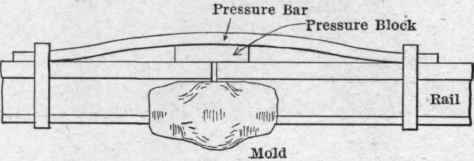
Fig. 31. - Weld and pressure block in place for cast welding.
It is desired to save a piece of track from scrapping, that is weak at the joints, and whose rail heads have been considerably worn. The cast-welder machine consists of two cars. The first car contains the sand blast which cleans all dirt from the rail joint. A cast-iron mold is then clamped onto the joint, and the ends of the rail heads are pressed down by a block which prevents them from springing when the joint is cast (see Fig. 31). The second car is now moved over the joint mold. This second car contains the melting cupola - a small, coke-fed blast furnace which melts down a mixture of charcoal iron and assorted scrap until it is at a high temperature. This very hot iron is run into the mold and forms a cast-weld around the heads of the rails. Examination of this joint shows that the cast iron of the joint and the steel of the rail have amalgamated. The cast-weld is still being used, though it has strong opponents. As many as 200 cast-welds can be made per day.
In Los Angeles there are several hundred miles of cast-welded track that are being displaced as unsatisfactory. Only one joint in ten was found to have amalgamated at the so-called weld. The result was a loss of electrical conductivity of from 25 to 75 per cent. The cost per cast-welded joint was given as roughly $7.00 as against $5.00 to $6.00 for the thermit joints which are displacing them. The breakage was said to be about two per cent per annum, and track that was welded in cold weather broke the least. "Sun snakes" were a common occurrence, and were prevented by building the paving close to the rail. No open rail track can be welded, as it will warp and snake.
Recently the electric roads have begun to adopt the electrically welded rail and also the thermit-welded rail (see page 123). Welded rails are a great improvement over those joined by fishplates and bonded with copper wire, for conducting the current:
1. The conductivity of the weld is as good or better than the unit section of rail. There is no bonding to come loose or leak or be stolen.
2. The rail will last much longer.
3. Welded tracks is smoother riding.
Rails running through city streets are well embedded in the street. If the street paving is not a good conductor of heat and the extremes of summer and winter temperature are not too great, very long sections of track can be welded into one piece without fear of pulling loose at the ends or at any of the joints. A section of 2300 feet has been solidly joined at Holyoke, Mass. It is calculated that the coefficient of expansion of steel in such a climate would cause a stress of about 16,000 pounds to the inch, while the tensile strength of the rail would run well over 40,000 pounds.
Friction of the pavement against the rail and inertia of the rail prevent dragging, and the expansion and contraction are taken up by the elasticity of the rail. Rails welded with thermit or by electricity are less liable to crack or pull apart at the weld than are cast-welded rails.
The Thomson process was the first process of welding applied to the production of continuous rails on electric railway tracks, and was introduced by the Johnson Company in 1892.
In 1897, the Lorain Steel Company, successors to the Johnson Company, improved the process and placed it actively on the market. Since that time it has been made use of in almost all the large cities of the United States, and the company found it necessary to double its equipment for this kind of work.
The joint consists of two bars welded to the web of the rail, one on each side. Three welds are made between the bars and the rail, one directly over the ends of the two rails and at each end of the bars. The central weld is made first. In cooling, the contraction of the bars draws the abutting rails together so that no opening remains across the head of the rail.
The apparatus is mounted on four trolley cars, propelled by their own motors. The first car carries a sand-blast apparatus for cleaning the rails and bars. The welder is suspended from a crane projecting from the front of the second car (see Fig. 32). The welder itself consists of a "step-down transformer for supplying current for heating the weld, and hydraulic pressure apparatus for supplying a heavy pressure to the portions to be welded." Suitable mechanism is carried within the car for raising and lowering the welder and to swing it from side to side to engage either rail. Coupled to the welder car, the third car carries rotary transformer and regulating apparatus for changing the direct current from the trolley to alternating current. A switchboard with instruments, etc., is also carried in this car.

Fig. 32. - Thomson special machine for welding rails in streets.
The fourth car carries two grinder carriages, one suspended over each rail, to smooth down any inequalities that may exist on the head of the rail after the joint has been welded and to produce a true running surface.
The process has been successfully applied to all kinds of rail, both girder and T-rails. Also to the welding of the "third "or conductor rail on elevated and surface lines.
The process particularly commends itself for use in crowded city streets on account of its harmlessness, as it is not affected by dampness and there is no danger of explosions, etc., due to sudden rain storms. The apparatus is practically noiseless in its operation.
An interesting application was the welding of the T-rail on the surface track on the north and south roadways of the Brooklyn Bridge in 1906.
The cost of the equipment makes it more desirable for a railway company to have the welding done for them than to do it themselves.
The apparatus is also made use of for welding heavy copper cables to the rails, either for overhead return or around special work. As the conductivity of the welded joint is greater than the rail, a most perfect system of bonding is thus afforded at the same time with the elimination of the joints.
From ten to twenty welds are made per day by this machine. The breakage is said to run less than 5 per cent., and often not higher than 1 per cent. The machines are leased, not sold, and the cost must accordingly be figured on the rental, power, and labor in calculating the cost per joint.
Continue to:


My Books

