


The Mold
Description
This section is from the book "Welding Theory, Practice, Apparatus And Tests Electric, Thermit And Hot-Flame Processes", by Richard N. Hart. Also available from Amazon: Welding: Theory, Practice, Apparatus And Tests, Electric, Thermit And Hot-Flame Processes.
The Mold
Molds for thermit work are adapted to the particular joint to be made. For welding a number of joints of uniform size the company furnishes patterns with which the operator can make his own molds, or else the company will furnish the molds themselves. Thus it will be convenient and cheap to buy or make special molds for continuous rail welding, pipe welding, rod welding (as in the case of steel rods in reinforced concrete), locomotive-frame welding, or in other repair work that turns up regularly.
Take the case of rail welding, such as the welding together of a continuous third rail for the Paris, France, subway. We will presume the mold patterns (Fig. 66) to represent the obverse shape of the rail. The patterns are laid down, face upward, and covered with their respective mold boxes (Fig. 67). The molding material is then rammed into place, and when the box is level-full, the operator pricks a number of holes all the way through the mold to allow the escape of gases when the mold is in use. As soon as formed the molds are placed in a drying oven for six hours at a heat of 500 deg. Fahr., until they have become a light brown color. Do not let them burn black, as they will then crumble easily. The molds are generally cast inside of an iron retaining frame or with iron handles.


Fig. 68. - Finished rail molds.
Mold sand must be more refractory than the ordinary river sand, which has enough iron and alumina in its make-up to render it easily fusible by the hot thermit. Coarse white silica sand and fire clay in equal proportions is the best, price considered. Cheap rye or wheat flour, proportion of 1 to 15, is the binder used. The sand and flour are mixed dry and then moistened to a stiff mass. Where an extra strong mold is needed, the operator can mix a spoonful of turpentine to each mold portion. For binding material it is not advisable to use the foundryman's occasional expedients, such as molasses, larger amounts of flour, clay, pitch, etc., for two reasons: The binder is subject to the great heat of the molten thermit. The more binder used, the greater space will be left when it burns out, and the mold will fall to pieces after two or three usings. Also, if much binder is used, its rapid burning will cause excessive gases which may burst the mold, and which are also liable to injure the composition of the steel joint.
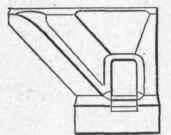
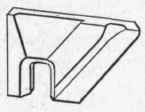
Fig. 69. - Mold partially assembled.
A good sand-flour mold should last for ten or more welds. Its life depends on the operator's skill in making and his care in using it.
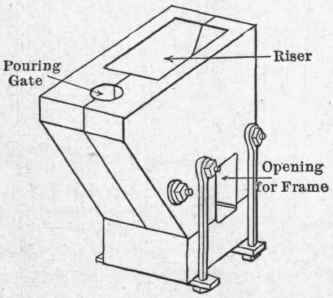
Fig. 70. - Assembled thermit mold.
For the welding of joints similar to rails, the molds used will vary in shape, but have the same composition. The operator can carve his own patterns out of wood.
For butt-welding of pipes not exceeding a diameter of 1 1/2 inches and of solid rods not exceeding 4 square inches crosssection, an iron mold is preferable because it is solid and easy to handle (see Fig. 75).
For welding larger breaks, such as fractured locomotive frames, the fire-clay, or fire-brick, mold is recommended. In this case the cross-section to be welded may range from 2 by 3 to 5 by 6 inches. An iron mold would absorb the heat too rapidly. The thermit collar would chill prematurely, and the mold itself would probably crack or melt, being cast iron. While a soft sand mold would propably crumble. The company furnishes a hard-baked, fire-brick mold, which is strong and refractory, at the same time being a fair non-conductor (Figs. 69 and 70).

Fig. 71. - Sectional view of mold.

Fig. 72. - Tapping the crucible.
It often happens, in thermit repair work, that the fracture to be mended is of a peculiar shape. The operator will be at a disadvantage in making his patterns, as the fracture is not only irregular, but the shape of the piece prevents measurements for a mold being taken, In this case the operator builds up a collar of cerecine wax of the size and shape that he intends for the finished welded collar. He then places the piece in an iron mold box, and tamps it around with wet sand, at the same time inserting wooden forms for pouring gate and riser; he next turns the flame of a gasoline torch into a special hole in the bottom of the sand box. The wax melts from around the piece and runs out of the hole. The flame is continued until the sand is dried, and then the operator stops the bottom hole in the mold with a sand plug. As already suggested the amount of thermit powder necessary for such a mold is thirty-two times the amount of wax, by weight. It should take less than twenty minutes to place a wax collar on an ordinary break and twenty minutes to dry out the mold. The cost of the wax is about ten cents per pound, so that for mending occasional or oddly-shaped breaks the wax mold is the cheapest and quickest. It is used for welds of embossing- and stamping-press pieces, forging hammers, stern-posts and rudder-posts of sailing vessels, gun-carriages, motor cases, etc., etc.
Practice
It should be borne in mind that the thermit joint itself is a steel casting of average analysis of:
Carbon .......... | ......................... | .0.05 | to | 0. 10 |
Manganese.. | ........................... | 08 | to | .10 |
Silicon .......... | ........................ | .09 | to | .20 |
Sulphur. . . . | ....................... | .03 | to | .04 |
Phosphorus. | .......................... | .04 | to | .05 |
Aluminium.. | ...................... | .07 | to | .18 |
Its average tensile strength is about 30 tons per square inch cross-section. If the joint is good, the thermit will amalgamate so closely with the metal of the welded parts that a ground and polished section of the joint will not show any marks of junction, even though the metals be of different color and structure. Therefore, the operator has only to calculate whether he shall vary the chemical composition of his thermit to give his weld the desired strength or whether he should gain strength by casting a big shoulder on the joint.
Continue to:


My Books

