


Butt-Welding Of Pipes
Description
This section is from the book "Welding Theory, Practice, Apparatus And Tests Electric, Thermit And Hot-Flame Processes", by Richard N. Hart. Also available from Amazon: Welding: Theory, Practice, Apparatus And Tests, Electric, Thermit And Hot-Flame Processes.
Butt-Welding Of Pipes
One of the unique applications of thermit is in the butt-welding of pipes and bars. It is a very difficult and often impossible thing to make a strong joint of two gas or water pipes without cutting reverse threads on the two and using a sleeve union. Welding such joints by ordinary means is generally out of the question, because with the facilities ordinarily at hand, it is difficult to obtain the right welding heat, and almost impossible to keep the surfaces clean enough to join them.
In using thermit for butt-welding, the slag of the thermit reaction is poured into the mold before the metal. It covers the iron surface in a thin layer that is at once chilled and adheres to the metal. This coating of slag serves as a distributor of the heat of the thermit metal to the iron, at the same time preventing direct contact of the thermit metal with the pipe. As soon as the operator believes the pipe ends are plastic, he pulls them tightly together, and the weld is effected.
As this is a very practical and necessary weld, it will be well to explain the operation and the appliances in detail.
Suppose two i-inch abutting gas pipes are to be welded. The ends are first cut square and filed to smoothness, so that when the pipes touch their ends shall fit closely all around. Clamps are then fitted on the pieces, about 5 inches from the ends, and screwed tightly on the pipes. These clamps have sockets for two connecting draw screws, which are fitted in place and tightened with pins (see Fig. 74) until the pipe ends touch. Brace the pipes so that they align as they should and place the lower mold jaw under the joined ends of the pipes, so that the line of joining is in the middle of the mold. This mold is a hinged affair, having two handles, and resembles a nut-cracker (see Fig. 75).

Fig. 74. - Clamps in position. Pipe-welding by thermit.
The thermit portion, about 2 pounds, is poured into a small cup crucible, which is lined with magnesia and operated with a pair of tongs. Allow the crucible to stand half a minute after firing, so that the slag and steel can separate. Then pour over the lip of the crucible so that the slag comes out first. Begin pouring at one end of the lip of the mold and travel to the other end. As the thermit slag is poured in on a cold surface of pipe, it forms a hard shell around the metal, and the liquid which follows distributes its heat evenly through this shell, which is a poor conductor. During the pouring, the operator's assistant presses the handles of the mold together to keep the mold in close contact with the pipe. About one minute's time is allowed for the iron of the pipe to reach welding heat. The draw pins are put in the sockets of the clamps and screwed tight. If the pipe ends are plastic and ready to weld, the operator can feel it by screwing the draw pins. The nuts on both pins are given two full simultaneous turns by the operator and his assistant. This is enough to force the pipe ends together and complete the weld. If the operator desires, he can force enough metal into the upset by giving the draw nuts another turn, to make the joint considerably stronger than the pipe itself.
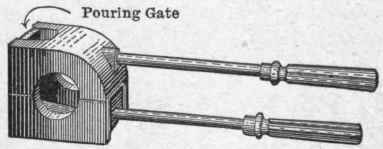
Fig. 75. - Mold for pipe-welding with thermit.
The mold is taken off at once by tapping the upper jaw loose with a hammer. The slag collar which adheres to the pipe is knocked off carefully, and the red-hot joint is allowed to cool.
The draw bars and clamps which held the pipes together are removed as soon as the weld is cooled. The joint will have a slight upset due to the extra metal forced into it. This may be machined off if necessary.
Tests on such a weld will give a fracture or a crease in the pipe outside of the line where the mold fitted.
The foregoing weld was made on a horizontal piece of piping. For an inclined or vertical piece, the apparatus and process are the same, except that the mold will have its mouth placed in the side so that the thermit can be poured in when the mold is in place (see Fig. 76).
For pipes or rods of different thickness or diameter, the size of the mold will vary, also the amount of thermit to use and the time it takes to raise the joint to welding heat. The manufacturers supply both molds and clamps for pipes and rods of standard sizes, and specify the amount of thermit to use in each case.
In this application of thermit, it should be noted that the thermit steel does not come in contact with the pieces to be welded, nor does its substance form a part of the weld. Accordingly, thermit butt-welding is applicable to pipes and rods of wrought iron and mild steel, and not to cast iron and high-carbon steel.
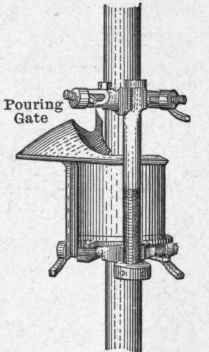
Fig. 76. - Clamps and mold in place for welding vertical pipe.
This process can be used for welding gas and water pipes while in the ground; steam and ammonia and compressed-air pipes; pipe coils, before or after bending; steel rods in reinforced concrete.
The entire cost of making one weld for a pipe of 1-inch bore is approximately $22. This includes the total cost of the apparatus necessary, and the time charge of one hour at thirty cents for the operator and twenty cents for the helper. This prohibitive cost is rapidly reduced for welds in number, just as the cost of a printed page rapidly decreases as the number printed increases. One hundred welds like the above would cost, approximately, one dollar each, supposing that two welds could be made per hour. The first cost of tongs and clamps is final, while the crucible must be replaced after about ten firings and the mold after fifty welds. The cost of the thermit and the ignition powder and also the labor is a constant.
One of the rivals to this welded joint is the plumber's sleeve joint. In comparing the two methods of joining, the contractor must consider several things; will it be cheaper to cut a thread on each pipe end and sleeve the joint? Also, will it be possible for the workman to get at his joint to cut the thread ? Is a leak at the joint going to be a vital matter? A weld cannot leak, while any other joint is apt to under pressure, especially where the pipes are cold, as in ammonia plants. Will a sleeve joint be strong enough in cases where the pipes are subject to strain ? And, finally, how do the total costs compare? This last will depend largely on the number of joints to be made.
Another rival is the oxy-acetylene-blowpipe weld. It is probable that with this method one workman can make from one to four welds an hour, depending on the amount of labor he must put on cutting and fitting the pipe ends preparatory to welding. This, together with the cheapness of the gas used, makes the operating cost much less than the thermit butt-weld. However, the cost of the apparatus, two- gas storage tanks, the blowpipe, and the checks-valves is much greater. Also, to travel from pipe to pipe, often necessary, the operator would need an assistant to carry the heavy tanks, etc.
Butt-welding of pipes can be done by the Thomson electric process. But this process is at a disadvantage here because the welding must be carried on in a heavy machine. Whereas, when pipes are to be butt-welded, the chances are that they are in some out-of-the-way corner of a room or cellar and cannot be taken out.
Continue to:


My Books

