


Welding Fires, Etc
Description
This section is from the book "Welding Theory, Practice, Apparatus And Tests Electric, Thermit And Hot-Flame Processes", by Richard N. Hart. Also available from Amazon: Welding: Theory, Practice, Apparatus And Tests, Electric, Thermit And Hot-Flame Processes.
Welding Fires, Etc
The ordinary fire used by the smith for his welding is a deep bed of coke. But the fire may be fed with hard or soft coal; it may also be a gas or oil flame.
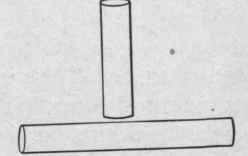
Fig. 5. - Jump weld.
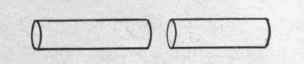
Fig. 6. - Butt weld.
For blacksmithing, the coke fire is much the best. In this fire nearly pure carbon is burned, and the resultant gases are carbon monoxid and dioxid. The carbon monoxid and the coke are reducing in their action. They will prevent the metal heated from oxidizing and will even clean the metal of scale.
Hard coal can be used, but in a small forge it is impossible to get a hot enough fire. Soft coal is a poor coal for forge work. It has, as a rule, high sulphur, which the hot iron readily absorbs to its detriment. While the thick carbon smoke of the flame is apt to collect on the iron in an oily soot unless the flame can be kept hot enough.
Gas and oil flames are often used for chain welding and similar operations. The gas or oil should be fairly free from sulphur. The gas flame is made by injecting the gas through a large Bunsen burner. Air is introduced through holes in the burner a short distance from the burner end. Or if the gas is under sufficient pressure to make a roaring flame, it will take in enough air at the end of the burner. The proper mixture gives a nearly colorless flame. The quickest and best way to tell if a flame is right for welding is to heat in it a small piece of steel or soft iron. If the flame has too much air, the metal piece will rust and scale off in the flame. If too little air, the soot will collect on the metal and it will not heat quickly. Gas flame is the most convenient for most purposes. It is easy to regulate and can be turned on the iron while welding. In this way iron can be welded without flux. When chain is made the links are hung on a bar above a long narrow furnace of fire bricks. The flame is played beneath.
The oil flame is a cheaper flame than gas. It can be manipulated in the same way as a gas flame. But the oil must be free from sulphur compounds to make a safe flame.
It has lately been tried to burn gases that have been preheated. If coal gas, starting to burn at 35 deg. C, will give a combustion point of about 2000 deg., then by preheating it to about 800 deg. C. and burning, there will be a gain of 400 or 500 deg. in the temperature of the flame. In other words, the welder has boosted his flame up to about 2500 deg., a very respectable temperature.
The preheating is done by passing the gases through copper coils which are nested above the welding-flame flue, and which receive the heat from the welding flue.

Fig. 7. - Cleft weld.
Continue to:


My Books

