


Elementary Mechanics. V. The Pulley
Description
This section is from the book "Amateur Work Magazine Vol3". Also available from Amazon: Amateur Work.
Elementary Mechanics. V. The Pulley
J. A. COOLIDGE
The pulley is a wheel with a groove in its rim set in a frame or "sheaf". The wheel must turn freely upon its axis and carry a rope in the groove of its rim. If the frame of the pulley be stationary the name "fixed pulley" is given it, and its value consists in enabling a force to act in some other direction than the direction we wish the weight to move.
Who ha6 not seen bales of hay lifted, one by one, into a stable door in the second story? A man stands on the ground and pulls down on a rope that passes over a pulley above the barn door. The force pulls down, the weight rises. Better still, sometimes the rope passes through a second pulley and a horse is attached to the end of the rope. As the horse moves in a horizontal direction, one part of the rope is going down, the other part with the hay is rising until it stops opposite the open door, and a man standing in the doorway swings the hay into the stable. The pulley of this kind is like a lever having equal arms. The force must be equal to the weight lifted and enough .more to overcome the friction. The advantage of the fixed pulley is a change in direction of the force, or lies in the ability to use the force of animals.
If two or more wheels are set in the same frame they make, with the rope used, what is called a block and tackle. In a system of pulleys, one pulley must be fixed and another be movable. We will new make a pair of pulleys, each having two wheels, and learn from the experiments we may perform, the laws governing their use and the advantages gained by using them. To one able and willing to buy some metal pulleys, directions for making them may be omitted. I have purposely made these of wood because, to most of the readers of these articles, I feel that the matter of expense is one of the foremost considerations, and with the materials needed for these pulleys the expense will be very slight.
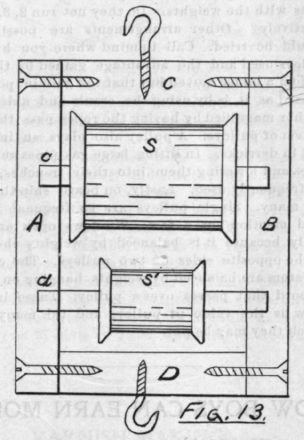
Take a small piece of half-inch stock, cherry, maple, or other hard wood, preferred, cut two strips, AB, Fig. 13, 4" long, 1/2" wide, and two others, CD, 21/4"x|" In each of the long strips bore two holes, c and d 5-16" in diameter and i" deep. Make c centre 1 5/8 from the upper end, and d 1 3/8" from the lower end. Take two brass rods J" diameter and 2 3/4 " long, on one place a spool S , 2" long and 1 1/4" smallest diameter; on the other place a smaller spool, S, 1 1/4" long and 3/4" in diameter. These maybe fastened to the rods with glue, but should be made very smooth. The rods should be fitted into the holes c, d, and should turn in these holes wilh very little friction. A little powdered graphite helps them turn readily. The frame may now be fastened at the corners by inch screws, or 11/4|" wire nails. A little glue in each joint will make the frame more substantial. At each end of the frame a screw hook should be inserted, as in Fig. 13.
Our pulleys are now ready for use, They diffeT from those in everyday use in not having the wheels side by side, but are quite like some that are sold for experimental purposes. Should any prefer wheels of the same size, two spools can be used of the same size as S by making AB 4 1/4 long and making d centre 1 5/8" from the lower end. A box 2 1/2' or 3' long, without top and bottom will give us a cheap frame in which to use our pulleys.
Experiment IX.
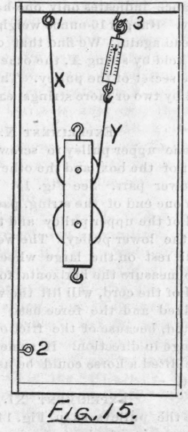
With our spring balance, first weigh thepalley. Take a short flexible linen cord, fasten one end to a screw eye in the upper part of the box and the other to the spring balance, as in Fig. 15. Notice that the reading in the balance indicates only one-half the weight of the pulley. Hang a 16-ounce weight on the hook be-low and read again. We find that one-half the entire weight is held by string X, the other half by string Y. This is the secret of the pulley. The weight lifted is supported by two or more strings, each one bearing its part.
Fasten one upper pulley to screw eye No. 1 in the upper part of the box, and the other to screw eye No, 2 in the lower part. See Fig. 15. Hang a 16-ounce weight on one end of the string, pass the string over one wheel of the upper pulley and through the small wheel of the lower pulley. The weight of the lower pulley will rest on the large wheel. Use the spring balance to measure the horizontal force which, applied to the end of the cord, will lift the weight. Both pulleys are fixed and the force used is more than the weight lifted, because of the friction. The only gain is the change in direction. If some very large weight were to be lifted a horse could be used in such an arrangement.
Experiment XI.
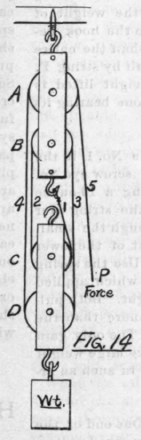
Arrange the pulleys as in Fig. 14. One end of the cord is attached to the lower hook of the fixed pulley, and, after passing over all the wheels, ends at P, where the power is exerted. A 32-ounce weight is hung from the lower hook of the fixed pulley, and an 8-ounce weight at the end, P. The weight is balanced by one one-fourth as large, because the four cords, 1, 2, 3, 4, are each holding one-fourth, and cord 5 is pulling against cord 4. The ratio of gain is 1 : 4. In place of the weight, P, use a spring balance and pull until the weight rises. Read the balance carefully and then allow the weight to descend, using just enough force on the balance to make its motion regular. Read the balance again. The difference between these readings shows how much friction must be overcome. This is, of course, considerable, and yet the gain in such a contrivance is apparent. Try two other weights and record carefully the results. Let us get the principle firmly fixed in our minds that, after deducting the friction, the weight lifted divided by the number of strings attached to the movable pulley must equal the power.
Where is the loss? Every machine shows a loss as well as a gain. Repeat experiment XI, measuring the distance that the weight rises while the power is moving over a distance of one foot. We shall find it three inches. To move a weight one foot will require the powor to pass through a distance of four feet. Experiment XII.
Fasten the string to the upper hook of the lower pulley, pass it through the grooves of the four wheels, and then fasten the end to our spring balance. Hang the upper pulley on screw eye No. 1, and the balance on screw eye No. 2. We now have five strings attached to the movable pulley. Hang weights amounting to 10 oz., 15 oz., 20 oz. and 25 oz., on the hook of the lower pulley. Compare the readings of the balance in these cases with the weights. Do they not run 2, 3, 4, 5, respectively? Other arrangements are possible and should be tried. Call to mind where you have seen pulleys used and the advantage gained by their use. Seldom a house moved but that the gain in power, increased as it is by using the crank and axle, is still further magnified by having the ropes pass through a system of pulleys. A pulley also plays an important part in derricks. In lifting large gas pipes and water pipes and lowering them into their trenches, pulleys are frequently used. Lastly, on board ship their uses are many. Single pulleys are so frequent that we need mention but a few. Windows open and shut easily because it is balanced by weights that hang on the opposite sides of two pulleys. The cages in elevators are balanced by weights hanging on a cable or cord that passes over a pulley. Tnese instances show us the value of pulleys and the many uses to which they may be put.
Continue to:


My Books

