


Boiler Fittings
Description
This section is from the book "Things To Make", by Archibald Williams. Also available from Amazon: Things to Make.
Boiler Fittings
Safety Valves
The best all-round type is that shown in Fig. 89. There is no danger of the setting being accidentally altered, as is very possible with a lever and sliding weight. The valve should be set by the steam gauge. Screw it down, and raise steam to the point at which you wish the safety valve to act, and then slacken off the regulating nuts until steam issues freely. The lock nuts under the cross-bar should then be tightened up. In the case of a boiler with a large heating surface, which makes steam quickly, it is important that the safety-valve should be large enough to master the steam. If the valve is too small, the pressure may rise to a dangerous height, even with the steam coming out as fast as the valve can pass it.
Steam Gauges
The steam gauge should register pressures considerably higher than that to be used, so that there may be no danger of the boiler being forced unwittingly beyond the limit registered. A siphon piece should be interposed between boiler and gauge (Fig. 90), to protect the latter from the direct action of the steam. Water condenses in the siphon, and does not become very hot.
Water Gauges should have three taps (Fig. 91), two between glass and boiler, to cut off the water if the glass should burst, and one for blowing off through. Very small gauges are a mistake, as the water jumps about in a small tube. When fitting a gauge, put packings between the bushes and the glass-holders, substitute a piece of metal rod for the glass tube, and pack the rod tightly. If the bushes are now sweated into the boiler end while thus directed, the gauge must be in line for the glass. This method is advisable in all cases, and is necessary if the boiler end is not perfectly flat.
Pumps
Where a pump is used, the supply should enter the boiler below low-water level through a non-return valve fitted with a tap, so that water can be prevented from blowing back through the pump. As regards the construction of pumps, the reader is referred to p. 164 and to Chapter XXII.
Filling Caps
The filling cap should be large enough to take the nozzle of a good-sized funnel with some room to spare. Beat the nozzle out of shape, to give room for the escape of the air displaced by the water.
The best form of filling cap has a self-seating ground plug, which, if properly made, is steam-tight without any packing. If needed, asbestos packing can easily be inserted between plug and cap.
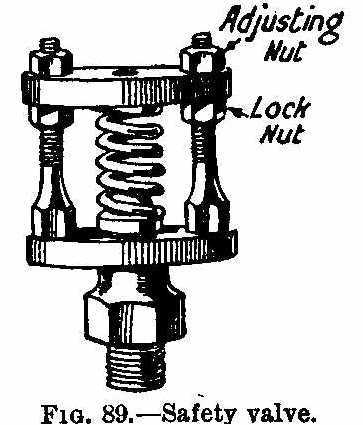
Fig. 89. Safety valve.
Mud-Holes
All but the smallest boilers should have a mud-hole and plug in the bottom at a point not directly exposed to the furnace. In Fig. 82 it is situated at the bottom of the barrel. In Figs. 86 and 87 there should be a mud-hole in one end of each of the three drums, A, B, and C. The plug may be bored at the centre for a blow-off cock, through which the boiler should be emptied after use, while steam is up, and after the fire has been "drawn." Emptying in this way is much quicker than when there is no pressure, and it assists to keep the boiler free from sediment.
Steam Cocks
The screw-down type (Fig. 92) is very preferable to the "plug" type, which is apt to leak and stick.
Testing Boilers
The tightness of the joints of a boiler is best tested in the first instance by means of compressed air. Solder on an all-metal cycle valve, "inflate" the boiler to a considerable pressure, and submerge it in a tub of water. The slightest leak will be betrayed by a string of bubbles coming directly from the point of leakage. Mark any leaks by plain scratches, solder them up, and test again.
The boiler should then be quite filled with cold water, and heated gradually until the pressure gauge has risen to over the working pressure. There is no risk of an explosion, as the volume of the water is increased but slightly.
The third test is the most important and most risky of all-namely, that conducted under steam to a pressure well above the working pressure.
In order to carry out the test without risk, one needs to be able to watch the steam-gauge from a considerable distance, and to have the fire under control. My own method is to set the boiler out in the open, screw down the safety-valve so that it cannot lift, and raise steam with the help of a blow-lamp, to which a string is attached wherewith to pull it backwards along a board. If the boiler is to be worked at 50 lbs., I watch the steam gauge through a telescope until 100 lbs. is recorded, then draw the lamp away. After passing the test, the boiler, when pressure has fallen, say, 20 lbs., may safely be inspected at close quarters for leaks.

Fig. 90. Steam gauge and siphon.
This test is the only quite satisfactory one, as it includes the influence of high temperature, which has effects on the metal not shown by "cold" tests, such as the hydraulic.

Fig. 91. Water gauge.
Do not increase your working pressure without first re-testing the boiler to double the new pressure to be used.
Fuels
For very small stationary boilers the methylated spirit lamp is best suited, as it is smell-less, and safe if the reservoir be kept well apart from the burner and the supply is controllable by a tap or valve. (See Fig. 104.)
For medium-sized model boilers, and for small launch boilers, benzoline or petrol blow-lamps and paraffin stoves have become very popular, as they do away with stoking, and the amount of heat is easily regulated by governing the fuel supply. Fig. 94 is a sketch of a blow-lamp suitable for the horizontal boiler shown on pp. 204, and 206, while Fig.

Fig. 92. Steam cock.

Fig. 94. Benzoline lamp for model central-flue boiler.
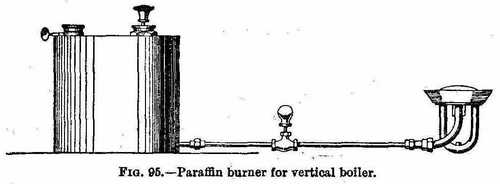
Fig. 95. Paraffin burner for vertical boiler.
95 shows a convenient form of paraffin stove with silent "Primus" burner, which may be used for a horizontal with considerable furnace space or for vertical boilers. In the case of all these liquid fuel consumers, the amount of heat developed can be increased by augmenting the number of burners. Where a gas supply is available its use is to be recommended for small stationary boilers.
Solid Fuels
The chief disadvantages attaching to these are smoke and fumes; but as a solid fuel gives better results than liquid in a large furnace, it is preferred under certain conditions, one of them being that steam is not raised in a living room. Charcoal, coke, anthracite coal, and ordinary coal partly burned are the fuels to use, the fire being started with a liberal supply of embers from an open fire. Every solid-fuel boiler should have a steam-blower in the chimney for drawing up the fire; and if a really fierce blaze is aimed at, the exhaust from the engine should be utilized for the same purpose.
Continue to:


My Books

