


Tools Used For Metal Having A Very Hard Skin
Description
This section is from the book "Wrinkles And Recipes, Compiled From The Scientific American", by Park Benjamin. Also available from Amazon: Wrinkles and Recipes, Compiled From The Scientific American.
Tools Used For Metal Having A Very Hard Skin
When the skin of the metal to be cut is unusually hard, as frequently occurs in cast-iron, the shape of the cutting part of the boring-tool must be such that its point will enter the cut first, so that it cuts the inside and softer metal. The hard outside metal will then break off with the shaving without requiring to be cut by the tool edge, while the angle of the cut will keep the tool point into its cut from the pressure required to break the shaving. A tool of this description is represented in the engraving, Fig. 1. a is the point of the tool, and from a to B is the cutting edge; the dotted lines, c and D, represent the depth of the cut, c being the inside skin of the metal, supposed to be hard. The angle at which the cutting edge stands to the cut causes the pressure, due to the bending and fracturing of the shaving, to be in the direction of e, which keeps the tool point into its cut; while the resistance of the tool point to this force, reacting upon the cut, from a to B, causes the hard skin to break away. For use on wrought-iron, however, the tool presented below will work to better advantage, it being a side tool. In the event of a side face being very hard, it possesses the advantage that the point of the tool may be made to enter the cut first, and, cutting beneath the hard skin, fracture it off without catting it, the pressure of the shaving on the tool keeping the latter to its cut, as shown in Fig. 2. a is the catting part of the tool; B is a shaft with a collar on it; c is the side cut being taken off the collar, and D is the face, supposed to be hard. The cut is here shown as being commenced from the largest diameter of the collar, and being led inward so that the point of the tool may cut well beneath the hard face, D, and so that the pressure of the cut on the tool may keep it to its cut, as already explained; but the tool will cut equally as advantageously if the cut is commenced at the smallest diameter of the collar and fed outward, if the skin, D, is uot unusually hard.
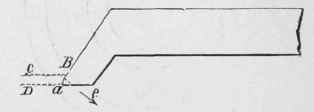
Fig. 1.-Tool For Hard Metal
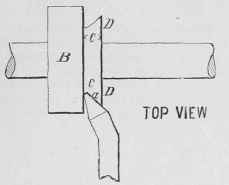
Fig. 2.-Tool For Hard Metal
Continue to:


My Books

