


Chapter IV. The Army Of The United States
Description
This section is from the book "Scientific American Reference Book. A Manual for the Office, Household and Shop", by Albert A. Hopkins, A. Russell Bond. Also available from Amazon: Scientific American Reference Book.
Chapter IV. The Army Of The United States
Twice in the history of the world we have had an example of large bodies of men who were not producers who disturbed economic conditions by living at the public, expense. We refer to the enormous monasteries in the middle ages and to the standing armies in Europe to-day. It seems to be essential to the maintenance of the integrity of a number of the countries of Europe to keep a large standing army - an army which takes some of the best years of the life of its citizens, as service is obligatory to all. These armies are supported at an enormous expense by systems of taxation which affect the poorest as well as the richest.
The question of the standing armies of Europe is a problem which is rapidly increasing in seriousness, and there does not appear as yet to be any solution of the difficulty.
For our protection we have to rely upon :
1. The Regular Army, which represents and is under the pay of the federal government, and which is officered : 1. By graduates of the United States Military Academy, who at present are largely in the minority. 2. By the promotion of meritorious enlisted men of the Army. 3. By the appointment of civilians, six of whom are annually selected from the best cadet-schools of the country. The last class is at present most largely represented.
The officers receive commissions at the hands of the President.
2. The organized militia or National Guard, which is composed exclusively of State troops, and, except when called into the service of the United States, is under the command of the Governors of the respective States. The officers of higher grade are appointed by the Governors, but the other officers, from Colonel down, are generally selected by ballot by the troops themselves. The National Guard is intended primarily for home defense.
3. The Volunteers, which form a branch of the service only to be found in time of war. They are such as offer their services upon the call of the President, and are officered either by West Point graduates, by officers of the National Guard, or civilian appointees.
Under the conditions existing in the late war with Spain, members of the National Guard were not called upon to serve in their capacity as State troops, but were invited to enlist in the volunteer service.
The term of enlistment in the regular service is for a period of three years, which term is fixed and not terminable by the ending of the war. In the volunteer service the period of enlistment is two years, but this term may be shortened by the ending of hostilities.
A certain proportion of the officers of the regular army are graduates of the United States Military Academy at West Point, New York.
By Acts of Congress approved June 6, 1900, June 28, 1902, and March 3, 1903, the Corps of Cadets as now constituted consists of one from each Congressional district, one from each Territory, one from the District of Columbia, one from Porto Rico, two from each State at large, and forty from the United States at large, all to be appointed by the President and, with the exception of the forty appointed from the United States at large, to be actual residents of the Congressional or Territorial districts, or of the District of Columbia, or of the States, respectively, from which they are appointed. Under these Acts, and under the apportionment of Members of Congress according to the 12th Census, the maximum number of cadets is 522.
The total number of graduates from 1802 to 1903, inclusive, is 4,214; 124 members graduated June 15, 1904.
Foreign governments can have cadets educated at the academy by authorization of Congress. 91
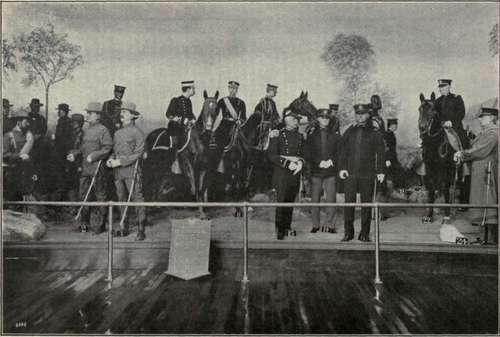
Group Of Officers And Men Of The United States Army, Showing Uniforms.
Group Of Officers And Men Showing Uniforms Worn IN
United States Army.
1. Major of Engineers in olive-drab uniform.
2. Captain of Ordnance in olive-drab uniform.
3. Private of Cavalry in olive-drab uniform.
4. First Sergeant of Artillery in olive-drab uniform.
5. Private of Infantry in olive-drab uniform and clothing roll.
6. First Sergeant of Cavalry in olive-drab uniform.
7. Corporal of Post Artillery in olive-drab uniform and overcoat.
8. Post Quartermaster-Sergeant in olivedrab uniform.
9. Trumpeter of Cavalry, mounted, in fulldress uniform.
10. Colonel of Infantry, mounted, in full-dress uniform.
11. Major-General, mounted, in full-dress uniform.
12. Lieutenant-Colonel of Artillery, Aide-de-Camp, mounted, in full-dress uniform.
13. First Sergeant of Infantry, in full-dress uniform.
14. Captain of Cavalry, dismounted, in fulldress uniform.
15. Brigadier-General, dismounted, in dress uniform.
16. Major, Medical Department, dismounted, dress uniform and cape.
17. Corporal of Engineers, full-dress uniform.
18. Private of Cavalry, full-dress uniform.
19. Sergeant of Artillery in full-dress uniform.
20. Post Commissary-Sergeant, dress uniform.
21. Lieutenant of Cadets, U. S. Military Academy, full-dress uniform.
22. Major, Quartermaster's Department, in full-dress uniform.
23. First-class Sergeant, Signal Corps, in fulldress uniform.
24. Captain Coast Artillery, in dress uniform and overcoat.
The commander-in-chief is, ex-officio, of course, the President of the United States.
Like the grades of Admiral and Vice-Admiral, the army also has two grades - General and Lieutenant-General. We have had only four Generals, Washington, Grant, Sherman and Sheridan. A general is supposed to command an army. An army is a large and organized body of soldiers generally composed of infantry, artillery and cavalry, completely armed and provided with necessary stores, etc., and the entire force is under the direction of one general, who is called the "general-in-chief." The army is subdivided as follows; the grades of rank and commands appropriate to each grade are given.
Continue to:


My Books

