


Quartz Fibers
Description
This section is from "Scientific American Supplement". Also available from Amazon: Scientific American Reference Book.
Quartz Fibers
In almost all investigations which the physicist carries out in the laboratory, he has to deal with and to measure with accuracy those subtile and to our senses inappreciable forces to which the so-called laws of nature give rise. Whether he is observing by an electrometer the behavior of electricity at rest or by a galvanometer the action of electricity in motion, whether in the tube of Crookes he is investigating the power of radiant matter, or with the famous experiment of Cavendish he is finding the mass of the earth - in these and in a host of other cases he is bound to measure with certainty and accuracy forces so small that in no ordinary way could their existence be detected, while disturbing causes which might seem to be of no particular consequence must be eliminated if his experiments are to have any value. It is not too much to say that the very existence of the physicist depends upon the power which he possesses of producing at will and by artificial means forces against which he balances those that he wishes to measure.
I had better perhaps at once indicate in a general way the magnitude of the forces with which we have to deal.
The weight of a single grain is not to our senses appreciable, while the weight of a ton is sufficient to crush the life out of any one in a moment. A ton is about 15,000,000 grains. It is quite possible to measure with unfailing accuracy forces which bear the same relation to the weight of a grain that a grain bears to a ton.
To show how the torsion of wires or threads is made use of in measuring forces, I have arranged what I can hardly dignify by the name of an experiment. It is simply a straw hung horizontally by a piece of wire. Resting on the straw is a fragment of sheet iron weighing ten grains. A magnet so weak that it cannot lift the iron yet is able to pull the straw round through an angle so great that the existence of the feeble attraction is evident to every one in the room.
Now it is clear that if, instead of a straw moving over the table simply, we had here an arm in a glass case and a mirror to read the motion of the arm, it would be easy to observe a movement a hundred or a thousand times less than that just produced, and therefore to measure a force a hundred or a thousand times less than that exerted by this feeble magnet.
Again, if instead of wire as thick as an ordinary pin I had used the finest wire that can be obtained, it would have opposed the movement of the straw with a far less force. It is possible to obtain wire ten times finer than this stubborn material, but wire ten times finer is much more than ten times more easily twisted. It is ten thousand times more easily twisted. This is because the torsion varies as the fourth power of the diameter. So we say 10 × 10 = 100, 100 × 100 = 10,000. Therefore, with the finest wire, forces 10,000 times feebler still could be observed.
It is therefore evident how great is the advantage of reducing the size of a torsion wire. Even if it is only halved, the torsion is reduced sixteenfold. To give a better idea of the actual sizes of such wires and fibers as are in use, I shall show upon the screen a series of such photographs taken by Mr. Chapman, on each of which a scale of thousandths of an inch has been printed.

Scale of 1000ths of an inch for Figs. 1 to 7. The scale of Figs. 8 and 9 is much finer.
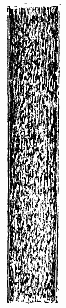 |  |
Fig. 1. | Fig. 2. |
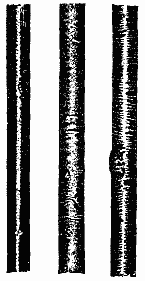
Fig. 3.
The first photograph (Fig. 1) is an ordinary hair - a sufficiently familiar object, and one that is generally spoken of as if it were rather fine. Much finer than this is the specimen of copper wire now on the screen (Fig. 2), which I recently obtained from Messrs. Nalder Brothers. It is only a little over one-thousandth of an inch in diameter. Ordinary spun glass, a most beautiful material, is about one-thousandth of an inch in diameter, and this would appear to be an ideal torsion thread (Fig. 3). Owing to its fineness, its torsion would be extremely small, and the more so because glass is more easily deformed than metals. Owing to its very great strength, it can carry heavier loads than would be expected of it. I imagine many physicists must have turned to this material in their endeavor to find a really delicate torsion thread. I have so turned only to be disappointed. It has every good quality but one, and that is its imperfect elasticity. For instance, a mirror hung by a piece of spun glass is casting an image of a spot of light on the scale.
If I turn the mirror, by means of a fork, twice to the right, and then turn it back again, the light does not come back to its old point of rest, but oscillates about a point on one side, which, however, is slowly changing, so that it is impossible to say what the point of rest really is. Further, if the glass is twisted one way first and then the other way, the point of rest moves in a manner which shows that it is not influenced by the last deflection alone: the glass remembers what was done to it previously. For this reason spun glass is quite unsuitable as a torsion thread; it is impossible to say what the twist is at any time, and therefore what is the force developed.

Fig. 4.
So great has the difficulty been in finding a fine torsion thread that the attempt has been given up, and in all the most exact instruments silk has been used. The natural cocoon fibers, as shown on the screen (Fig. 4), consist of two irregular lines gummed together, each about one two-thousandth of an inch in diameter. These fibers must be separated from one another and washed. Then each component will, according to the experiment of Gray, carry nearly 60 grains before breaking, and can be safely loaded with 15 grains. Silk is therefore very strong, carrying at the rate of from 10 to 20 tons to the square inch. It is further valuable in that its torsion is far less than that of a fiber of the same size of metal or even of glass, if such could be produced. The torsion of silk, though exceedingly small, is quite sufficient to upset the working of any delicate instrument, because it is never constant. At one time the fiber twists one way and another time in another, and the evil effect can only be mitigated by using large apparatus in which strong forces are developed.
Continue to:


My Books

