
![previous page: 16. Tithymàlus [Tourn.] Adans. Fam. 2: 355. 1763. Part 4](../../../images/nav/page_prev.gif)

![next page: 16. Tithymàlus [Tourn.] Adans. Fam. 2: 355. 1763. Part 6](../../../images/nav/page_next.gif)
16. Tithymàlus [Tourn.] Adans. Fam. 2: 355. 1763. Part 5
Description
This section is from the book "An Illustrated Flora Of The Northern United States, Canada And The British Possessions Vol2", by Nathaniel Lord Britton, Addison Brown. Also available from Amazon: An Illustrated Flora of the Northern United States, Canada and the British Possessions. 3 Volume Set..
16. Tithymàlus [Tourn.] Adans. Fam. 2: 355. 1763. Part 5
10. Tithymalus Darlingtònii (A. Gray) Small. Darlington's Spurge
Fig. 2762
Euphorbia Darlingtonii A. Gray, Man. 404. 1848. T. Darlingtonii Small, Fl. SE. U. S. 719. 1903.
Perennial, dark green, often minutely pubescent. Stem rather stout, erect, 1 1/2°-5° tall, fleshy, topped by a 5-8-rayed umbel, branched above, the branches simple or forked; the leaves oblong or oblanceolate, 1 /2'-4' long, mostly obtuse at the apex, sessile, often undulate, more or less pubescent beneath, those of the stem scattered, those subtending the umbels verticillate; bracts opposite, ovate or nearly reniform; involucres cam-panulate, nearly 2" long, bearing 5 reniform crenulate unappendaged glands; capsule depressed-globose, minutely warty; seeds ovoid-globose.
New York, Pennsylvania and New Jersey to West Virginia and North Carolina. May-Sept.
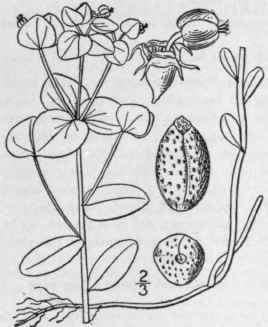
II. Tithymalus Péplus (L.) Hill. Petty Spurge
Fig. 2763
Euphorbia Peplus L. Sp. Pl. 456. 1753. Tithymalus Peplus Hill, Hort. Kew. 172/3. 1768.
Annual, glabrous. Stem rather slender, erect or nearly so, 4'-12' high, simple or branched, topped by a 3-5-rayed umbel; stem-leaves scattered, oblong or obovate, 1/2' - 1 1/4' long, obtuse or retuse, entire, crisped, narrowed into a slender petiole; those at the base of the umbel whorled; bracts opposite, ovate or triangular-ovate, apiculate, sessile; involucres campanulate, almost sessile, less than 1" long, bearing 4 crescent-shaped unap-pendaged glands prolonged into slender horns; capsule globose-ovoid, 1"-1 1/2" in diameter, slightly nodding, smooth, the lobes 2-keeled; seeds oblong or oblong-ovoid, whitish, nearly terete, marked with 1-4 series of pits.
In waste places, New Brunswick to western New York, Wisconsin, Iowa, New Jersey, Pennsylvania and West Virginia. Bermuda, Jamaica. Adventive from Europe. Devil's-milk. Seven sisters. Wartweed. June-Sept.

12. Tithymalus Commutàtus (Engelm.) Kl. & Garcke. Tinted Spurge
Fig. 2764
Euphorbia commutata Engelm. in A. Gray, Man. Ed. 2, 389. 1856. Tithymalus commutatus Kl. & Garcke, Abh. Akad. Ber.
1859: 82. Euphorbia ohiotica Steud. & Hochst.; Boiss. in DC.
Prodr. 15: Part 2, 142. 1862.
Biennial, yellowish green, often tinged with red, glabrous. Stem slender, usually decumbent at the base, 4'-15' long, branched, topped by a 3-rayed umbel; branches forked or umbellately branched; leaves, except the whorl at the base of the umbel, scattered, spatulate to ovate, ¥-\Y long, obtuse or mucronulate, entire, flat, narrowed into a slender petiole; bracts opposite, ovate-reniform; involucres campanulate, 1 1/4" long, sessile, bearing 3 or 4 crescent-shaped unappendaged glands prolonged into slender horns; capsule globose-ovoid, 1 1/2" in diameter, glabrous, the lobes rounded; seeds oblong, terete, irregularly pitted.
On hillsides, chiefly along streams, Ontario to Minnesota, Pennsylvania, Florida and Missouri. March-July.
Tithymalus falcàtus (L.) Kl. & Garcke, a native of Europe, with spatulate leaves, subulate-tipped bracts and rugose-pitted seeds, has been found in western Virginia.
Continue to:


My Books

