
![previous page: I. Paronychia [Tourn.] Adans. Fam. Pl. 2: 272. 1763](../../../images/nav/page_prev.gif)


I. Paronychia [Tourn.] Adans. Fam. Pl. 2: 272. 1763. Continued
Description
This section is from the book "An Illustrated Flora Of The Northern United States, Canada And The British Possessions Vol2", by Nathaniel Lord Britton, Addison Brown. Also available from Amazon: An Illustrated Flora of the Northern United States, Canada and the British Possessions. 3 Volume Set..
I. Paronychia [Tourn.] Adans. Fam. Pl. 2: 272. 1763. Continued
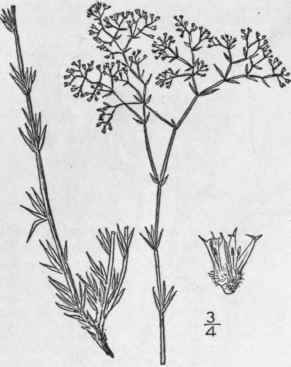
2. Paronychia Jamesii T. & G. James' Whitlow-Wort
Fig. 1717
Paronychia Jamesii T. & G. Fl. N. A. I: 170. 1838.
Scabrous-pubescent, stems 3-10' high, much branched from the base. Leaves linear-subulate, 10" long or less, the lowest obtuse, the uppermost mucronate or bristle-pointed; stipules entire; flowers in small cymes, the branches of the inflorescence ascending; bracts shorter than the calyx; calyx 1"-1 1/4" long, the segments lanceolate, gradually acuminate, tipped with divergent awns of about one-fourth their length; staminodia about as long as the filaments.
In dry soil, Nebraska and Colorado to Texas and New Mexico. July-Oct.
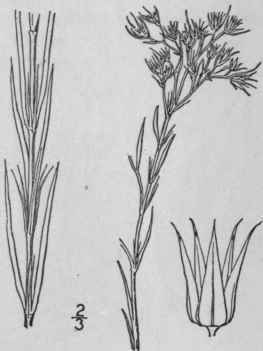
3. Paronychia Wardi Rydb. Ward's Whitlow-Wort
Fig. 1718
Paronychia Wardi Rydb.; Small, Fl. SE. U. S. 400. 1903.
Branched from a woody base, or simple up to the inflorescence, minutely pubescent, the branches slender. Leaves linear-filiform, 3"-10" long, acute, early deciduous; branches of the inflorescence spreading, very slender; calyx puberulent, only about 1" long; sepals oblong, abruptly acuminate, the short awns at length divergent-ascending.
In dry or stony soil, Kansas and Colorado to Texas and New Mexico. Aug.-Oct.
4. Paronychia Dichótoma (L.) Nutt. Forking Whitlow-Wort. Nailwort
Fig. 1719
Achyranthes dichotoma L. Mant. 51. 1767. Paronychia dichotoma Nutt. Gen. 1: 159. 1818.
Much branched from the thick woody base, glabrous or puberulent, 4'-14' tall. Leaves subulate, smooth, all acute, mucronate or bristle-tipped; stipules entire, silvery, often 5"-6" long, tapering into a slender awn; cyme loose, its branches ascending; calyx 2" long, glabrous or merely puberulent, the awns of its segments divergent, short; stami-nodia of minute bristles hardly one-fourth as long as the filaments; styles nearly as long as the perianth-segments, the stamens fully one-half as long.
In dry soil, Maryland to North Carolina, west to Arkansas and Texas. July-Oct.
5. Paronychia Depréssa (T. & G.) Nutt. Depressed Whitlow-Wort
Fig. 1720
P. Jamesii depressa T. & G. Fl. N. Am. 1: 171. 1838.
Paronychia depressa (T. & G.) Nutt.; A. Nelson, Bull. Torr. Club 26: 236. 1899.
Root deep, woody, the numerous prostrate or spreading branches 3' long or less, forming dense mats, roughish-puberulent. Leaves linear, 3"-7" long, cuspidate; stipules silvery, as long as the leaves or shorter, long-acuminate; flowers in small cymes, or solitary in the axils; calyx pubescent, about 1 1/4" long, exceeded by the bracts; awns of the sepals divergent-ascending; filaments shorter than the slender staminodia.
In dry soil, South Dakota to Nebraska and Wyoming. June-Aug.
Paronychia diffusa A. Nelson, of South Dakota, Nebraska, Wyoming and Colorado, differing in shorter bracts and stipules, does not appear specifically distinct.


6. Paronychia Sessiliflora Nutt. Low Whitlow-Wort
Fig. 1721
Paronychia sessiliflora Nutt. Gen. 1: 160. 1818.
Densely tufted from stout thick roots, low, the internodes very short and hidden by the imbricated leaves and stipules. Leaves linear-subulate, glabrous or puberulent, the lowest erect and obtuse, the uppermost recurved-spreading, mucronate or bristle-pointed; stipules 2-cleft, usually shorter than the leaves; bracts entire, mostly shorter than the flowers; flowers sessile, solitary at ends of branch-lets; calyx 1"1 1/2" long, its segments hooded at the apex, tipped with at length divergent awns of nearly their own length; staminodia about as long as the filaments.
In dry soil. Saskatchewan to Montana, Nebraska and Colorado. Aug.-Sept.
Continue to:


My Books

