
![previous page: 2. Viburnum [Tourn.] L. Sp. Pl. 267. 1753](../../../images/nav/page_prev.gif)

![next page: 2. Viburnum [Tourn.] L. Sp. Pl. 267. 1753. Part 3](../../../images/nav/page_next.gif)
2. Viburnum [Tourn.] L. Sp. Pl. 267. 1753. Part 2
Description
This section is from the book "An Illustrated Flora Of The Northern United States, Canada And The British Possessions Vol3", by Nathaniel Lord Britton, Addison Brown. Also available from Amazon: An Illustrated Flora of the Northern United States, Canada and the British Possessions. 3 Volume Set..
2. Viburnum [Tourn.] L. Sp. Pl. 267. 1753. Part 2
2. Viburnum Opulus L. Cranberry-Tree. Wild Guelder-Rose. High Bush-Cranberry
Fig. 3958
Viburnum Opulus L. Sp. Pl. 268. 1753. V. trilobum Marsh. Arb. Am. 162. 1785. V. americanum Mill. Gard. Dict. Ed. 8, no. 8. 1768.
A shrub sometimes 12° high, with nearly erect smooth branches. Leaves broadly ovate, sometimes broader than long, glabrous, or with scattered hairs above, more or less pubescent on the veins beneath, rather deeply 3-lobed, rounded or truncate and 3-ribbed at the base, the lobes divergent, acuminate, coarsely dentate; petioles 1/2'-1' long, glandular above; cymes peduncled, 3'-4' in diameter, the exterior flowers radiant, neutral, 1/2'-1' broad; drupes globose, or oval, 4"-5" in diameter, red, very acid, translucent; stone orbicular, flat, not grooved.
In low grounds, Newfoundland to British Columbia, New Jersey, Michigan, Iowa, South Dakota and Oregon. Also in Europe and Asia. Among many English names are marsh-, rose- or water-elder, white dogwood, whitten-tree, dog rowan-tree, gaiter-tree or gatten, cherry-wood, May-rose,, squaw-bush, cramp-bark. In cultivation, the snowball. Gadrise. Red elder. Love-roses. Witch-hopple or -hobble. Pincushion-tree. June-July.
3. Viburnum Pauciflorum Pylaie. Few-Flowered Cranberry-Tree
Fig. 3959
V.pauciflorum Pylaie;T.&G.Fl.N.A.2:17. 1841. Viburnum Opulus var. eradiatum Oakes, Hovey's Mag. 7: 183. 1841.
A straggling shrub, 2°-6° high, with twigs and petioles glabrous or nearly so. Leaves broadly oval, obovate, or broader than long, 5-ribbed, truncate or somewhat cordate at the base, mostly with 3 rather shallow lobes above the middle, coarsely and unequally dentate, glabrous above, more or less pubescent on the veins beneath, l1/2'-3' broad; cymes peduncled, short-rayed, 1/2'-1' broad; flowers all perfect and small; drupes globose to ovoid, light red, acid, 4"-S" long; stone flat, orbicular, scarcely grooved.
In cold mountain woods, Newfoundland to Alaska, south to Maine, New Hampshire, Vermont, Pennsylvania, in the Rocky Mountains to Colorado, and to Washington. June-July.
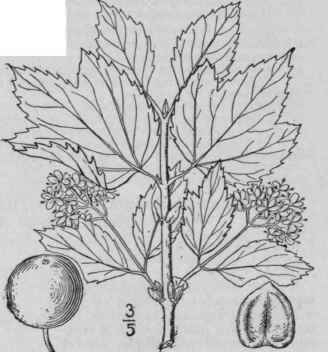

4. Viburnum Acerifolium L. Maple-Leaved Arrow-Wood
Fig. 3960
V. acerifolium L. Sp. Pl. 268. 1753.
A shrub 3°-6° high, with smooth gray slender branches, and somewhat pubescent twigs and petioles. Leaves ovate, orbicular, or broader than long, cordate or truncate at the base, pubescent on both sides, or becoming glabrate, 2'-5' broad, mostly rather deeply 3-lobed, coarsely dentate, the lobes acute or acuminate; petioles ¥-1' long; cymes long-peduncled, 1Y-3' broad; flowers all perfect, 2"-3" broad; drupe nearly black, 3"-4" long, the stone lenticular, faintly 2-ridged on one side and 2-grooved on the other.
In dry or rocky woods, New Brunswick to Georgia, Alabama, Ontario, Michigan and Minnesota. Upper leaves sometimes merely toothed, not lobed. May-June. Squash-berry. Maple-leaf guelder-rose. Dockmakie.
Continue to:


My Books

