


29. Boltonia L'Her. Sert. Angl. 16. 1788
Description
This section is from the book "An Illustrated Flora Of The Northern United States, Canada And The British Possessions Vol3", by Nathaniel Lord Britton, Addison Brown. Also available from Amazon: An Illustrated Flora of the Northern United States, Canada and the British Possessions. 3 Volume Set..
29. Boltonia L'Her. Sert. Angl. 16. 1788
Perennial glabrous branching herbs, with striate or angled stems, alternate, entire, sessile or clasping leaves, and numerous rather large heads of both tubular and radiate flowers, paniculate, or solitary at the ends of the branches. Involucre hemispheric or broadly campanulate, its bracts scarious-margined, imbricated in few series, the outer slightly shorter. Receptacle convex or conic, foveolate. Ray-flowers pistillate. Disk-flowers perfect, their corollas elongated, 5-lobed. Anthers obtuse and entire at the base. Style-branches flattened, their appendages short, lanceolate. Achenes flattened, obovate, their margins thickened or narrowly winged, glabrous or nearly so. Pappus a series of short scales, usually with 2-4 slender rigid bristles. [Named for James Bolton, an English botanist of the 18th century.]
As here limited, the genus consists of the 4 following species, with perhaps a fifth in Oregon. Type species: Boltonia glastifolia (Hill) L'Her.
Disk about 2" broad; leaves linear.
1. B. diffusa.
Disk 3"-6" broad; leaves lanceolate to oblanceolate.
Leaves narrowed at the base, sessile, not decurrent on the stem. Involucre-bracts lanceolate, acute.
2. B. asteroides.
Involucre-bracts spatulate, obtuse, or mucronate.
3. B. latisquama.
Stem leaves, and sometimes those of the branches decurrent, sagittate.
4. B. decurrens.

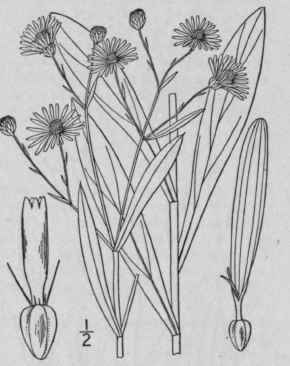
1. Boltonia Diffusa Ell. Panicled Boltonia
Fig. 4275
Boltonia diffusa Ell. Bot. S. C. & Ga. 2: 400. 1824.
Paniculately much branched, 2°-7° high, the branches very slender or filiform. Leaves linear, or the lower linear-lanceolate, acutish, the larger 1'-2' long, 1 1/2" - 2" wide, those of the branches very small and subulate: heads about 2" high; disk about 2" broad; rays usually white, 1"-2" long; involucre broadly campanulate, its bracts oblong or oblong-lanceolate, acutish or obtuse; achenes obovate, narrowly winged; pappus of several short scales and 2 subulate bristles shorter than the achene.
In dry soil, southern Illinois to Texas, east to South Carolina and Florida. Aug.-Oct.
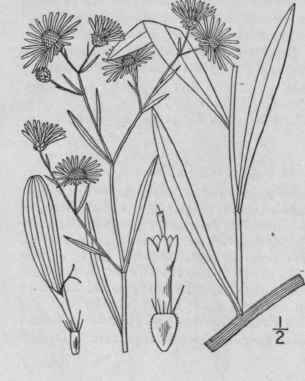
2. Boltonia Asteroides (L.) L'Her. Asterlike Boltonia
Fig. 4276
Matricaria asteroides L. Mant. 116. 1767. Matricaria glastifolia Hill, Hort. Kew. 19: pl. 3. 1769. Boltonia glastifolia L'Her. Sert. Angl. 16. 1788. Boltonia asteroides L'Her. Sert. Angl. 16. 1788.
Rather stout, 2°-8° high, somewhat cymosely paniculate. Leaves lanceolate, to oblanceolate, sessile, 2'-5' long, 3"-12" wide, the upper linear-lanceolate, smaller; heads 2"-4" high; disk 3"-6" wide; rays white, pink or purple, 3"-6" long; involucre hemispheric, its bracts lanceolate or oblong-lanceolate, acute or acuminate; pappus of setose scales, with or without 2-4 slender bristles nearly as long as the obovate or oval achene.
In moist soil, Connecticut to Florida, west to Minnesota, Nebraska and Louisiana. July-Sept.
3. Boltonia Latisquama A. Gray. Broad-Scaled Boltonia
Fig. 4277
Boltonia latisquama A. Gray, Am. Journ. Sci. (II) 33: 238. 1862.
Similar to the preceding species and perhaps a race of it. Leaves lanceolate, acute, sessile; heads rather larger; rays violet-blue; bracts of the involucre oblong-spatulate, obtuse or mucronate; pappus of numerous small short broad scales and 2 long bristles.
Western Missouri, Kansas, Arkansas and Oklahoma. Autumn.
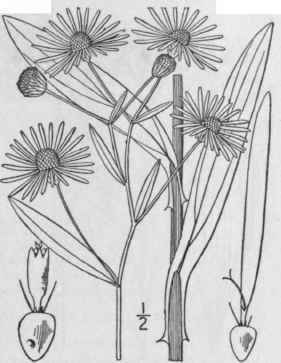
4. Boltonia Decurrens (T. & G.) Wood. Clasping-Leaved Boltonia
Fig. 4278
Bol onia glastifolia var. ( ?) decurrens T. & G. Fl. N. A. 2: 188. 1841.
Boltonia decurrens Wood, Bot. & Flor. 166. 1870.
Boltonia asteroides var. decurrens Engelm.; A. Gray, Syn. Fl. 1: Part 2, 166. 1884.
Stout, 3º-6° high, branched above. Leaves oblong-lanceolate or elongated-lanceolate, mucronate at the apex, those of the stem decurrent and sagittate at the base, 3'-6' long, 6"-8" wide, those of the branches smaller and merely sessile or some of them also decurrent; heads 2 1/2"-3" high; involucre hemispheric; rays about 3" long, violet or purple; pappus of several or numerous short scales and 2 very slender bristles.
In wet prairies, Illinois and Missouri. Aug.-Sept. Perhaps a race of B. asteroides.
Continue to:


My Books

