


3. Apocynum L. Sp. Pl. 213. 1753. Continued
Description
This section is from the book "An Illustrated Flora Of The Northern United States, Canada And The British Possessions Vol3", by Nathaniel Lord Britton, Addison Brown. Also available from Amazon: An Illustrated Flora of the Northern United States, Canada and the British Possessions. 3 Volume Set..
3. Apocynum L. Sp. Pl. 213. 1753. Continued
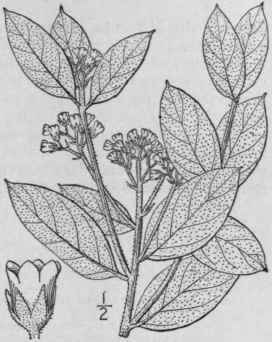
2. Apocynum Medium Greene. Intermediate Dogbane
Fig. 3377
Apocynum medium Greene, Pittonia 3: 29. 1897.
Apocynum speciosum G. S. Miller, Proc. Biol. Soc. Wash. 13: 83. 1899.
Rootstock horizontal; stem stout, 40 high or less, the branches ascending, glabrous. Leaves oblong to oval or elliptic, mucronulate, ascending, 21/2'- 4' long, somewhat pubescent beneath; petioles 2"- 4" long; cymes terminal, compact; pedicels 1 1/2"- 21/2" long; flowers erect; calyx-segments ovate, about half as long as the 5-angled corolla-tube; corolla white or pinkish, 21/2"- 3 1/2" long, urceolate-campanulate, its lobes acutish, somewhat spreading, nearly as long as the tube; follicles 3'- 4' long.
Fields and hillsides, Quebec to the District of Columbia, west to Iowa. June-Aug.

3. Apocynum Milleri Britton. Miller's Dogbane
Fig. 3378
Apocynum Milleri Britton, Manual 739. 1901.
Stem slender, 3° high or less, the branches spreading. Leaves oblong to ovate-lanceolate, 2 1/2'-3 1/2' long, pubescent beneath, the pubescent petioles 1 1/2"- 3" long; cymes small, terminal or also in the upper axils, the pedicels i"- 1 1/2" long; flowers nearly erect; corolla pinkish, 2 1/2"-3" long, its rounded segments spreading, much shorter than the tube, which is longer than the ovate calyx-segments; follicles about 4' long.
Dry soil, New York to Maryland and the District of Columbia. June-July.
4. Apocynum Cannabinum L. Indian Hemp. Amy-Root
Fig. 3379
Apocynum cannabinum L. Sp. Pl. 213. 1753.
A. cannabinum glaberrimum DC. Prodr. 8: 439. 1844.
A. nemorale G. S. Miller, Proc. Biol. Soc. Wash. 13: 87.
1899. Apocynum urceolifer G. S. Miller, loc. cit.
Root deep, vertical, soon branching. Stem extensively branched, the branches erect or ascending, glabrous or nearly so, more or less glaucous. Leaves oblong, lanceolate-oblong or ovate-oblong, acute or obtuse and mucronate at the apex, narrowed or rounded at the base, glabrous above, sometimes pubescent beneath, 2'- 6' long, 1/2'-3' wide; petioles 1"-6" long, or sometimes none; cymes dense; pedicels short, bracteolate at the base; calyx-segments about as long as the tube of the greenish-white corolla; corolla-lobes nearly erect; follicles similar to those of the preceding species.
In fields and thickets, Connecticut to Wisconsin, Alabama, Tennessee, Missouri and Kansas, perhaps extending farther north. Rheumatism-root. Wild cotton.


5. Apocynum Sibiricum Jacq. Clasping-Leaved Dogbane
Fig. 3380
A. sibiricum Jacq. Hort. Vind. 3: 37. pl. 66. 1776. A. hypericifolium Ait. Hort. Kew. 1: 304. 1789. A. cannabinum var. hypericifolium A. Gray, Man.
365. 1848. Apocynum album Greene, Pittonia 3: 230. 1897.
Glabrous, pale green, often glaucous; stem l°-2° high, the branches ascending. Leaves oblong, oblong-lanceolate to oval, l'-3' long, 1/2'-1 1/2' wide, obtuse or acutish at the apex, cordate-clasping, rounded, truncate, or most of the upper narrowed at the base, short-petioled, or sessile, the primary venation forming broad angles with the midvein; cymes many-flowered, dense to loose; pedicels mostly not longer than the flowers, bracteolate; calyx-segments about as long as the corolla-tube, lanceolate, acute; corolla-lobes nearly erect; follicles 2'-3 1/2 long.
Mostly along streams. Quebec to British Columbia, Long Island, Ohio, Kansas and New Mexico. St. John's-dogbane. June-Aug.
6. Apocynum Pubescens R. Br. Velvet Dogbane
Fig. 3381
A. pubescens R. Br. Mem. Wern. Soc. 1: 68. 1811. Apocynum cannabinum var. pubescens A. DC. Prodr. 8: 440. 1844.
Whole plant, including the pedicels and calyx, densely velvety-pubescent, or the stem sometimes glabrate. Branches ascending; leaves oval to elliptic, obtuse or acute at the apex, strongly mucronate, obtuse or obtusish at the base, the veins impressed in the pubescence of the lower surface; petioles 1"-2" long; cymes dense; calyx-segments about as long as the tube of the corolla, lanceolate, acute; corolla-lobes erect; follicles about 4' long.
In dry sandy soil, Ontario to Rhode Island, Maryland, Alabama, Iowa and Kansas. April-Aug. Perhaps a pubescent race of A. cannabinum L.
Continue to:


My Books

