


31. Aster L. Sp. Pl. 872. 1753. Part 3
Description
This section is from the book "An Illustrated Flora Of The Northern United States, Canada And The British Possessions Vol3", by Nathaniel Lord Britton, Addison Brown. Also available from Amazon: An Illustrated Flora of the Northern United States, Canada and the British Possessions. 3 Volume Set..
31. Aster L. Sp. Pl. 872. 1753. Part 3
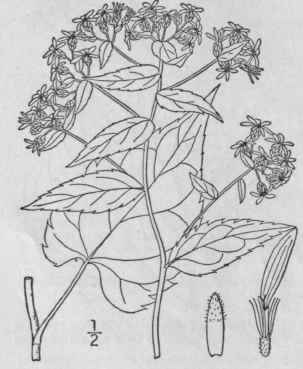
4. Aster Furcatus Burgess. Forking Aster
Fig. 4285
Aster furcatus Burgess; Britt. & Brown, III. Fl. 3: 358. 1898.
Stem leafy, 1 1/2 high, or less, loosely forked above. Leaves hispid above, hispidulous beneath, firm, sa-liently cut-toothed, the lower ovate, short-petioled, with a small or shallow sinus, the upper sessile, with broad laciniate winged bases, often 5' long by 2 1/2' wide, the uppermost elliptic-oblong, often 3 1/2' long; teeth long and low, sharp; heads few (5-20), slender-peduncled; involucre turbinate to campanulate, with a truncate or rounded base; rays 3-toothed; disk turning brown, the florets funnelform with rather broad lobes; pappus long, straight; achenes pubescent, subangular, not constricted at the summit.
In woods, especially on shaded cliffs, Indiana, Illinois and Missouri. Aug.-Oct.
5. Aster Glomeratus (Nees) Bernh. Bern- Hardi's Aster
Fig. 4286
Eurybia glomerata Nees, Gen. & Sp. Ast. 139. 1832. Aster glomeratus Bernh.; Burgess in Britt. & Brown, III. Fl. 3: 358. 1898.
Loosely clustered, dull green. Leaves not large, mostly short-pilose beneath, thickish, rough above; basal leaves present, these and the lower stem leaves cordate with a deep, narrow sinus, the teeth sharp, rather close and small; petioles slender, ciliate; upper leaves much smaller, ovate, truncate with a short broadly winged base, or the uppermost ovate to lanceolate, sessile, entire; inflorescence compact, of many glomerate clusters, round-topped; heads about 4" high; bracts pubescent, obtuse, green, the inner twice as long as the outer; rays about 6, cream-white, short, soon deciduous; disk turning brown.
In moist thickets or swamps, especially in ravines, Maine to New York and Virginia. July.

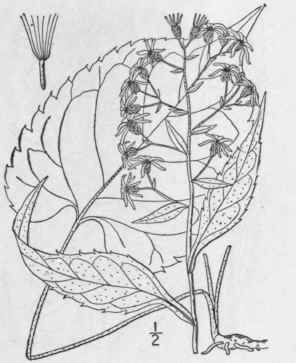
6. Aster Claytoni Burgess. Clayton's Aster
Fig. 4287
Aster Claytoni Burgess; Britt. & Brown, III. Fl. 3: 358. 1898.
Similar to A. divaricatus, stems red, tough. Leaves chiefly ovate-lanceolate, not large, rough, thick, slender-petioled, coarsely serrate, pale, or dull, the apex incurved-acuminate, the upper spreading or deflexed, sessile by a broad base, lanceolate-triangular, serrulate; inflorescence high, with percurrent axis, the long suberect branches each bearing a small umbelliform cluster of heads; peduncles filiform, as long as the heads, 3"-4" long; bracts pale; rays short, narrow, chiefly 6, snow-white; disks at first golden-yellow, finally sienna-brown; florets about 20, achenes densely short-hairy.
In sunny or slightly shaded rocky places, Maine to New York and the mountains of Virginia. Sept.
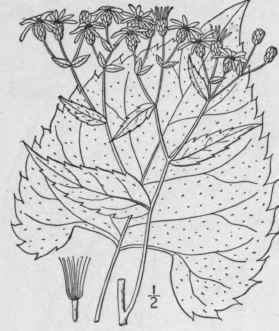
7. Aster Curvescens Burgess. Dome-Topped Aster
Fig. 4288
Aster curvescens Burgess; Britt. & Brown, III. Fl. 3: 359. 1898.
Dark green, chiefly glabrous; rootstocks often 10' long; stem smooth, striate, delicate, 1 1/2°-3 1/2° high. Basal leaves tufted, conspicuous, these and the lowest stem leaves with a broad sinus tapering into a petiole 1-2 times as long as the blade, abruptly in-curved-acuminate; middle leaves ovate, short-peti-oled, rounded at the base, the upper lanceolate, slenderly acuminate, often falcate; leaves firm, smooth-ish, the teeth broad, curved; inflorescence mostly convex, 3'-5' broad, its short filiform naked branches widely ascending; heads 4"-5" high; lower bracts short, obtuse, the others longer, nearly uniform, scarious, shining, linear, often acute, usually glabrous; rays about 8, cream-white, about 5" long; disk becoming purple-brown; pappus early reddening; achenes slender, glabrous.
In loose moist shaded soil, New England and New York to Virginia. Aug.-Sept.
Continue to:


My Books

