


31. Aster L. Sp. Pl. 872. 1753. Part 4
Description
This section is from the book "An Illustrated Flora Of The Northern United States, Canada And The British Possessions Vol3", by Nathaniel Lord Britton, Addison Brown. Also available from Amazon: An Illustrated Flora of the Northern United States, Canada and the British Possessions. 3 Volume Set..
31. Aster L. Sp. Pl. 872. 1753. Part 4
8. Aster Schreberi Nees. Schreber's Aster
Fig. 4289
Aster Schreberi Nees, Syn. Ast. 16. 1818.
Stem stout, 2°-3° high, with long internodes. Basal leaves often in extensive colonies, thin, dull green, firm, rough above, with scattered slender ap-pressed bristles, pubescent beneath on the veins, reni form-cordate or cordate-triangular, often 7' long by 5' wide, the basal sinus when well developed rectangular, 2' across and 1' deep; upper leaves ovate-oblong to lanceolate, with a short broad basal wing, or sessile; petioles of the lower leaves long, conspicuously ciliate when young; inflorescence decompound, flattish, or irregularly convex, 6'-12' broad; heads about 5" high; bracts greenish, mostly obtuse, ribs and midrib dark green, ciliate; rays usually 10.
In borders of woods, and along fence rows in partial shade, New York to Michigan and Virginia. July-Aug.
9. Aster Macrophyllus L. Large-Leaved Aster
Fig. 4290
Aster macrophyllus L. Sp. Pl. Ed. 2, 1232. 1763.
Rough; rootstocks long, thick; stem reddish, angular, 2°-3° high. Basal leaves forming large colonies, 3 or 4 to each stem, broad, cordate with a large irregular sinus, rough above, harsh, thick, the teeth broad, curved, pointed, the petioles long, narrow; upper stem leaves oblong with short broadly winged petioles, the uppermost sessile, acute; inflorescence strigose and glandular, broadly corymbose, irregular; heads 5"-6" high; peduncles rigid, thickish; rays about 16, 5"-7" long, chiefly lavender, sometimes violet, rarely pale; bracts conspicuously green-tipped, the lower acute, the inner oblong, obtuse; disk turning reddish brown; florets short-lobed.
In moderately dry soil, in shaded places, Canada to Minnesota and North Carolina. Here regarded as consisting of numerous slightly differing races, perhaps including the five following described as species. Aug.

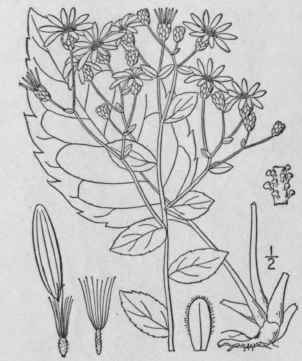
10. Aster Roscidus Burgess. Dewy-Leaf Aster
Fig. 4291
Aster roscidus Burgess; Britt. & Brown, III. Fl. 3: 360. 1898.
Clammy-hairy, odorous, copiously glandular when young, somewhat so at maturity; stem 30 high, or less. Basal leaves in close colonies, coriaceous, the earlier ones cordate-quadrate, low-serrate, the sinus deep, narrow, the later, or winter leaves, elliptic, long-petioled, often prostrate, often 5' long; stem leaves chiefly orbicular and not cordate, with short broadly winged petioles, rarely slender-petioled; inflorescence convex, sometimes irregular; involucre hemispheric, its bracts chiefly with rounded ciliate tips; rays 14-16, broad, clear violet; disks at first golden yellow, soon turning red; pappus long, white, copious.
In slight shade and rich cleared woodlands, Maine to Pennsylvania and Michigan. Aug.-Sept.
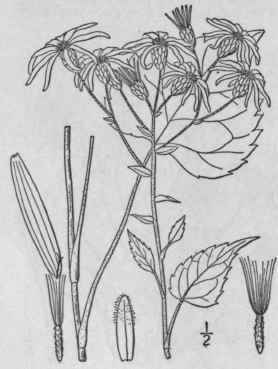
11. Aster Ianthinus Burgess. Violet Wood Aster
Fig. 4292
Aster ianthinus Burgess; Britt. & Brown, III. Fl. 3: 360. 1898.
Glandular, dark green, slightly strigose-pubescent; stem erect, or decumbent, 2°-3° tall. Leaves thin-nish, rough, the lower and basal ones orbicular to oblong, 5' long, or less, abruptly acuminate, low-serrate or crenate; the sinus broad, open, shallow, upper leaves sessile by a narrowed base, crenate-serrate; inflorescence open, nearly naked, peduncles slender, divergent; heads large; rays 10-13, long, very deep violet or sometimes pale, 4"-6" long; bracts green-tipped, little pubescent.
On shaded banks and along woodland paths, Maine to Lake Erie and West Virginia. July-Oct.

Continue to:


My Books

