


61. Rudbeckia L. Sp. Pl. 906. 1753. Part 4
Description
This section is from the book "An Illustrated Flora Of The Northern United States, Canada And The British Possessions Vol3", by Nathaniel Lord Britton, Addison Brown. Also available from Amazon: An Illustrated Flora of the Northern United States, Canada and the British Possessions. 3 Volume Set..
61. Rudbeckia L. Sp. Pl. 906. 1753. Part 4
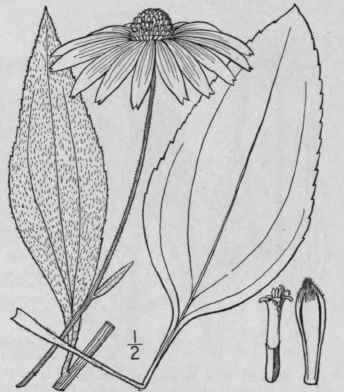
8. Rudbeckia Grandifldra Gmelin. Large-Flowered Cone-Flower
Fig. 4449
Rudbeckia grandiflora Gmelin; DC. Prodr. 5:
556. 1836.
Perennial; stem 1 3/4°-3° tall, scabrous or hispid throughout. Leaves mainly on the lower part of the stem, very rough on both surfaces, ovate-elliptic to lanceolate, 21/2'-6' long, acute or acuminate at the apex, cu-neate or more abruptly contracted at the base, shallowly serrate or denticulate, the petioles of the lower cauline and basal leaves as long as the blades or longer; heads large, solitary or few, showy; rays several, yellow, 1 1/4'-1 1/2' long, drooping; bracts of the involucre linear, acuminate; disk ovoid or ovoid-globose, 2/3'-l' thick; chaff obtuse, canescent; pappus conspicuous, crenate or toothed.
On dry prairies, Oklahoma to Louisiana and Texas; introduced into Missouri. June-Aug.
9. Rudbeckia Maxima Nutt. Great Cone-Flower
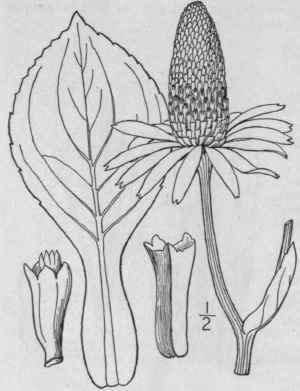
Fig. 4450
Rudbeckia maxima Nutt. Trans. Am. Phil. Soc. (II) 7: 354. 1841.
Perennial; stem 3°-9° tall, simple or branched above, smooth, glaucous. Leaves oblong, oval, or ovate, or pandurate, 21/2'-8' long, mostly obtuse, undulate, repand-denticulate or entire, the upper sessile and partly clasping; heads large, showy; rays several, yellow, 7"-20" long; bracts of the involucres linear or linear-lanceolate, acute, short; disk cylindric to conic-cylindric, 1'-2 1/2' long; chaff abruptly short-pointed, pubescent at the summit; pappus conspicuous, denticulate, accentuated at the angles.
In moist soil, Missouri to Louisiana and Texas. June-Aug.
10. Rudbeckia Laciniata L. Tall, Or Green-Headed Cone-Flower
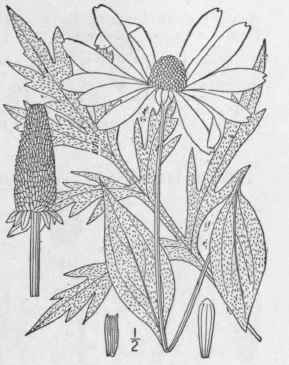
Fig. 4451
Rudbeckia laciniata L. Sp. Pl. 906. 1753.
Perennial; stem much branched, glabrous, or nearly so, 3°-12° high. Leaves rather thin, minutely pubescent on the margins and upper surface, broad, the basal and lower ones long-petioled, often 1° wide, pinnately 3-7-divided, the segments variously toothed and lobed; stem leaves shorter-petioled, 3-5-parted or divided, the uppermost much smaller, 3-lobed, dentate or entire; heads several or numerous, 21/2'-4' broad; rays 6-10, bright yellow, drooping; bracts of the involucre unequal; chaff of the receptacle truncate and canescent at the apex; disk greenish-yellow, at length oblong and twice as long as thick or longer; pappus a short crown.
In moist thickets, Quebec to Manitoba, Idaho, Colorado, Florida and Arizona. Thimble-weed. A double-flowered form in cultivation is called golden-glow. July-Sept.
A southern mountain race, lower, often only 1° high, with smaller heads, has been described as Rudbeckia laciniata humilis A. Gray.
Continue to:


My Books

