


Genus Boletus
Description
This section is from the book "The Mushroom Book", by Nina L. Marshall. Also available from Amazon: Mushroom Book.
Genus Boletus
The species in the genus Boletus are numerous, and many are extremely beautiful. They are distinguished from the other pore-bearing fungi by the fact that their tubes are easily separable from each other and from the portion on which they are borne.
They are to be looked for in the warmest part of the season, and with a few exceptions will be found on the ground. As it is difficult to dry specimens so that they will retain their size, shape, and colour, careful notes should be taken of these points, together with the colour of the spores, the colour of the tubes, the colour of the flesh before and after being bruised, the character of the stem, the presence or absence of hairs and fibres on the several parts of the plant. The genus Boletus contains many edible species, and also many which are dangerous; and as the recognition of the different species is a difficult matter, even for experts, the beginner should be especially cautious. In general it will be well to avoid for edible purposes all Boleti which change colour on exposure to the air or on being pressed; all those which have red-mouthed tubes, or mouths of a deeper colour than the rest of the tube; and all those with a peppery or acrid taste. Experiment cautiously with the other species.
A detailed description of the species is out of the question in this book; for such the reader must refer to " Boleti of the United States,"* or to "Fuhrer fur Pilzfreunde."
Boletus glabellus
Cap - Smoky yellow.
Flesh - White, changing to blue when 'wounded.
Tubes - Brownish yellow tinged with green, changing to blue when wounded. Stem - Reddish at the base, pallid above, with a narrow reddish circumscribing Zone or line at the top. Habitat - Grassy ground.
Gla-bel -lus
* Bulletin, New York State Museum, No. 8, 1888. This can be obtained at a small price of the State Librarian at Albany, New York. In it are described one hundred and ten species.
By Edmund Michael. A book in German, with sixty-eight coloured plates.
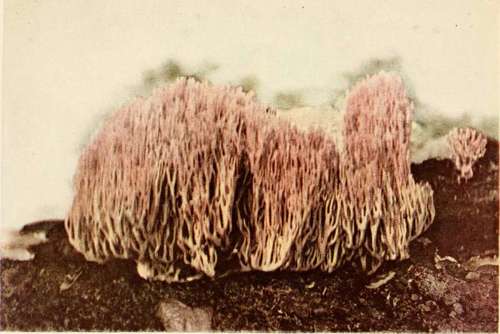
Clavaria formosa, Pers. (edible). See page 101.
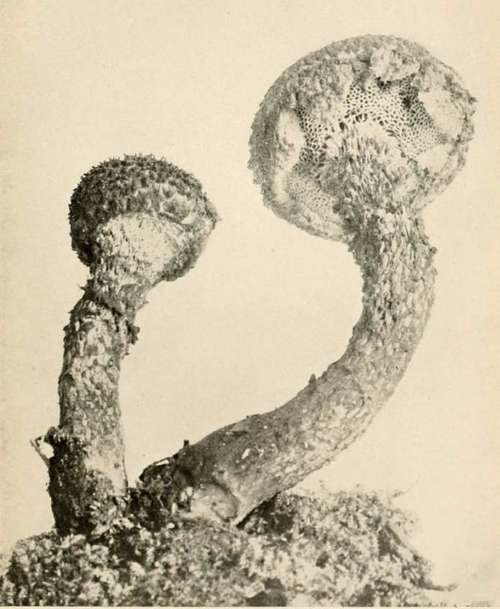
Cone-Like Boletus (Edible, Mol ).
{Strobilomyces strobilaceus, Berk.)
Purplish black ; flesh white, changing to red when bruised. See p. 102

Painted Boletinus (edible). (Boletinus pictus, Pk.).
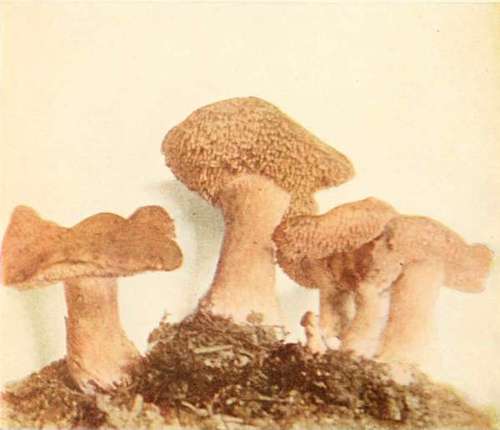
Spreading Hydnum (edible).
(Hydnum repanduin, L.).
See page 95.
Boletus bicolor
Cap - Dark red, fading when old; often marked with yellow. Flesh - Yellow, slowly changing to blue when wounded. Tubes - Bright yellow, changing to blue. Stem - Solid, red, generally yellow at the top. Habitat - Woods and open places.
Boletus cyanescens
Cap - Pale buff or greyish yellow. Covered with woolly scales, two-fifths of an inch wide. Flesh - White, quickly changing to blue when wounded. Tubes - White, becoming yellowish, changing to blue when bruised. Stem - Coloured like the cap. Swollen, stuffed, not covered with a network. Habitat - Woods and open places.
Boletus pallidus
Cap - Pallid or brownish white, sometimes tinged with red. Flesh - White.
Tubes - Pale whitish yellow, changing to blue when wounded. Stem - Long and whitish, sometimes streaked with brown ; smooth.
Boletus mutabilis
Cap - Brown, becoming blackish ; smooth and shining ; or dry, somewhat woolly.
Flesh - Bright yellow, promptly changing to blue when wounded.
Tubes - Yellow, changing to greenish yellow, and quickly becoming blue when wounded. Mouths large and angular.
Stem - Stout, bright yellow within, covered with brown and dotted scales.
Habitat - Dense woods.
Boletus speciosus
Cap - Red. 3-7 inches broad.
Flesh - Pale or bright lemon yellow, changing to blue when wounded.
Bl'-co-1or Cy-an-es'-cens I'al'-li-dus .Mu-ta-bulls Spe-cI-o'-sus
Tubes - Bright lemon yellow, becoming dingy yellow with age; changing to green, then to blue, when wounded. Stem - Bright lemon yellow without and within, sometimes reddish at the base. 2-4 inches long. Habitat - Thin woods.
Golden-flesh Boletus
Boletus chrysenteron (See Plate Facing Page 60)
Cap - Yellowish brown, reddish brown, brick red, or olive tinted with reddish chinks. Flesh - Yellow, red just under the skin, often changing to blue when wounded. Tubes - Greenish yellow, changing to blue when wounded. Stem - Red or pale yellow. Habitat - Woods or mossy banks, common.
Boletus radicans
Cap - Dry, somewhat woolly. Greenish grey, becoming pale yellow. Margin rolled under.
Flesh - Pale yellow, instantly changing to dark blue when wounded.
Tubes - Lemon yellow.
Stem - Tapering downward and rooting. Woolly, with a reddish bloom. Pale yellow, becoming dark with a touch.
Habitat - Woods, Ohio.
Boletus Peckii
Cap - Firm, dry. Red, fading to yellowish red or buff brown, Tubes - Yellow, changing to blue when wounded. Stem - Red; yellow at the top. Habitat - Woods.
Boletus calopus
Cap - Olive tinted, somewhat woolly. 2-3 inches wide.
Flesh - Pallid, slightly changing to blue when wounded.
Tubes - Yellow.
Stem - Covered with a network. Wholly scarlet, or at the apex only. Longer than the diameter of the cap. Habitat - Woods.
Cris-en-ter-on Ra'-dl-cans Peck'-i-i Cal-o'-pus
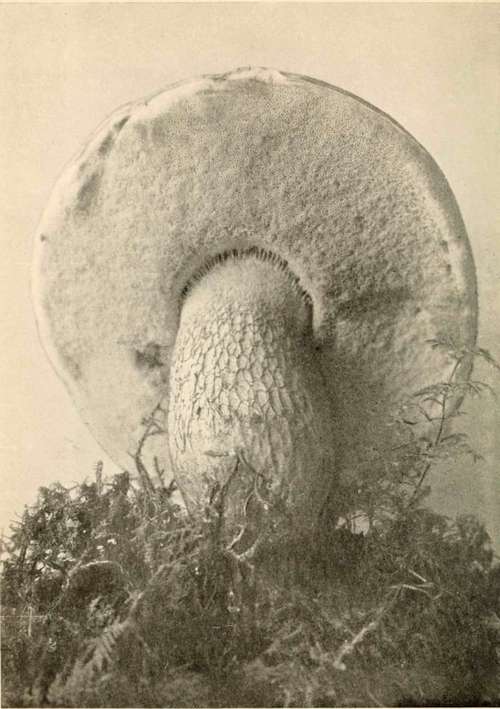
Bitter Boletus (Unpalatable) (Boletus felleus, Bull.; var. obesus, Pk.). See p. 107.
Purple Boletus
Boletus purpureus
Cap - Dry, velvety. Purple red.
Flesh - Changing to blue, and then to dark yellow in the young plant. Tubes - Yellow or greenish yellow. Mouths minute, orange tinged with purple, changing to blue where wounded. Stem - Stout, with purple veins or dots. Apex sometimes covered with a network. Yellow, reddish within. Habitat - Woods.
Boletus Satanus
Cap - Smooth, somewhat sticky. Pale brown or whitish. 3-8 inches broad.
Flesh - Whitish, becoming reddish or v iolet when wounded. Very poisonous.
Tubes - Yellow. Mouths bright-red, becoming orange.
Stem - Thick, swollen, marked above with a red network. 2-3 inches long.
Habitat - Woods.
Bitter Boletus
Boletus felleus
Cap - Smooth, pale yellowish, greyish brown, yellowish brown, reddish brown, or chestnut. 3-8 inches broad. Flesh - White, changing to flesh colour when bruised. Taste bitter. Tubes - White, becoming flesh colour. Mouths angular. Adnate to the stem. Stem - Covered with network. Colour similar to the cap. 2-4 inches long. Habitat - Woods and open places.
Pur-pu'-re-us Sa-ta'-nus Fel-le-us

B- Satanus.
Fungi with Pores - Boletaceae
Boletus scaber
Cap - Smooth, viscid when moist, or minutely woolly, velvety, or scaly. 1-5 inches wide. Colour ranges from nearly white to almost black.
Tubes - Free from the stem, white, long. Mouths minute.
Flesh - White.
Stem - Long, ground colour whitish, roughened with blackish brown or reddish dots or scales. 3-5 inches long.
Habitat - Common in woods, swampy and open places.
Orange-cap Boletus
Boletus versipellis
Cap - Orange red. 2-6 inches wide. Dry, minutely woolly, then scaly or smooth. Margin edged with the remains of the veil.
Flesh - White or greyish.
Tubes - Long. Mouths minute. Greyish-white.
Stem - Solid; white scaly wrinkles. Whitish colour. 3-5 inches long.
Habitat - Woods and open places.
Chestnut Boletus
Boletus castaneus
Cap - Dry, minutely velvety. Cinnamon or reddish-brown. 1-3 inches broad. Flesh - White.
Tubes - White, becoming yellow. Short, and free from the stem. Stem - Clothed and coloured like the cap. 1-2 1/2 inches high. Habitat - Woods and open places.
Boletus eximius
Cap - Purplish-brown or chocolate colour, fading to smoky red or pale chestnut. 3-10 inches broad. Flesh - Greyish or reddish white.
Tubes - Resembling the cap in colour. Mouths minute. Stem - Stout, covered with a meal-like powder. Colour resembling the cap, grey tinged with purple within. 2-4 inches long. Habitat - Woods.
Sca-ber Ver-sl-pel'-lls Cas-ta -ne-us Ex-lm'-T-us

Scabrous-Stemmed Boletus (Edible).
(Boletus scaber, Fr. ; var. niveus, Gill.) Cap white. Sec p. 108
Fungi with Pores - Polyporaceae
Edible Boletus
Boletus edulis
Cap - Convex or nearly plane; smooth, moist; compact, then soft. Greyish red, brownish red, or tawny brown. 4-6 inches broad. Flesh - White or yellowish; reddish beneath the skin. Tubes - Convex, nearly free, long, minute, round. White, then yellow and greenish. Stem - Short or long, straight or curving, sometimes bulbous, stout, covered with network. Just beneath the stem whitish or brownish. 2-6 inches long. Habitat - Woods and open places.
Boletus subtomentosus
Cap - Covered with soft woolly hairs. Somewhat olive green, uniform in colour under the skin, yellow chinks on the surface.
Flesh - White.
Tubes - Yellow, with large angular mouths.
Stem - Stout, rugged, with minute dots.
Habitat - Common in woods.
Boletus Americanus
Cap - Thin, soft, viscid, slightly woolly on the margin when young. Yellow, becoming dingy with age; sometimes streaked with bright red. 1-3 inches broad.
Flesh - Pale yellow.
Tubes - Not free from the stem. Large, angular. Pale yellow, becoming tinged with brown.
Stem - Slender. No annulus. Yellow, brownish towards the base, marked with numerous brown or reddish-brown glandular dots; yellow within. 1 1/2-2 1/2 inches long.
Habitat - Woods, swamps.
Polyporaceae
The fungi with pores permanently united to the surrounding tissue and to each other form a large and important group, the Polyporarea'. With but few exceptions they are leathery, corky, membranous, or woody.
Nearly six hundred species have been reported from America.
Ed'-u-lls Sub'-to-men-to'-sus A-mer-i-ca'-nus Po'-ly-po-ra -ce-ae l00
Continue to:


My Books

