


Carbonic Acid
Description
This section is from the book "Fermented Alcoholic Beverages, Malt Liquors, Wine, And Cider", by C. A. Crampton. Also available from Amazon: Fermented Beverage Production, Second Edition.
Carbonic Acid
Most investigators have given very little attention to the determination of the carbonic acid in beer, regarding it as of little importance in forming an estimate of the quality of the sample examined. The practical consumer, however, is of quite a different opinion and condemns immediately a beer which is "flat" or insufficiently carbonated, however worthy it may be in other respects. The reason for its unimportance as a determination is found in the difficulty of the accurate estimation in the beer as supplied to the customer. The usual method of determining it is to measure or weigh out a convenient quantity of the beer into a flask, connect the latter either with an absorbing apparatus for the estimation of the CO2 direct; or with a suitable apparatus for the retention of water, thus estimating it by loss or indirectly, its liberation from the beer being accomplished by the aid of heat. But this manner of manipulation gives simply the amount of carbonic acid capable of being held in solution by a liquid of the density and temperature of the beer when it was measured out, supposing it to have been fully charged previously. The excess of gas above the saturation point, however, which is held by the beer so long as it is kept under pressure, or at a low temperature, escapes as soon as the pressure is removed and gives the beer its "head," which is so desirable a qualification. This excess of gas soon passes off, but during this short interval the beer is drank. The problem is to estimate the carbonic acid just as it exists in the beer as it is consumed. This is a difficult matter with beer contained in casks or kegs, though it might be done by drawing the sample off by gas-tight connections as in gas analysis. But where the beer is furnished in stoppered bottles it is an easy matter and furnishes a most valuable index as to the freshness and proper preparation of the beer. Where secondary fermentation or souring has set in, there will be an excess of carbonic acid and the beer will have become cloudy.
1 Rep. Anal.Chem. 47 Analyst, 1887, 14. See further under wine.
Where there is a good content of carbonic acid, but the acidity of the beer is very low, the indications are that bicarbonate of soda has been added.
Hassall speaks of the estimation of CO2 in bottled aerated waters, the gas being drawn off by means of a champagne tap, and Dr. Wiley1 has estimated the CO2 in koumiss in that way, using a calcium chloride tube for retention of the water carried off by the gas, and estimating it by difference, the whole bottle being weighed. In applying this form of apparatus to beer considerable difficulty was experienced on account of the viscosity of the liquid; the bubbles formed were so tenacious that when the bottle was connected directly with a calcium chloride or sulphuric acid tube, the latter would become filled with the beer in a very short time. This difficulty was obviated by the use of the form of apparatus shown in the accompanying figure, devised by Mr. T. C. Trescot and myself.
The cork of the bottle is pierced with a champagne tap, and this is connected with an Erlenmeyer flask, in the broad bottom of which the bubbles are broken and not allowed to pass beyond it; next comes a U tube filled with sulphuric acid, then a calcium chloride tube, then a soda lime tube to absorb the dried CO2. The bottle of beer is placed in a convenient vessel - an empty ether can with the tap cut away answers admirably, as shown in the cut - which is nearly filled with cold water. After the apparatus is connected the tap is opened slowly and the gas allowed to flow through the apparatus; when it ceases to flow spontaneously a burner is placed under the can and the temperature gradually raised until it reaches 80° C, beyond which it should not be carried. By holding it at this temperature for about half an hour and taking the bottle out of the can and shaking it occasionally all the CO2 may be driven off. Then the tube from a suction pump is con-nected with a calcium chloride tube and this in turn with the soda lime tube. The valve of the tap is then closed, the latter removed from the bottle, connected with a soda lime tube, and by gradaully opening the valve, a stream of air, from which the CO2 has. been removed, is drawn through the apparatus by the pump, so that all the CO2 contained in it is drawn into the soda lime tube and absorbed; the increase in the weight of the latter, of course, gives the weight of CO2 in the beer. The quantity of the beer is measured or weighed, that which has been carried into the Erlenmeyer flask being added, and the per cent. ascertained.
1 Am. Chem. Jour. 1888. Ann. Rept. U. S. Dept. Agr'l., 1835, p. 118.
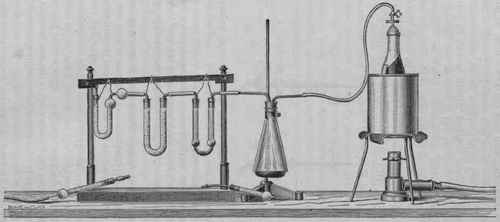
Fig. 14.
4450 - No. 13, pt. 3------3
In the case of large bottles it may be found necessary to add a second soda lime tube, and it is best to use fresh soda lime for each determination. It was found necessary to modify the champagne taps, as the thread with which they are provided cuts the cork too much and allows the escape of the gas. Accordingly this thread was turned off entirely, leaving a smooth tube, as shown in the figure.
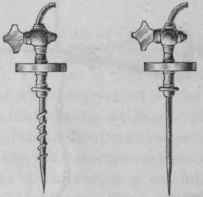
Fig. 15.
This can be forced through the cork with little difficulty, and allows no leakage of gas. It was also found necessary to have the cocks reground to make them fit accurately.
The patent rubber-stopper beer bottles presented a difficulty to this method of analysis, as it was impossible to make a gas-tight connection with them without the escape of the confined gas. In these the gas was estimated by loss of weight, calcium chloride and sulphuric acid tubes and connections being weighed with the bottle on a large balance, the bottle opened and connection made as quickly as possible, the gas driven off as before, and the loss ascertained by weighing the entire apparatus again. It is necessary to raise the heat very gradually to prevent the filling up of the tubes with the beer carried over by the bubbles. There is a slight error from the watery vapor which escapes with the pressure of gas when the bottle is opened, and altogether the determination is not so satisfactory as with the cork stoppered bottles.
The percentage of CO2 in the keg beers was not determined. For convenience of inspection the results of the determinations made are given again below:
Number. | Percent. CO2. |
4800 | .411 |
4001 | .300 |
4802 | .489 |
4803 | .415 |
4804 | .328 |
4805 | .471 |
480G | .717 |
4807 | .219 |
4808 | .324 |
Number. | Per cent. CO2. |
4817 | .629 |
4818 | .344 |
4820 | .503 |
4821 | .397 |
4827 | .441 |
4828 | .592 |
4843 | .242 |
4845 | .265 |
Nos. 4801-4803 and 4806 had rubber stoppers, the rest cork. No. 4068 was evidently in a state of after-fermentation, cloudy, and acid; excluding that analysis, the 16 others gave an average of .398 per cent. Most authorities give an average of .1 to .2 per cent. in beer. In Nos. 4801 and 4804 duplicate analysis were with different bottles of the same lot, with the following results:
1. | 2. | |
No. 4801.......................,...... | .294 .329 | .307 .327 |
No. 4804.............................. | ||
Continue to:


My Books

