


Choosing Hat's Trimming
Description
This section is from the book "A Manual Of Home-Making", by Martha Van Rensselaer. Also available from Amazon: A Manual of Home-Making.
Choosing Hat's Trimming
The foregoing discussion of the principles of design applies also to the trimming of hats. The following suggestions apply to that considered in relation to the entire costume and the wearer, not as an isolated article of clothing.
The function of trimming, in addition to its decorative value, is to effect slight changes that may add to the becomingness of hats. Trimming should aid in. emphasizing the good points of the face and hair of the wearer and should mitigate any-unfortunate elements. By the addition of a bow, a feather, or other ornament, the lines of a hat may be changed and adapted to the wearer.
Trimming should be so placed that it gives the impression of being rightly distributed. Color must be reckoned with when balance is being considered: a small bit of intense color may balance a larger mass of a more subdued color. The prevailing fashion may present difficulties, but no fashion should undermine good judgment.
There should be one general direction of line and a center of interest to which all trimming should appear to converge or to be subordinate (Fig. 113). Cross lines in trimming should be avoided. More than one point of interest, unless these points are perfectly balanced, produces a confused appearance and causes the eye to jump from one spot to another. The center of interest in the trimming should not be so conspicuous in color or size as to detract from the face, which after all is the picture for which the hat serves as the frame.
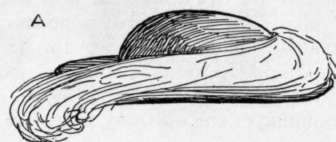
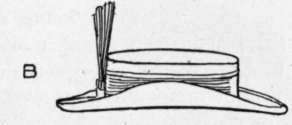
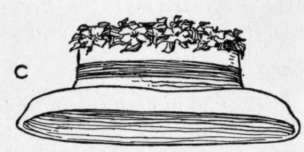
Fig. 113. - The decoration should strengthen the structural lines of the hat. There should be but one center of interest and all decoration should appear to converge to that point (A and B). Some contrast in line is always interesting (B). The proportion of space covered by the decoration should have an interesting relation to the uncovered surface (B and C).
If the hat is too heavily trimmed in the back, there is a tendency to bend the head and shoulders forward in an effort to balance the trimming. If it is too heavily trimmed in front, it gives the undesirable appearance of pitching forward, or creates a tendency to place the hat too far back on the head. This is likely to make the most graceful line unbecoming and disturbs the balance of the figure. Hats with the bulk of the trimming at one side may appear to be burdensome.
Continue to:


My Books

