


Chapter XVI. Millinery. How To Select A Hat
Description
This section is from the book "A Manual Of Home-Making", by Martha Van Rensselaer. Also available from Amazon: A Manual of Home-Making.
Chapter XVI. Millinery. How To Select A Hat
By Beulah Blackmore
Hats should be analyzed, and the peculiar defects of every unsatisfactory hat should be exactly noted. In this way a group of principles may be mastered, which should be followed regardless of the season's vagaries in shape and trimming.
How To Select A Hat
No definite statement can be made as to what should or should not be worn. In selecting a hat, the arrangement of the hair, the shape of the face and its coloring, the relation of the hat to the head and of the head to the whole figure must be considered.
Proportion And Balance
Of first consideration in the study of hats is the relation both of the hat to the head and of the head, including the hat, to the entire figure. Since the figure may be seen from all sides, the hat should look well, not only from the direct front view, but from every possible point of view. In general, the crown and the brim should be in good proportion to each other, and the hat should be in proportion to the head and to the whole figure.
To make broad shoulders appear less broad, the crown of the hat should be fairly high, while the brim should be fairly wide in order to balance the hips. This is but a single example of the relation of the hat to the figure. A hat that is too large gives a top-heavy appearance and thus disturbs the proportions of the human figure. A sufficient sense of balance is inherent in the average person to guide her judgment in selecting a hat, if she studies in a long mirror its relation to her full-length figure.
Small hats, such as toques and turbans, should be carefully-related to the head, and therefore, set securely and squarely on the head. Nothing has a more misfit appearance than a toque so large that is seems to be burdensome, or so small that it seems to be insecurely perched on the head. The toque generally should not be worn by a person with a large face or with high color, because it tends to emphasize both feature and color. It is designed for a person of delicate features and moderately pallid complexion. The hair should show slightly around the face.
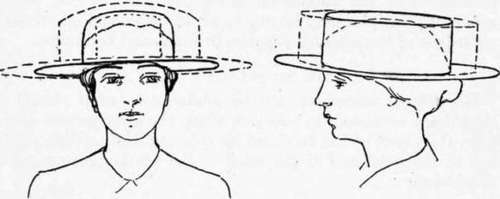
Fig. 107. - Correct size of a crown, shown by the heavy line.
A hat with a brim sets the face somewhat in the shadow and retires any unduly prominent features. If it is desired to lessen the prominence of a single feature, an interesting color or line of construction may be so arranged as to divide the attention called to the feature. As an example, for a face with a prominent nose, trimming that tends to lengthen the line from the nose to the back of the hat should be avoided. Instead, the interesting spot on the hat should be placed at the front or the side front in order to break the line and divide the center of interest.
The test for the correct size of the crown is that it shall be neither less than the width of the face, nor greater than the contour of the hair (Fig. 107). If the hair is puffed considerably at the sides, an elongated crown placed crosswise on the hat may be used.
The crown should not be set so low on the head that the eyebrows, which give the dark contrast to the face, are covered. The hat should be large enough and low enough, to give the appearance of being firmly placed on the head, not perched on the hair (Figs. 108, 109). The crown should be placed squarely on the head; if a tilted effect is desired, it may be accomplished by tilting the brim only (Fig. 110).
In general, the front line of the crown should continue the line of the forehead (Figs. 107-109). At the back, the line should not extend beyond the hair. If the hair extends far beyond the head, the back line of the crown should fall between the contour of the hair and the head. In no case should the back line of the crown fall inside the line of the head. The tarn o'shanter crown should bear at its base the same relation to the head as should any other crown.
A turban should be placed well on the head, not allowed to hang off at the back (Fig. III), and thus destroy the balance of the whole figure.
Brims are intended as a protection for the eyes, but they are usually extended at the sides and the back for balance. The brim of a hat should not under any circumstances extend beyond the shoulders. A brim may be tilted in any becoming way if the balance of the hat is not destroyed or if the balance is restored by the use of trimming. A brim should not be so drooping that the eyebrows are covered, or so upturned that a becoming shadow for the face is lost.
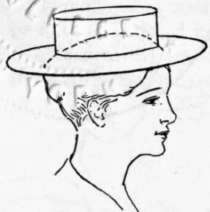
Fig. 108. - Incorrect size of crown. The crown should be sufficiently large to be set well down on the head; otherwise, the hat may appear to be insecurely placed as here shown.

Fig. 109. - Correct placing of a hat, shown by the heavy line.
Hats of straw and other light-weight textures may be larger than those of velvet and other heavy materials. A hat that is light in color always has the effect of being larger than a dark one of the same size. If a dark hat is desired and dark colors are unbecoming, the hat may be faced with a light color.
Continue to:


My Books

