


Chapter VIII. The Nursery
Description
This section is from the book "The New Cyclopaedia of Domestic Economy, and Practical Housekeeper", by Elizabeth Fries Ellet. Also available from Amazon: The New Cyclopaedia of Domestic Economy, and Practical Housekeeper.
Chapter VIII. The Nursery
Among the many duties a woman is called upon to fulfil, surely none can be deemed of such paramount importance as those she owes to her children. Now it is by no means our intention to write a chapter of "advice to mothers," or enter upon the subject of the education and general management of little people; all we have to do with the matter here is to notice it as forming a branch of our subject; for the nursery is an important part of a house, and upon its good management much of the comfort, as well as the health and well-being of every member of the family, will depend.
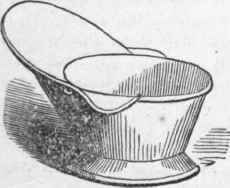
Sitz Bath.
If ever a woman has need of thought, care, and patience, it is when she becomes a mother. Who can look upon that most helpless of all created beings - a new-born infant - and not feel pity for it, interest in it; and surely no mother can bestow her first kiss on the little unconscious innocent without feeling some sense of the responsibilities which now rest upon her - for it is not only a human being, but an immortal soul which is committed to her charge.
Wherever such an arrangement can be made, a good-sized airy room should be set apart for the nursery, and always kept scrupulously clean, well ventilated, and of an even wholesome temperature. Warmth is highly necessary to the health of infants and young children - but not the warmth of a close, over-heated room, for that oppresses their lungs, and makes them delicate and very susceptible of cold. Let the child be comfortably clad, and a natural temperature of body thus maintained. The health of very many infants is impaired by the foolish custom of exposing their little chests and arms by finely-worked low bodies and very short sleeves, tied up so as effectually to prevent their being of any use in the way of covering. Very young children have so little natural heat, that they absolutely require that the temperature of their bodies should be kept up, by means of clothing, to a proper standard.
The furniture of the nursery ought to be very simple, and to consist of no more things than are absolutely necessary. The "bassinet," a wicker basket stuffed very soft and lined within, two and a-half or three feet longr and one and a-half wide, has been used in England for very young infants, and may be carried about. Cradles and swinging cots are condemned by medical men, and are now less used than cribs. Children's chairs of various sizes, a washstand, shower bath, a child's bath, or a large earthernware basin fixed in a stand of wood, various vessels of earthenware, a nursery lamp for warming liquids when there is no fire, sponges and linen baskets - comprise the requisite articles of furniture. A wire guard for the fire, and bars for the windows should never be omitted.

French Folding Fender.
Next to warmth, in the category of matters indispensable to health is cleanliness. Morning and night, an infant or a child under three years of age, should be bathed in tepid water in winter, and cold water in summer. This operation should be performed both thoroughly and quickly, and then the whole body wiped quite dry with a soft towel, and the limbs and back gently rubbed with the hand. The skin of an infant is so delicate that a little dirt, a slight accumulation of powder, any dampness, any rough handling or friction with a coarse cloth, will break or crack it, and often produce a humor which is not easily got rid of. The clothes of an infant, and especially those in immediate contact with its body, should be soft and clean. Its bed-clothes must likewise be kept well aired, and free from damp and unpleasant smells. Very young children should be kept, as much as possible, in a recumbent posture; the less a child is allowed to sit upright for the first six months, the stronger will be its back afterwards. Too strong a light is prejudicial to young children; neither within nor out of door3 should their eyes be exposed to anything like glare; they ought likewise to be shielded from high winds. Sleep is a great strengthener of children, when it is natural, and care should be taken that they lie comfortably as regards position, are warm, and sheltered from all draughts and from light, though allowed sufficient air. In all things endeavor to establish regular habits from the very first; regular hours for feeding, sleeping, dressing, and undressing, should be observed. Few people can form an idea how much their own comfort and the child's well-being will be promoted by this. Of course, every now and then illness, or some unforeseen event, will interfere with this system, but it must be resumed again as soon as possible. We are aware that many people will deem this regularity unnecessary, but from the cradle to the grave, we are all more or less the creatures of habit; and from the time a child first begins to notice anything, its habits may be said to commence.
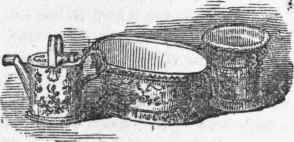
Can, Bath and Pail.

Infants' Bath.
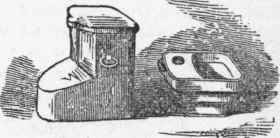
Leg Bath.
Foot Bath.
When a child is fed, it should be from a proper bottle, and with light, thin food, not given too hot or in large quantities. Farinaceous substances of various kinds are best adapted for children of tender age. For the first twelvemonth these may be given in a fluid, and semi-fluid state, and afterwards in the shape of puddings either baked or boiled. Many children will not take meat, and they do not appear to thrive less than others; nature at this early age is generally the best pilot, and we shall seldom err if we follow her lead.
The period of teething is always one of anxiety, and requires additional care and watchfulness; but plenty of fresh air, good and sufficient, but not over-feeding, and an occasional warm bath or gentle aperient when there appears to be tendency to fever, will in most cases ward off serious evils. The less physic a child takes the better in a general way - not that we would advise mothers ever to slight any actual premonitory symptoms of illness; infantile diseases being frequently very rapid in their course.
Continue to:


My Books

