


Hints And Maxims. Continued
Description
This section is from the book "The New Cyclopaedia of Domestic Economy, and Practical Housekeeper", by Elizabeth Fries Ellet. Also available from Amazon: The New Cyclopaedia of Domestic Economy, and Practical Housekeeper.
Hints And Maxims. Continued
Buffaloes' tongues should soak a day and a night, and boil six hours.
Molasses used in cooking should be first boiled and skimmed. One or two gallons may be thus prepared at a time. It is a prodigious improvement.
Always have a heavy stone on the top of your pork in pickle. You may keep a bit of fresh meat on this stone, in summer, when you fear it may spoil.
Have plenty of towels in the kitchen, or Biddy will use your white napkins.
Soap dirty clothes, and soak them in water over night. Use hard soap for clothes, and soft for washing floors.
Cut lemon and orange peel, when fresh, into a bottle kept full of brandy. This brandy gives a delicious flavor to pies, cakes, etc. Roseleaves may be preserved in brandy. Peach leaves steeped in it make* an excellent seasoning for custards and puddings.
Grate horseradish when the root is in perfection, put it in bottles, fill it with strong vinegar, and keep it corked tight, for winter use.
Keep a bag for odd pieces of tape and strings, and a bag or box for old buttons.
A little salt sprinkled in starch, while boiling, prevents its sticking: it is also good to stir it with a clean sperm candle.
To separate wax from honeycomb, tie up the comb in a linen or woollen bag; place it in a kettle of cold water, and hang it over the fire. The wax melts and rises to the surface, while all the impurities remain in the bag. A few pebbles in the bag will prevent its floating.
Honey may be separated from the comb by placing it in the hot sun .or before the fire, with two or three colanders or sieves under it - each finer than the other.
Potatoes boiled and mashed hot, are good in shortcakes and puddings; they save flour and shortening.
To corn meat simply - rub in plenty of salt, and set it in the cellar for a day or two. In summer it is good to corn meat, which will not keep more than a day and a half. If you want to keep it longer, rub in more salt, and secure it from the flies. A little saltpetre rubbed in before you apply the common salt, makes the meat tender; but it is not best to use it in summer.
Legs of mutton are good, aired in the same way as hams - six pounds salt, eight ounces saltpetre, five pints molasses, will make pickle enough for one hundred pounds. Small legs should be kept in pickle twelve or fifteen days; large, four or five weeks; and they should be hung up a day or two before being smoked. Lay them in the oven on crossed sticks, and make a fire at the entrance with cobs or walnut bark, or chips, which impart a sweet taste. Smoke the smallest pieces forty-eight hours; the large legs four or five days. If hung till thoroughly dry, the mutton may be eaten in thin slices, like hung beef When legs of meat are put in pickle, the thickest part should be uppermost, as the creature stood while living; also when hung to dry; thus the juices of the meat are kept in. Meat should be turned over once or twice while smoking.
Hams should be well covered in paper bags, and put in a chest or barrel, with layers of charcoal or ashes between. When you take one out to cut for use put it away in a dark place, well covered.
Let there be a place for every article, and when not in use let every article be in its place.
Keep every utensil ready for immediate use.
The stock pot should never be suffered to be empty, as almost any meats (save salt meats) or fowls make stock; the remnants should never be thrown anywhere but into the stock pot, and should too much stock be already in your possession, boil it down to a glaze: waste is thus avoided.
Keep your meat in a cool, dry place; your fish on ice. and your vegetables on a stone floor free from air.
Cut your soap when it comes in, and let it dry slowly.
Keep your sweet herbs in paper bags, each bag containing only one description of herb. They should be dried in the wind and not in the sun, and when ordered in a receipt should be cautiously used, as a preponderance in any seasoning spoils it.
When oranges or lemons are used for juice, chop down the peel, put them in small pots and tie them down for use.
Apples
In choosing apples, be guided by the weight; the heaviest are the best, and those should always be selected which, on being pressed by the thumb, yield with a slight crackling noise. Prefer large apples to small, for waste is saved in peeling and coring.
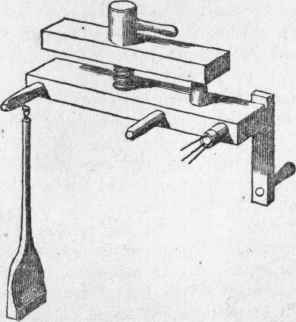
Apple Peeler.
Apples should be kept on dry straw in a dry place, and pears hung up by the stalk.
Batter For Fish, Meat, Fritters, Etc
Prepare it with fine flour, salt, a little oil, beer, vinegar, or white wine, and the whites of eggs beaten up; when of a proper thickness, about the size of a nutmeg, it will drop out of the spoon at once. Fry in oil or hog's lard.
Carrots, if young, need only be wiped when boiled - if old, they must be scraped before boiling. Slice them into a dish, and pour over them melted butter.
Cauliflowers
Cut off the stalks, but leave a little of the green on; boil in spring water with a little salt in it: they must not boil too fast.
Celery
Very little is sufficient for soups, as the flavor is very predominating. It should be particularly cleanly washed and curled when sent to table. To curl celery, wash well, and take off the outside stalks, cut it to a proper length, split each stalk into three or four divisions with a large needle, then place the head of celery in spring water with the root uppermust, and let it remain for four or five hours - it may then be tastefully arranged on the dish.
Game may often be made fit for eating when it seems spoiled, by cleaning it and washing with vinegar and water. Birds that are not likely to keep, should be drawn, cropped, and picked, then washed in two or three waters, and rubbed with salt; have in readiness a large saucepan of boiling water, and plunge them into it one by one, drawing them up and down by the legs, so that the water may pass through them. Let them stay for five or six minutes, then hang them up in a cold place; when they are completely drained, well salt and pepper the insides, and thoroughly wash them before roasting.
Gravies -The skirts of beef and the kidney will make quite as good gravy as any other meat, if prepared in the same manner. The kidney of an ox. or the milt, makes excellent gravy, cut to pieces and prepared as other meat, and so with the shank end of mutton that has been dressed, if much gravy is not required. The shank bones of mutton add greatly to the richness of gravies, but they should be first well soaked and scoured clean. The taste of gravies is improved by tarragon, but it should be sparingly used, immediately before serving.
Lard should be carefully melted in a jar put in a kettle of water and boiled, and run into bladders that have been strictly cleaned; the bladders should not be too large, as the lard will become rank if the air gets to it. While melting it, put in a sprig of rosemary.
Mustard mixed smooth with new milk, and a little cream added, will keep; it is very soft, and by no means bitter.
Sago should soak for an hour in water previous to using, to take off the earthy taste.
Suet may be kept for a twelvemonth, thus: choose the firmest and most free from skin or veins, remove all traces of these, put the suet in a saucepan at some distance from the fire, and let it melt gradually; when melted, pour it into a pan of cold spring water; when hard, wipe it dry, fold it in white paper, put it into a linen bag, and keep it in a dry, cool place; when used, it must be scrap ed, and will make an excellent crust, either with or without butter.
Tongue, which has been dried, should be soaked in water three or four hours. One that has not been dried will require but little soaking; put it in cold water, and boil gently till tender.
Raisin wine may be substituted for sherry, for sweets generally.
Copper vessels, when the tinning is worn off, must never be used, or the poisoning of those who partake of whatever may have been cooked in them is inevitable. They should be sent to be re-tinned immediately they require it.
Keep tapes and jelly bags clean, or when again used they will impart an unpleasant flavor.
All soups should be moderately thin and bright.
Meats, such as beef, mutton, and venison, must rather be underdone than overdone, excepting veal and pork, which require to be well done.
Fish should be quite done, but not overdone.
Pastry must be carefully baked; it should be sent to table a pale gold color.
Onions should be kept on ropes in a dry place - a specked one should be removed or it will contaminate the others.
Cold water cracks hot iron infallibly.
Pudding towels should be carefully washed, and kept clean in a dry place. Put a clean round towel on the roller quite as often as necessary.
Be very particular in not letting your stocks and sauces pass over two days without boiling them up, and be careful to stir the thick soups and sauces all the time they are on the fire, and change all your cold meats into fresh clean dishes every morning, wiping down the dressers and shelves, and if allowed larding cloths see that they are clean. Keep your larder door shut, free from dust and damp; do not have your baked paste in the larder, but in your kitchen cupboard, and then see to your game, wiping, and peppering and gingering your venison, arranging the game which requires to be dressed first, and see that all the blood which may have dropped from the game or venison is cleaned from the dressers and flooring. Then see to the vegetables, removing all stale and what is not wanted, giving it to the poor, either dressed in some way or uncooked; do not be overstocked, but always keep a little reserve. Be sure to look well, every morning to your pickled pork and hams, keep and rub them well, and turn them, marking those to be used first. Your fish must be looked to and well cleaned and washed, and if intended for that day's dinner, kept in water until required; if not, keep it on the marble or stones; your doors should always be shut.
Clean hands, always clean hands.
A dirty kitchen is a disgrace to every one connected with it.
With these few hints we wind up our remarks, merely adding that many of the receipts given, which are on too large a scale for a small family, may have their proportions equally reduced, and an excellent dish will be the result. In some instances also, the more expensive ingredients may be left out without destroying the integrity of the receipt, discretion and judgment being alone required in these cases.
In conclusion, the mistress of the household will understand that the well-being of her establishment depends upon her surveillance; and though her too frequent presence in the kitchen would be yet she should not be deterred from visiting it by any false delicacy, or deference to an absurd custom which makes it vulgar for a lady to visit her cook in her own domains. If the cook is thrifty and clean, she will be glad to receive the praise to which she is fairly entitled; if dirty and careless, it is very essential that the lady should be acquainted with the fact in order to remedy it by a change.

unnecessary and annoying to the cook.
Continue to:


My Books

