


Dinners
Description
This section is from the book "The New Cyclopaedia of Domestic Economy, and Practical Housekeeper", by Elizabeth Fries Ellet. Also available from Amazon: The New Cyclopaedia of Domestic Economy, and Practical Housekeeper.
Dinners
Dinners
The appearance a dinner-table presents does not depend so much upon a profuseness of viands, as upon the neatness, cleanliness, and well-studied arrangement of the whole. Taste, if well directed, may produce a handsome dinner; whereas three times the amount of money may be expended upon another, and yet not make even a respectable appearance.
We cannot too strongly urge the necessity of having things done in the same manner every day as when there is. company. The servants become accustomed to waiting properly, things are always at hand, and they do not appear awkward when visitors drop in; then every thing is regular, and goes on smoothly.
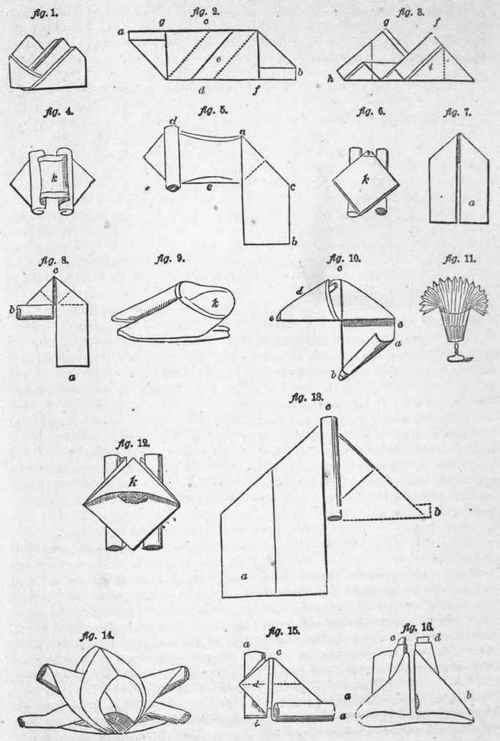

How To Lay The Cloth
The table should he well polished, and then covered with a cloth, over which a fine white damask one should be spread. If the white cloth is to be kept on after dinner, it is customary to spread a small cloth at either end of the table where the large dishes are placed, to protect the long cloth from accidental spots arising from gravy, etc.; these slips are removed after dinner, and the cloth cleaned with crumb-brushes. In some houses an entire upper cloth is placed upon the table instead of slips, and this being removed after dinner, does not require the tedious process of brushing the table-cloth.
When the cloth has been spread, place carafes, with the tumblers belonging to and placed over them, between every four persons, a salt-cellar between every third person, and a large and small knife, fork, and spoon, to each guest, with two wine-glasses, a champagne-glass, and a tumbler, to the right of each, and the bread placed in or under folded napkins between the knives, forks, and spoons; and at large entertainments or public dinners, the name of each guest neatly written on a card in front of the napkin, so as to prevent confusion. The centre ornament, usually a candelabrum, plateau, an epergne, or a vase of artificial flowers, must now be set on, and the mats for the various dishes arranged; then the wine-coolers or ornamental vases placed between the centre piece and the top and bottom dishes, with the wines in the original bottles, loosely corked; the spoons for helping the various dishes, asparagus tongs, fish knife and fork or slice, and carving knives and forks, are placed in front of the respective dishes to which they belong; and knife-rests opposite to those who have to carve; with a bill of fare, and a pile of soup-plates before those that have to help the soup.
In arranging or laying out a table. several things require particular attention, and especially the following:-
Plate should be well cleaned, and have a bright polish; few things look worse than to see a greasy-looking epergne and streaky spoons. Glass should be well rubbed with a wash-leather, dipped in a solution of fine whiting and stone-blue, and then dried; afterwards it should be polished with an old silk handkerchief. Plates and dishes should be hot, otherwise the guests will be disgusted by seeing flakes of fat floating about in the gravy. Bread should be cut in pieces about an inch thick, and each round of a loaf into six parts, or if for a dinner party, dinner rolls should be ordered. The bread is placed under the napkins, or on the left of each guest, if dinner napkins are not used; some of the bread being placed in a bread-tray covered with a crochet cloth upon the sideboard. Lights, either at or after the dinner, should be subdued, and above the guests, if possible, so as to be shed upon the table, without intercepting the view. Sauces, either bottle, sweet, or boat-vegetables, and sliced cucumber, or glazed onions for stubble goose, should be placed upon the sideboard; a plate basket for removing the soiled plates is usually-placed under the sideboard, or some other convenient part of the room; and two 7cnife-trays, covered with napkins, are placed upon a butler's tray; these are used for removing soiled carvers and forks, and the soiled silver. It is useful to have a large-sized brad-awl, a corkscrew, and funnel, with strainer; the former to break the wire of the champagne bottles, and the latter to strain port wine, if required to be opened during dinner.
How To Lay Out The Sideboard Or Tray
Little requires to be done, except to arrange the silver, knives, cruets, and various dishes to be placed there. The silver should be arranged on one end of the sideboard, as in Figs. 1 and 2, the gravy spoons being placed bowl to handle, and the cheese-scoop, marrow-spoon, and salad spoons or scissors, where most convenient. The knives are placed as in Fig. 3, for the convenience of removal, because by this means a single knife can be abstracted without disturbing the others;
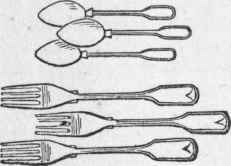
Figs. 1 & 2.
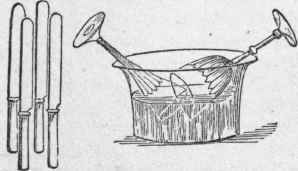
Figs. 3 & 4.
carving knives and forks should be placed above the others, point to handle. The wine-glasses, tumblers, and finger-glasses, for dessert, are placed where most convenient, but usually in the centre of the back, with ice-plates near to them, and the wine-glasses placed in the finger-glasses, as in Fig. 4; but when only one glass is used, that is placed in the centre, mouth downwards. At very large or fashionable dinners, the finger-glasses are sometimes placed on the dinner-table with the plain and colored wine-glasses in them, and the same, refilled, are placed on again at dessert. The cruets, sauces, etc, are placed at one end, and the vegetables, etc, in the centre front of the sideboard.
How To Place The Dishes On The Table
Each servant should be provided, at large din-ders, with a bill of fare, and instructed at small ones, where the dishes are to be placed. No two dishes resembling each other should be near the same part of the table. Soups or broth should always be placed at the head of the table; if there are two, top and bottom; if four, top, bottom, and two sides, opposite each other, or alternately with fish. Fish should be placed at the head of the table; if there are two sorts, have fried at the bottom and boiled at the top; if four, arrange the same as the soup. We may observe, that a white and a brown, or a mild and a high-seasoned soup, should occupy either side of the centre piece, and that it looks handsomer to have fried and boiled fish opposite each other, but they should never be placed upon the same dish. Fish is generally served upon a napkin, the corners of which are either turned in or thrown over the fish, or upon a piece of simple netting, which is turned in all round; but we recommend our readers to use the elegant serviette, as being more stylish.
Continue to:


My Books

