


Dinners. Part 3
Description
This section is from the book "The New Cyclopaedia of Domestic Economy, and Practical Housekeeper", by Elizabeth Fries Ellet. Also available from Amazon: The New Cyclopaedia of Domestic Economy, and Practical Housekeeper.
Dinners. Part 3
Liqueurs are handed round when sweets are on the table. Sauces are handed round in the sauce-boat, and when served placed on the side-board or dinner returned to the table. Sweet sauces are handed round in glass dishes, and bottle sauces in a stand or basket made for that purpose.
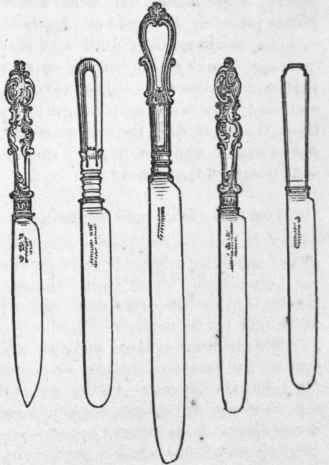
wagon; if only a family party, they are.
In removing the dinner things, one servant goes round the table with a butler's tray, and the other removes and places the things upon it. The cloth is then brushed with a crumb-brush; or the two sides are turned in, and then the cloth dexterously jerked off the table, the lights replaced, and the dessert set on.
"When knives, forks, and spoons are removed from dishes or plates, they should be placed in proper trays covered with napkins; one being used for the silver, the other for the steel articles.
When plates or dishes are removed from the table, great care is to be observed with respect to holding them horizontally, otherwise the gravy, syrup, or liquid, may injure the dresses of the guests.
In some circles, the fashion prevails of placing finger-glasses on table immediately preceding dessert; but in others, cut-glass bowls, partially filled with rose or orange flower water, iced in summer and lukewarm in winter, are handed down each side of the table, upon salvers; into these the guest dips the corner of the dinner napkin, and just touches the lips and the tips of the fingers.
Desserts, Teas, and Suppers.
The Dessert
The dessert may consist of merely two dishes of fruit for the top and bottom; dried fruits, biscuits, filberts, etc, for the sides and corners; and a cake for the centre.
When the party is large, and ices are served, the ice-plates are placed round the table, the ice-pails at both ends of the table, and dishes with wafer-biscuits, at the sides. Some persons have the ices served in glass dishes, which, together with the wafer biscuits, are handed round be1 fore the usual dessert.
When there is preserved ginger, it follows the ices, as it serves to stimulate the palate, so that the delicious coolness of the wines may be better appreciated.
The side and corner dishes usually put on for dessert, consist of:- Competes in glass dishes; frosted fruit served on lace-paper, in small glass dishes; preserved and dried fruits, in glass dishes; biscuits, plain and fancy; fresh fruit, served in dishes surrounded with leaves or moss; olives, wafer biscuits, brandy-scrolls, etc.
The centre dish may consist either of a savoy or an ornamental cake, on an elevated stand - a group of waxen fruit, surrounded with moss - a melon - a pine apple - grapes - or a vase of flowers.
Each plate should contain a knife, fork, and spoon, with two wine-glasses, arranged upon a d'oyley, as in Fig. 5. These are to be placed before each guest, and a finger-glass, with cold water in summer, andluke-warm water in winter, on the right of each plate; with grape-scissors, and melon knife and fork, before their respective dishes. Glass bowls containing sifted sugar, with pierced ladles, or others filled with cream, are to be placed near the centre dish, if they are required. A cut glass pitcher with a tumbler on either side should be placed in a convenient part of the centre of the table.
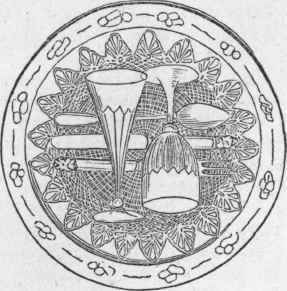
Fig. 5.
The wine, either cooled or not, should be placed at both ends of the table, or at the bottom, if only a small party, the decanters being placed in castors, though this fashion is now nearly abolished.
Zests are put down after the dessert is removed, and consist chiefly of anchovy toasts, devilled poultry and game, and biscuits, gravy toast, grills, etc.
Coffee is the last thing served, and is generally handed round upon a salver; after this, the gentlemen withdraw to the drawing-room.
Tea
After a dinner party, the tea is generally handed round by two servants, the one having tea and coffee, with hot milk, cream, and sugar upon one tray; the other having thinly cut and rolled bread and butter, biscuits and cake, upon another tray. .
If served at an evening party or dance, a servant helps the guests to tea or coffee, which is arranged upon a side-table in a small room. The tea and coffee occupy the two ends of the table, on either side of the urn, which is placed in the centre and back. In front of the urn are ranged the sugar-candy for coffee, sugar, hot milk, cream, bread and butter, cake, and biscuits.
Tea, when only for a small party, may be brought in upon a tray, the tea and coffee-pots occupying the centre of the tray; the cups and saucers the front; and the hot milk, cream, slop-basin, and sugar, the ends. The urn is placed at the back of the tray; and the bread and butter, cut or not, with cake, biscuits, muffins, crumpets, or toast, at the sides.
Suppers
The great secret of laying out a supper consists in arranging the china, glass, silver, linen, lights, confectionery, substantials, trifles, flowers, and other articles, with a due regard to form, color, size, and material.
A supper table should neither be too much crowded, nor too scanty, nor scattered and broken up with small dishes. Two dishes of the same description should not be placed near each other: dishes should not be heaped up as if for a ploughman's repast, but contain sufficient to make them look well, without being over or under-done as regards quantity.
Hot suppers are now seldom served; for people dine later than they did formerly; and besides being more expensive than cold ones, they also give more trouble.
The centre of the table is generally occupied by an epergne, vase of flowers, globe of fish upon an elevated stand, a plateau, or small fountain; around which are arranged:- Dried, preserved, frosted, or candied fruits; custards, jellies, and trifles, in glasses; and small biscuits. The top and bottom of the table are furnished with game, fowls, or meat; the sides have dishes of ham sliced; tongue; collared, potted, hung, and grated beef; brawn, mock or real; savory pies; lobsters; oysters; dressed crab or cray-fish; prawn pyramids; sandwiches of ham, beef, tongue, anchovy, or other savory morsels; tarts, tartlets; cake, biscuits; whipped and other creams; jellies, blancmange; caramel baskets; patties, etc.
Continue to:


My Books

