


Food And Cookery For Children
Description
This section is from the book "The New Cyclopaedia of Domestic Economy, and Practical Housekeeper", by Elizabeth Fries Ellet. Also available from Amazon: The New Cyclopaedia of Domestic Economy, and Practical Housekeeper.
Food And Cookery For Children
The kinds of food to be given to very young children should be of the simplest description: besides cow's milk, diluted with one-third part of water, arrow-root and milk; pearl sago boiled in water till perfectly soft, and thinned with new milk; rusks; biscuit powder; four previously boiled like a pudding in a basin till it is formed into a hard ball, from which portions can be grated into milk, and boiled in it till it thickens the milk, are the chief ingredients used as food for infants.
Rice, barley, and farina gruels, are also used with advantage; and as a change in the diet of children is advisable when they are occasionally indisposed, these kinds of gruel may be found useful varieties in the food of children.
Food which contains milk should never be warmed over and over again, as is sometimes done; nor should it be suffered to remain, when cold, in metal utensils; if intended for future use, it should be put into earthen-ware basins, and set in a cold place; but no food thus set by for another day should have milk put into it.
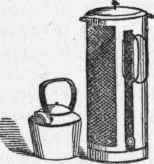
Nurse Lamp, with Tea Kettle to keep children's food warm.
The nutriment of children, after the completion of their first year and a half, it will be necessary to increase in solidity, and, if their appetite seems to demand it, in quantity also. Their teeth begin now to aid them in masticating food, their limbs become firmer, and carry their bodily exertions often to a great extent; the degree of exercise which healthy children voluntarily give themselves, stimulates the digestive organs, enabling them to receive and act upon more solid nutriment. Having previously had animal food three or four times a week, children may, in the second year of their lives, safely eat it once children's food.
every day - meats being chosen for them that are tender and nutritious. Boast beef; mutton, either boiled, roasted, or broiled; chickens, some kinds of fish, well-boiled vegetables, such as brocoli, turnips, potatoes (the latter are best for them when mashed with hot milk and a little salt); simple compounds of egg and milk; fruits, baked or boiled; bread well made and baked, with small portions of butter; these, with milk for breakfast and supper, with water as beverage, are the chief articles of wholesome food for children as long as they continue under nursery management.
The species of food we would not give them consists of salted meats (beef, pork, or bacon); of rich stews, ragouts, and soups; of fried fish, of pastry and confectionery generally; of cheese; and of beverages, tea, coffee, beer, and wine. Of the two last mentioned, beer and wine, we may remark that, in cases of delicate health, they may be advantageously allowed; but they should always be given under medical direction, for the stimulus of fermented or spirituous liquors is not in every case of debility beneficial; sometimes the reverse; neither ought children to be allowed to drink much at a time of any liquid, however mild and innocent it may be. Too much liquid has a tendency to create flatulency, and to distend the bowels. It has been said that parents accustoming their children to drink water only, bestow a fortune upon them of the value of which they will be sensi-ble all the days of their life.
Children's meat should be minced as small as possible. If too much trouble is left to their feeble power of masticating, they will shun it by swallowing their food unmasticated. For children whose digestion is weak, it may even be desirable to have their meat pounded.
French Pap
Put a table-spoonful of flour into a pap saucepan, to which add by degrees two gills of milk, mixing it into a very smooth batter with a wooden spoon; place the saucepan upon the fire, let it boil ten minutes, keeping it stirred the whole time, or it is liable to burn or become brown; then add about half an ounce of sugar and a little salt, put it into a basin, and it is ready for use. A little butter is also very good in it. It may be made with dry rusk or cracker, scalded merely in water, and beaten to a pulp with a little sugar.
Infant's Food
Take a pound of the best flour, tie it very tightly in a strong cloth, and put it into a pan of boiling water (in which put a plate to prevent the cloth sticking to the bottom of the pan). Boil it for three hours without allowing it to go off the boil - when coldish untie the cloth, and scrape off the outside of the ball: when to be used, grate down the quantity required and break it with cold water; boil four or five minutes only, and sweeten to the taste. Flour prepared in this way is confidently recommended by an experienced sick nurse as a soft and nutritious food for the youngest infant, and will keep for a month or more in its hard compact state. Milk may be added when about to be eaten, if .wished.
Semoulina
Semoulina is very delicate and glutinous; it is good in any kind of broth or milk for invalids or children, of easy digestion, and having also the advantage of being tolerably cheap and quickly cooked.
Arrowroot
When broth is boiling, put two teaspoonfuls of arrowroot into a cup, which mix smoothly with a gill of cold broth, or half ditto of water; then pour it into your boiling broth, which keep stirring with a spoon; let it simmer ten minutes, and it is ready for use.
Calces For Children
Sugar and egg, browned before the fire, or dropped as fritters into a hot frying-pan, without fat, will make them a nourishing delicacy.
Rice Pudding With Fruit
In a pint of new milk put two large spoonfuls of rice well washed; then add two apples, pared and quartered, or a few currants or raisins. Simmer slowly till the rice is very soft, then add one egg, beaten, to bind it. Serve with cream and sugar.
Continue to:


My Books

