


Chapter XI. Domestic Manipulation
Description
This section is from the book "The New Cyclopaedia of Domestic Economy, and Practical Housekeeper", by Elizabeth Fries Ellet. Also available from Amazon: The New Cyclopaedia of Domestic Economy, and Practical Housekeeper.
Chapter XI. Domestic Manipulation
Under the head of Domestic Manipulation, we propose giving a series of articles on the numerous and essential manual operations that are constantly required in every family, and which, whether they are well or ill done, must of necessity be performed. The term Domestic Manipulation, employed in the widest sense, would include all the manual operations required in a house, but we propose to limit it to such as partake in a slight degree of a scientific character; thus the operations of Filtering, Decanting, Weighing. Measuring, Bottling, Corking, Unstoppering, Pounding, Heating, Boiling, Distilling. Cementing, etc etc will be included; whilst Dusting. Washing, and Scrubbing, though no less in strictness, manipulations, will be passed over in silence.
We propose treating of the manipulations connected with Bottles and Decanters, etc, under the following heads: Cleaning, Drying, Corking. Tying down, Stoppering, and Unstoppering.
Cleaning
Perhaps no more effectual and easy mode of cleaning wine and beer bottles can be recommended than that commonly adopted, viz., the use of small shot and water; in the case of old port wine bottles, however, it often occurs that the mechanical action of the shot does not remove the hardened crust from the interior; a small quantity of pearl-ash or soda, or still better, washing liquids, added to the water, will soften the crust sufficiently to permit its easy removal. There is, however, one objection to the use of shot for the purpose of cleaning bottles; unless due care be taken, by the violence of the shaking it often happens that several become firmly wedged between the bottom and sides of the bottles, and are not removed by the subsequent rinsings of clean water, and if the bottles are used for acid wines or other liquids, (almost all home-made wines contain a considerable portion of free acid,) the shots are slowly dissolved; and from the metallic arsenic which they contain, as well as from the lead itself, the liquid is rendered poisonous. This effect may be readily guarded against by removing any shots which may have become fixed, by a stiff wire slightly hooked at the end.
Decanters are formed of flint glass, which is much softer and more readily scratched than the common kinds; they require therefore a less rough treatment; in general, warm (not boiling) water, with the addition of a few pieces of coarse brown paper, and if requisite a little soda, will be found effectual; should greater force be required, a small portion of tow wrapped round the notched end of a moderately stiff wire, and used with a little strong soda, will be found sufficient. Sand or ashes should never be employed in cleaning decanters, as they roughen and totally disfigure the brilliant surface of the glass.
Drying
It is scarcely necessary to speak of the advantages of being able to dry thoroughly both decanters and common bottles; if the former, after having been cleaned, are put away wet, they become musty; and many liquids are much injured by being put into wet bottles. Some of our readers have doubtless experienced the inefficiency of the ordinary means of drying decanters, etc.; after draining for some days they still remain damp, and if placed near a fire the warmth merely drives the vapor to the colder part of the vessel; they may, however, be readily and quickly dried after draining, by making them slightly warm and blowing in fresh air with a pair of bellows, which rapidly carries out the damp vapor, and leaves the vessel perfectly dry. If bellows are not at hand, the damp air may be drawn out (not blown) with the mouth, assisted by a tube sufficiently long to reach nearly to the bottom of the decanter; in the laboratory a piece of glass tube is usually taken, being always at hand, but for domestic use a piece of paper may be rolled up so as to form an extemporaneous and effectual substitute.
Corking
Little can be said with regard to the corking of bottles, beyond stating the fact that cheap bad corks are always dear; the best corks are soft, velvety, and free from large pores; if squeezed they become more elastic and fit more closely. If good corks are used of sufficiently large size to be extracted without the corkscrew, they may be employed many times in succession, especially if they are soaked in boiling water afterwards, which restores them to their original shape, and renews their elasticity.
Tying Down
The operation of tying down corks merits a longer notice, as without it many effervescent liquids could not he preserved. The most common mode of fastening down corks, is with the ginger-beer knot, which is thus made: First the loop is formed as in Fig. 1, then that part of the string which passes across the loop is placed on the top of the cork, and the loop itself passed down around the neck of the bottle, and by pulling the ends of the cord is made tight beneath the rim; the ends of the string are finally brought up, and tied either in a double knot, or in a bow on the top of the cork. When ginger-beer is made at home, it will be found most advantageous to use the best corks, and to tie them down with a bow, when both corks and strings may be made use of repeatedly.

Fig. 1.
For effervescent wines, such as champagne, gooseberry, etc, which require to be kept a longer time, and are more valuable, a securer knot is desirable, which may be made thus:- A loop as in Fig.
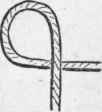
Fig. 2.

Fig. 3.
2 is first formed, and the lower end is then turned upwards and carried behind the loop as shown at Fig. 3; it is then pulled through the loop as in Fig. 4, and in this state is put over the neck of the bottle; the part a being on one side, and the two parts of the loop on the other •

Fig. 4.
on pulling the two ends the whole becomes tight round the neck, and the ends, which should be quite opposite, are to be brought up over the cork, twice twisted, as in Fig. 5, and then tied in a single knot.

Fig. 5.
Stoppering
The stoppering of bottles is an operation usually performed by the makers; it may, however, be useful to know that badly fitting stoppers may be readily fitted by regrinding; this is done by dipping the stopper in a mixture of fine sand, or still better, emery and water, replacing it, and turning it backwards and forwards with a slight pressure; fresh sand must be applied from time to time. When the fitting is exact, so that the stopper turns freely without shaking, the whole may be finished off by using a little fine emery and oil.
Unstoppering
This operation is much more likely to be required than the last one described, for the stoppers of decanters, smelling-bottles, etc, from various causes, frequently become fixed, and many are the fractures both of bottles and stoppers, caused by the misdirected efforts to remove them. In treating of the various means that may be employed we will mention them in the order in which they should be tried, beginning with the simpler and more easy, and passing on to those which are more effectual, and at the same time, unfortunately, more dangerous. The first method, then, that should be tried, is to press the stopper upwards with the fore-finger and thumb of the left hand (the other fingers holding the neck of the bottle), and at the same time giving the stopper a succession of short, sharp, light taps, with the wooden handle of a chisel, knife, or small hammer; care must be taken not to strike the stopper with sufficient force to break it and it should be borne in mind that it is not the force of the blow, but the vibration, or jar, which is effectual in loosening it; should this plan be found ineffectual after a short trial, it may probably be from the stopper being cemented by some substance, such as the dried sugar of a sweet wine. In such" cases we should endeavor to dissolve the cement by a suitable solvent, which should be placed in the groove between the stopper and the bottle; thus if the stopper is cemented with sugar, gum, or salt, water may be used; in many circumstances, oil is advantageous, or spirit, or even strong acid may be used; whatever liquid is employed it should be allowed to remain some days, being renewed if requisite, and the tapping, etc, should be again had recourse to.
Should these methods fail, a piece of cloth may be dipped in very hot water and wrapped round the neck of the bottle, when the heat causes the expansion of the glass, and if the stopper be tapped or twisted before the heat has had time to enlarge it, its removal may be effected; this operation must necessarily be a quick one. for if the stopper is heated and enlarged, as well as the bottle, it is obvious that no benefit will result. In the laboratory it is often customary to heat the bottle, not by a strip of cloth* dipped in hot water, but by turning it rapidly over the flame of a lamp; in this way there is more danger of cracking the bottle, and the plan is not to be recommended in general, although employed with considerable success by those who, like operative chemists, are constantly in the habit of applying heat to glass vessels. It will at once be seen that the plan is fraught with great danger if applied to bottles containing inflammable liquids, as spirits, etc.
The most effectual mode of removing stoppers, especially those of small bottles, such as smelling-bottles, remains to be described. Take a piece of strong cord, about a yard or four feet in length, double it at the middle, and tie a knot (Fig. 6, b) so as to form a loop (a) of about four inches in length at the doubled end, bring the knot close to one side of the stopper, and tie the ends tightly together on the opposite side, as at Fig. 7, e, so as to fasten the string securely round the neck of the stopper; now pass one of the ends through the loop (a), and then tie it firmly .to the other end; for doubled cord is then to be placed over a bar or other support,.then if the bottle is surrounded by a cloth to prevent accidents in case of fracture, and pulled downwards with a jerk, the fores of which is gradually increased, it will be found that in a short time the stopper is liberated. Two precautions are requisite; one is, that the strain on both sides of the stopper is equal; the other, that care be taken that when the stopper is liberated, it is not dashed by the rebound against any hard substance, which would cause its fracture.

Fig. 6.
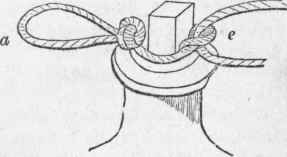
Fig. 7.
Continue to:


My Books

