


Chapter XV. Knots, Packages, Parcels, Etc
Description
This section is from the book "The New Cyclopaedia of Domestic Economy, and Practical Housekeeper", by Elizabeth Fries Ellet. Also available from Amazon: The New Cyclopaedia of Domestic Economy, and Practical Housekeeper.
Chapter XV. Knots, Packages, Parcels, Etc
The poet Crabbe, speaking of the writing of the rustics, signing his parish registers, says -
"Tis strange that men Who guide the plough should fail to guide the pen 1 For half, a mile the furrows even lie; For half an inch the letters stand awry."
A parallel remark might with equal justice be made on the gentler sex, who, after exercising a degree of tact, neatness, and tasteful invention, that the self-styled "lords of the creation" might in vain hope to rival, in the formation of a piece of needlework, knitting, netting, or crochet, are, for the most part, totally unable, when it is finished, to tie it up so as to make a decent parcel; ladies' packages are, in fact, the opprobrium of the sex - the annoyance of all carriers, who have any thing to do with their conveyance, and the torment of their owners; the cords are certain to become loose, the knots are sure to slip, except when a slip-knot is requisite, and then it is a fixture! It is in the hope that we may be instrumental in improving this state of things, that we are induced to devote this chapter to Knots, Packages, Parcels, etc, and we shall at once lay before our fair readers a method of tying a parcel neatly and securely, and at the same time affording facilities for releasing the contents without destroying the string by cutting it away - a too ordinary practice, especially where time is an object.
The most simple purpose for which a knot is required, is the fastening together of two pieces of string or cord: the knot selected for this purpose should possess two important properties;- it should be secure from slipping, and of small size. Nothing is more common than to see two cords attached together in a manner similar to that shown in Fig. 13. It is scarcely possible to imagine a worse knot; it is large and clumsy, and as the cords do not mutually press each other, it is certain to slip if pulled with any great force. In striking contrast to this - the worst of all, we place one of the best; namely, the knot usually employed by netters, and which is called by sailors "the sheet-bend." It is readily made by bending one of the pieces of cord into a loop (a b, Fig. 14), which is to be held between the finger and thumb of the left hand; the other cord c is passed through the loop from the farther side, then round behind the two legs of the loop, and lastly, under itself, the loose end coming out at d. In the smallness of its size, and the firmness with which the various parts grip together, this knot surpasses every other: it can, moreover, be tied readily when one of the pieces, viz. a b, is exceedingly short; in common stout twine, less than an inch being sufficient to form the loop. The above method of forming it is the simplest to describe, although not the most rapid in practice; as it may be made in much less time by crossing the two ends of cord (a b, Fig. 15) on the tip of the fore-finger of the left hand, and holding them firmly by the left thumb, which covers the crossing; then the part c is to be wound round the thumb in a loop as shown in the figure, and passed between the two ends, behind a and before b; the knot is completed by turning the end b downwards in front of d, passing it through the loop, securing it under the left thumb, and tightening the whole by pulling d. As formed in this mode, it is more rapidly made than almost any other knot; and, as before stated, it excels all in security and compactness, so firmly do the various turns grip each other, that after having been tightly pulled, it is very difficult to untie; this the only drawback to its usefulness, and in this respect it is inferior to the reef-knot, Fig. 16, which is made in precisely the same manner that a shoestring is tied, only pulling out the ends instead of leaving them as bows. The only precaution necessary in making a reef-knot is, to observe that the two parts of each string are on the same side of the loop; if they are not, the ends (and the bows if any are formed) are at right angles to the cords; the knot is less secure, and is termed by sailors a granny-knot. Other knots are occasionally used to connect two cords, but it is unnecessary to describe them, as every useful purpose may be answered by those above-mentioned. The binding knot (Figs. 17 and 18) is exceedingly useful in connecting broken sticks, rods, & c, but some difficulty is often experienced in fastening it at the finish; if, however, the string is placed over the part to be united, as shown in Fig. 17, and the long end 5, used to bind around the rod, and finally passed through the loop a, as shown in Fig. 18, it is readily secured by pulling d, when the loop is drawn in, and fastens the end of the cord.
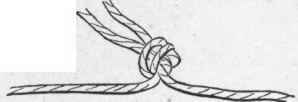
Fig. 13.

Fig. 14.

Fig. 15.
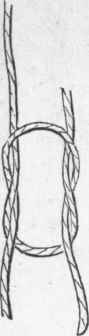
Fig. 16.
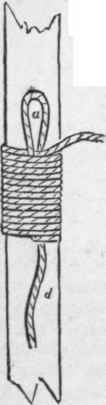
Fig. 18.
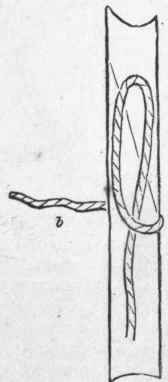
Fig. I7.
For fastening a cord to any cylindrical object, one of the most useful knots is the clove hitch, which, although exceedingly simple and most easily made, is one of the most puzzling knots to the uninitiated. There are several modes of forming it, the most simple being perhaps as follows:- make two loops, precisely similar in every respect as a and 5, Fig. 19, then bring b in front of a, so as to make both loops correspond, and pass them over the object to be tied, tightening the ends if this is properly done, the knot will not slip, although surrounding a tolerably smooth cylindrical object, as a pillar, pole, etc. This knot is employed by surgeons in reducing dislocations of the last joint of the thumb, and by sailors in great part of the standing rigging. The loop which is formed when a cable is passed around a post or tree to secure a vessel near shore, is fastened by what sailors term two half hitches, which is simply a clove hitch made by the end of the rope which is passed around the post or tree, and then made to describe the clove hitch around that part of itself which is tightly strained.
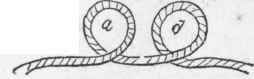
Fig. 19.
From the tying of knots we may pass on to the tying over of bottles, preserves, jars, etc.; the object with which this operation is performed is either to prevent the excess of air or the escape or entrance of moisture; the act itself is so very simple as to require no explanation; but a few words may be said on the choice of material, which should be varied so as to suit the exigencies of each particular case. When a vessel of spirit is to be tied over, leather is frequently selected - a very erroneous practice, as the vapor of spirit passes readily through that substance, but cannot penetrate bladder, which should be invariably used for the purpose. So effectually is spirit confined by bladder, that when weak spirits are put into bladders or into vessels tied over with bladder, and allowed to remain some time, they are strengthened, as the vapor of the water passes away, that of the spirit being retained.
Bladder or other animal membranes of the same nature, in a moist and flaccid state, are usually selected for tying over preserves and jams, for which they are well adapted. Many persons place a thin piece of brandied paper in the jar resting on the jam, in addition to tying it down; this assists in excluding air and preventing mouldiness, but we have found a piece of very thin paper moistened with white of egg much more efficacious. The thin sheet-lead used for lining the interior of tea-chests, or stout tin-foil, is very advantageously used in tying down vessels containing specimens of natural history preserved in spirits, as they effectually prevent the escape of the latter for a long series of years. The plan usually pursued is to tie the cork over first with a single bladder, then with the metal, and finally with a second piece of bladder, which is afterwards covered with a coat of black paint.
The tying up of parcels in paper is an operation which is seldom neatly performed by persons whose occupations have not given them great facilities for constant practice. Whether the paper be wrapped round the objects, as is the case usually when it is much larger than sufficient to enclose them, or merely folded over itself, as is done by druggists, who cut the paper to the required size, it is important that the breadth of the paper should be no longer than sufficient to enable it to be folded over the ends of the object enclosed, without passing over the opposite side; it is impossible to make a neat or close parcel with paper which is too broad; excess in length may be readily disposed Of by wrapping it round; but excess of breadth should be cut away. With regard to turning in the ends the mode adopted by grocers is the best. The most common cause of failure in parcels is their being badly corded; we will, therefore, (however unnecessary the description of so simple a performance may appear to those already acquainted with it), describe the most readily acquired mode of cording.
Let a single knot be made in the end of the cord, which is then passed round the box or parcel. This knotted end is now tied by a single hitch round the middle of the cord (Fig. 20), and the whole pulled tight. The cord itself is then carried at right angles round the end of the parcel, and where it crosses the transverse cord on the bottom of the box (Fig. 21), it should (if the parcel is heavy, and requires to be firmly secured) be passed over the cross cord, then back underneath it, and pulled tightly, then over itself; lastly, under the cross cord, and on around the other end of the box. When it reaches the top it must be secured by passing it under at that part of the cord which runs lengthways (a, Fig. 20), pulling it very tight, and fastening it by two half hitches round itself! The great cause of parcels becoming loose is the fact of the cord being often fastened to one of the transverse parts (as b, Fig. 20), instead of the piece running lengthways, and in this case it invariably becomes loose. The description may perhaps be rendered clearer by the aid of the figures, which exhibit the top and bottom of a box corded as described. The cords, however, are shown in a loose state to allow their arrangements to be perceived more easily.
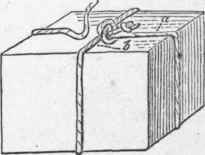
Fig. 20.
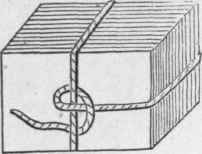
Fig. 21.
Continue to:


My Books

