


Cutting, Grinding, And Writing On Glass
Description
This section is from the book "The New Cyclopaedia of Domestic Economy, and Practical Housekeeper", by Elizabeth Fries Ellet. Also available from Amazon: The New Cyclopaedia of Domestic Economy, and Practical Housekeeper.
Cutting, Grinding, And Writing On Glass
We have described the most advantageous modes of extracting fixed stoppers from decanters, etc. It is possible that some of our readers may have followed our advice sufficiently well to have succeeded, in cracking the necks of their decanters. In case any should have been so unfortunate, or rather we would say, if we were quite sure we were not addressing ladies - so clumsy, let them not despair; dexterity in manipulation comes by practice; and as no evil is without a remedy, we will next consider what can be done with the broken decanter. Unless it is cracked down to the bottom, it may be cut off and converted into a handsome sugar basin; or if not high enough for that purpose, will serve for a pickle-dish, or a flower-stand, etc.; and in the same way, a tumbler broken at the upper part will furnish an elegant salt-cellar, or serviceable soap-dish; and even common bottles, if sufficiently stout, may be made into useful jars, instead of being consigned to the dust-heap.
The operation of cutting glass, consists in leading a crack in the required direction; this is readily done by a hot iron rod, a piece of pointed burning charcoal, or, what is still better, a burning pastile - which is somewhat similar in its composition to those used for fumigation; and which latter, although rather expensive, and inconvenient from their shape, may be applied for the purpose. When the operation of cutting up glass vessels into useful forms is much had recourse to, pastiles are prepared for the purpose, being superior to a heated iron rod, as they continue to burn and retain their heat, whilst the latter requires to be re-heated, if the crack has to be led any considerable distance. Pastiles are readily made toy rubbing up half an ounce of powdered gum tragacanth with water, so as to form a mucilage about as thick as ordinary starch; this should be allowed to remain a few hours, and then mixed with a quarter of an ounce of benzoin, previously dissolved in the smallest possible quantity of proof spirit; after mixing them together in a mortar, as much powdered charcoal should be added as will form a stiff paste, and the whole well worked together, rolled into sticks the size of a common black-lead pencil, and dried. As thus prepared, they should be free from cracks, and solid throughout; and on being ignited at the end, they will burn steadily away to a point. If an iron rod is used, it should be nearly as stout as the little finger, and taper at the end. for an inch and a half to a blunt point. Before commencing the line along which it is wished to divide the glass, it should be marked with a pen and ink, and allowed to dry, when the iron, heated to dull redness, on the lighted extremity of the pastile, should be brought to the end of a crack, being held in a slanting direction with regard to the glass, as shown in the cut, and slowly moved in an oblique direction towards the line; the crack will be found to follow the heated point, and may thus be led as required, even passing over parts varying very considerably in thickness, as in the case of the flut-ings on a cut decanter; but it cannot, with certainty, be made to pass suddenly from a very thin to a very stout part, or the reverse: thus it may be led around the sides of a tumbler, but could hardly be made to pass down one side, across the bottom and up the other. The rapidity with which the operation is performed, depends upon the heat of the iron or pastile; if the former is very hot, or the latter made to burn more vividly by blowing upon it, the operation is quickened, but it is not performed with so much certainty, as the crack may pass on further than is desirable: care should be taken not to lead the crack too near the edge of the vessel, or to another crack, as in that case it is apt to leave the proper course, and fly suddenly to the edge, to which an inexperienced operator should not attempt to go nearer than half an inch.
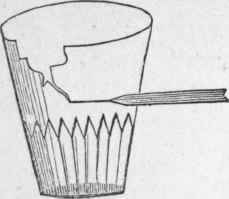
It sometimes occurs that a piece is broken out of a glass, without leaving any crack to commence from; in this case, one must be made, by heating the edge (one formed by the fracture, if possible) with the iron or pastile, and instantly applying the moistened finger. When a crack is formed, which may be used as described above, care must be taken not to cause an extensive fracture, which may run across the intended line of division; this may be avoided by commencing the crack at some distance from the line, and by applying the heated point for a very short time, preferring to make two or three unsuccessful attempts rather than to hasten the operation, and risk the destruction of the glass. When a glass vessel has been thus divided, the edges are sufficiently sharp to cut the fingers in handling, and are usually wavy; it is therefore necessary to make them smooth and even. The most ready way of doing this is, by grinding them down on a flat sandstone, or ordinary paving-stone, with a little sharp sand or emery, and water, taking care to move the glass in a circular direction, and not merely backwards and forwards; the smoothness of the whole will depend entirely on that of the stone, and on the fineness of the sand or emery employed. If, from any irregularity, there is much glass to grind away, it is preferable to commence with sand, and finish with emery on a smooth stone; if the edges are not thus ground down, they should have the sharp angles, which are really dangerous, removed by a fine file, which should be moistened with oil of turpentine or camphene, as this liquid has an extraordinary effect in increasing the action of the file upon the glass, and at the same time protecting the steel instrument from wear.
Advantageous as cracks are in glass vessels whenever we wish to separate them into two parts, they are by no means desirable under other circumstances; and it is as important to know how to stop their progress, as to lead them forward. This is readily done in stout glass, by drilling a hole about half an inch in advance of the crack, which gradually passes on into it, and then its farther progress is arrested. Holes may be drilled in glass with a common drill and bow, the place being first marked with a file or flint, and the drill point kept wet with oil of turpentine. It is hardly necessary to state, that a crack existing in the neck of a decanter, and liable to be forced apart with the stopper, could not be arrested in its progress by such means. If necessary, a little emery powder may be used with oil of turpentine; and after the operation, the hole must be filled up with some cement; it the vessel is to be used for holding liquids, a little fresh slacked lime, moistened with equal parts of white of egg and water, may be used for this purpose.
The grinding of glass on a flat stone with sand or emery, and water, is often useful in making a bottle stand steadily; and by its means a wineglass with a broken foot may be turned to good account; for if as much of the stem as possible is knocked off, by striking it with the back of a knife, the remainder may be ground away so that the vessel will stand.
One of the most important Domestic Manipulations, although one of the most simple and easy, is the labelling of glass vessels. It is not too much to affirm, that scores of lives might have been saved if this had been attended to. In cases of accidental poisoning, we usually find that the victim has drunk from some bottle which has been put away without a label; and thus some corrosive liquid used for cleaning, or some poisonous lotion, has been inadvertently swallowed. One of the most ready modes of label-ting glass, and other objects, consists in having at hand a sheet of paper, which has had spread on one side some gum water, mixed with half its weight of coarse brown sugar, and allowed to dry; this may be cut into labels, written on, and readily attached to glass by moistening with the tongue; the white margin of a sheet of postage stamps answers the purpose very well. If, however, acid liquids are used, or the vessel is placed in a damp situation, as a cellar, other means must be had recourse to. With a little practice, it is easy to write in a legible, though not very conspicuous manner, on glass, with a gun-flint, or with the sharp-edged fragments of common flint. In the laboratory what is called a writing diamond is used for this purpose; this should not be confounded with a glazier's diamond, which is used for dividing, and not scratching glass. "We would here caution our readers against writing on glass with a diamond ring, etc, as the practice injures the jewel considerably; in the glazier's diamond, the natural edges of the crystal are used, which are not liable to injury as are the cut angles of a brilliant.
When glass vessels are exposed to damp, the best mode of writing on them is to prepare an ink for the purpose, by mixing the common cheap varnish, called Brunswick black, with half its weight of oil of turpentine, or what is the same thing, in a purer state, camphene; this should be kept in a closely corked bottle, and used with a broad nibbed quill pen; it soon dries, and though pale, is very distinct, and almost imperishable. If it is required much darker, about a quarter of an hour after it has been done, a little lampblack should be rubbed over it, with cotton or wadding, when it immediately becomes as black as common ink, and resists damp, and rubbing or wiping with either wet or dry cloths for a very long time. The same ink is equally advantageous for use with white earthenware; and although we have never had occasion to use such a mixture, there is no doubt that a little whiting mixed thin with any common varnish, would furnish an equally useful ink for writing on black bottles.
Continue to:


My Books

