


Part Third. Perfumery And The Toilet, The Family Medical Guide, Miscellaneous Receipts. Perfumery And The Toilet
Description
This section is from the book "The New Cyclopaedia of Domestic Economy, and Practical Housekeeper", by Elizabeth Fries Ellet. Also available from Amazon: The New Cyclopaedia of Domestic Economy, and Practical Housekeeper.
Part Third. Perfumery And The Toilet, The Family Medical Guide, Miscellaneous Receipts. Perfumery And The Toilet
The perfumes for the handkerchief, as found in the shops of Paris and London, are either simple or compound; the former are called extracts, extraits, esprits, or essences, and the latter bouquets and nosegays, which are mixtures of the extracts so compounded in quantity that no one flower or odor can be discovered as predominating over another. Perfumes are procured by the processes of maceration, absorption, and distillation.
In making pomade, a certain quantity of purified mutton or deer suet is put into a clean metal or porcelain pan, this being melted by a steam heat; the kind of flowers required for the odor wanted are carefully picked and put into the liquid fat, and allowed to remain from twelve to forty-eight hours; the fat has a particular affinity or attraction for the oil of flowers, and thus, as it were, draws it out of them, and becomes itself, by their aid, highly perfumed; the fat is strained from the spent flowers, and fresh are added four or five times over, till the pomade is of the required strength. For perfumed oils the same operation is followed; but, in lieu of suet, fine olive oil or oil of ben, derived from the ben nuts of the Levant, is used, and the same results are obtained.
The odors of some flowers are so delicate and volatile, that heat would spoil them; the process of absorption or enfleurage is, therefore, conducted cold, thus:- Square frames, about three inches deep, with a glass bottom, say two feet wide and three feet long, are procured; over the glass a layer of fat is spread, about half an inch thick, with a kind of plaster knife; into this the flower buds are stuck, cup downwards, and ranged completely over it, and there left from twelve to seventy-two hours.
Almond perfume is obtained from the bitter almonds, and exists in the skin or pellicle that covers the seed after it is shelled. The essential oil of almonds enters into combination with soap, cold cream, and many other materials prepared by the perfumer.
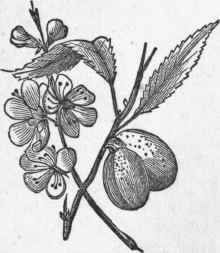
Almond.
A beautiful imitation of Essence of white Lilac may be compounded thus: One pint spirituous extract from tubereuse pomade; one quarter of a pint spirituous extract of orange-flower pomade; three drops of otto of almonds; half an ounce extract of civet.
The civet is only used to give permanence to the perfume of the handkerchief.
Benzoin, Also Called Benjamin
This is a very useful substance to perfumers. It exudes from the Styrax benzoin by wounding the tree, and drying, becomes a hard gum-resin. It is principally imported from Borneo, Java, Sumatra, and Siam.
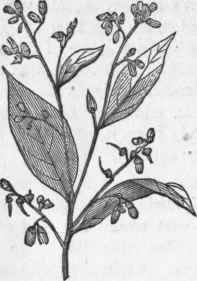
Styrax Benzoin.
Bay
Oil of sweet Bay, also termed essential oil of laurel-berries, is a very fragrant substance, procured by distillation from the berries of the bay laurel.
Bergamot
This most useful perfume is procured from the Citrus Bergamia, by expression from the peel of the fruit. Mixed with rectified spirit in the proportions of about four ounces of bergamot to a gallon, it forms what is called "extract of bergamot," and in this state is used for the handkerchief.
Geranium (Pelargonium Odoratis-Simum, Rose-Leaf Geranium)
The leaves of this plant yield by distillation a very agreeable rosy-smelling oil, so much resembling real otto of rose, that it is used very extensively for the adulteration of that valuable oil, and is grown very largely for that express purpose. When dissolved in rectified spirit, in the proportion of about six ounces to the gallon, it forms the "extract of rose leaf geranium" of the shops.
Heliotrope
Either by maceration or enfleurage with clarified fat, we may obtain this fine odor from the flowers of the Heliotrope Peruvianum or H. grandi florum. For a small trial, which can be managed by any person having the run of a garden, we will say, procure an ordinary glue-pot now in common use, which melts the material by the boiling of water. At the season when the flowers are in bloom, obtain half a pound of fine mutton suet, melt the suet and strain it through a close hair-sieve, allow the liquefied fat, as it falls from the sieve, to drop into cold spring water; this operation granulates and washes the blood and membrane from it In order to start with a perfectly inodorous grease, the melting and granulation process may be repeated three or four times; finally, re-melt the fat and cast it into a pan to free it from adhering water.
Now put the clarified suet into the macerating pot, and place it in such a position near the fire of the greenhouse or elsewhere, that will keep it warm enough to be liquid; into the fat throw as many flowers as you can, and there let them remain for twenty-four hours; at this time strain the fat from the spent flowers, and add fresh ones; repeat this operation for a week: we suppose at the last straining the fat will have become very highly perfumed, and when cold may be justly termed Pomade a la Heliotrope.
The cold pomade being chopped up like suet for a pudding, is now to be put into a wide-mouthed bottle, covered with spirits as highly rectified as can be obtained, and left to digest for a week or more; the spirit then strained off will be highly perfumed: in reality it will be extract of Heliotrope, a delightful perfume for the handkerchief. The rationale of the operation is simple enough: the fat body has a strong affinity or attraction for the odorous body, or essential oil of the flowers, and it therefore absorbs it by contact, and becomes itself perfumed. In the second operation, the spirit has a much greater attraction for the fragrant principle than the fatty matter; the former, therefore, becomes perfumed at the expense of the latter. The same experiment may be repeated with almond oil substituted for the fat.
The experiment here hinted at may be varied with any flowers whatever; indeed, by having the macerating bath larger than was mentioned above, an excellent millefleur pomade and essence might be produced from every conservatory.
Continue to:


My Books

