


Artificial Light
Description
This section is from the book "Warne's Model Housekeeper", by Ross Murray. See also: Larousse Gastronomique.
Artificial Light
Artificial light has next to be considered; and here the science of chemistry has been of the greatest service to man. In all ages, when science was little known, men provided themselves with artificial light. Probably the first lights used were torches of dry and resinous woods, but very early the use of oil for the purpose was discovered. It was olive-oil which fed the golden candlesticks in the Tabernacle, and in tombs of the greatest antiquity oil lamps have been frequently found.
Many other vegetable oils besides that of the olive-tree exist, and have been used for light. Nuts and almonds yield a pure sweet smelling oil: so do seeds of flax, hemp, and rape.
The cocoa-nut and the fruit of the African palm give us oil; animals and minerals also supply it; the sperm whale affords sperm oil; it may also be obtained from the pilchard. Mineral oils are of peculiar lustre and brilliancy; naphtha, pitch, asphalte, all burn. Petroleum springs have yielded a new supply of light.
A wax myrtle grows in Louisiana, from which berries enough may be gathered in a day to make eight pounds of tallow, which is much harder and purer than common tallow.
The candleberry myrtle of the United States has its fruit or nuts covered with a waxy secretion, which may be readily separated and manufactured into candles. This wax has long been an article of commerce.
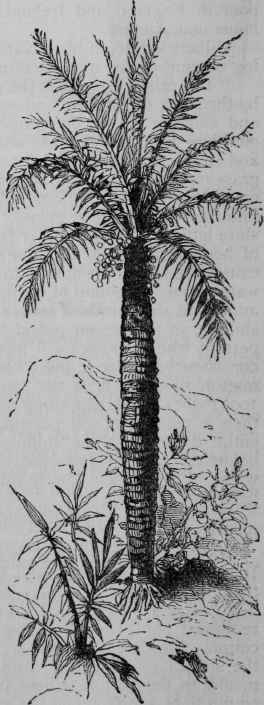
Young Wax Palm.
The Wax-palm and the Wax-tree of Japan, again, assist us in procuring artificial light; the candles made with it are coated with bees -wax. Bornean vegetable tallow, chemically treated, yields a valuable product for the same purpose.
Candles were at first made by dipping ropes, rushes, or the papyrus fibre into grease or wax. They are of great antiquity. Egyptian candles have been discovered, and Roman ones have been found in Shropshire.
The time-measuring candles of Alfred the Great are well known. Rushlights are of the greatest antiquity of all candles. In the last century the poor in England and Ireland used no other candles, and they were of home manufacture.
Gilbert White, in his "Natural History of Selborne," gives the following account of this manufacture of our forefathers: -
"The proper species is the common soft rush, found in most pastures by the sides of streams and under hedges. Decayed labourers, women, and children gather these rushes late in summer. As soon as they arc cut, they must be flung into water, and kept there, otherwise they will dry and shrink, and the peel will not run. When peeled, they must lie on the grass to be bleached, and take the dew for some nights, after which they are dried in the sun. Some address is required in dipping these rushes into the scalding fat or grease. The careful wife of an industrious Hampshire labourer obtains all her fat for nothing, for she saves the scummings of her bacon-pot for this use; and if the grease abound with salt she causes the salt to precipitate to the bottom by setting the scummings in a warm oven. A pound of common grease may be procured for fourpence, and about six pounds of grease will dip a pound of rushes, which cost one shilling, so that seven pounds of rushlights will cost three shillings. If persons who keep bees will mix a little wax with the grease it will give a consistency, render it more cleanly, and make the rushes burn longer; mutton suet will have the same effect.
A pound avoirdupois contains 1000 rushes; and, supposing each to burn on an average but half-an-hour, then a poor man will purchase 500 hours of light - nearly twenty-one entire days - for three shillings. According to this account, each rush before dipping, costs one thirty-third of a farthing, and one-eleventh afterwards. Thus, a poor family will enjoy five-and-a-half hours of comfortable light for a farthing".
A pound and a half of rushes supplied a poor family of that period with light for a year.
Tallow-dips came next, probably, in the course of candle progress. In them, cotton is substituted for rushes as the wick, the mode of making them being much the same. Lengths of cotton are cut off, hung up by a loop, dipped into melted tallow, taken out again, and cooled; then re-dipped until enough tallow has been accumulated round the wick-cotton. Dips were followed by moulds. A frame with a number of moulds the size of the intended candles is made. A wick is passed down each mould to the bottom where it is pegged in - the little peg holding the cotton tight and stopping the aperture so that no fluid shall run through. The tallow is then melted and the moulds are filled. After a while, the moulds cool, the excess of tallow is poured off at one corner, and then cleaned off altogether and the ends of the wick cut away. The candles can then be easily lifted from the mould, as they are narrower at the top than the bottom.
The Russian tallow, suet or fat of the ox, of which dips and old-fashioned mould candles were made, was converted, by Gay-Lussac, into the substance known to us by the name of stearine, in the following manner. - Fat, or tallow, consists of a chemical combination of fatty acids, with glycerine. It is first boiled with quick-lime, which unites with the palmitic, olive, and stearic acids, and separates the glycerine. Thus a soap is made. This is decomposed by sulphuric acid, which takes away the lime; the melted fatty acids rise to the surface, where they are decanted. They are again washed and cast into thin plates which, when cold, are placed between layers of cocoa-nut matting, and submitted to intense hydraulic pressure. In this way the olive acid, which is soft, is pressed out, and the hard palmitic and stearic acids remain. These are again purified by pressure at a higher temperature, and by washing in warm diluted sulphuric acid, when they are ready to be made into candles, and are harder, whiter, cleaner, and more combustible than the fats from which thev are obtained.
Continue to:


My Books

