


Wheat Flour And Its Nutritional Value
Description
This section is from the book "Warne's Model Housekeeper", by Ross Murray. See also: Larousse Gastronomique.
Wheat Flour And Its Nutritional Value
Wheat-flour is sold by millers, and all of these grains are sold at corn, chandlers.
21 ounces of wheat are required to yield lib. of flour. More than 100 varieties of wheat are cultivated in Great Britain and elsewhere.
There are many kinds of foreign wheat.
Flour of every kind consists of two classes of substances - one niti-ogenzzed, the other non-nitroge-nized. It also contains mineral substances.
Constituent parts - lib. contains -
Oz. | Grs. | |
Water... | ....2 | 106 |
Gluten... | .....2 | 21 |
Albumen . . | . . 0 | 126 |
Starch . . | . . 9 | 242 |
Suagr... | ........0 | 335 |
Oz. | Grs. | |
Gum... | 0 | 119 |
Fat... | 0 | 84 |
Woody fibre . . . | 0 | 119 |
Ashes... | 0 | 112 |
Carbon .... | 7 | 0 |
* It will be here seen how nutritious oatmeal is.

Lammas.

Essex.

Spalding.

Chiddam.
The gluten is the substance of most importance in flour, as it contains, in its crude state, most of the other nitrogenized substances - viz., fibrine, mucine or caseine, and oil. The greater part of the oil is contained in the bran, or husk, as are also the phosphates. The nitrogenized substances - pure gluten, vegetable fibrin, caseine, and oil, serve to form in the human body flesh or muscle through the agency of the blood into which they first enter; the starch, sugar, and gum are used for forming fat and carrying on respiration.

Section of a Mill turning two sets or Mill-stones.
It will be seen, by Comparison with the following tables, that the nitrogenized, or flesh-forming substances, are in larger proportion in wheat than in any other grain, consequently wheaten bread is the most economical in the end.
Before grinding, several sorts of wheat are mixed together, as the mixture makes better bread than any single kind alone. The process of mixing is called "mealing".
After the wheat is mixed, it is carefully winnowed from the dust, and then descends through a hopper (a) to the space between two mill-stones (b). These are about four or live feet in diameter, and are made of a very hard French stone - called French burr-stone.
The burr-stones are not often brought to this country much larger than a man's hat - a number of them are, therefore, carefully cemented together with a very strong cement, and bound with iron hoops to form one mill-stone. The method that is employed in France to split the burr-stones to the requisite thickness, is rather singular. Circular indentations are made round the blocks, at proper distances, and then wedges of willow that have been dried in an oven are driven into the indentations with a mallet. When these wedges have been sunk to a proper depth they are moistened with water; and, after a few hours, the several stones that have been marked out are found to be perfectly separated. The surfaces of the stones are rough or grooved, and the lower one being fixed, the upper one revolves rapidly - more than a hundred times in a minute.
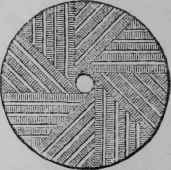
Mill-stone.
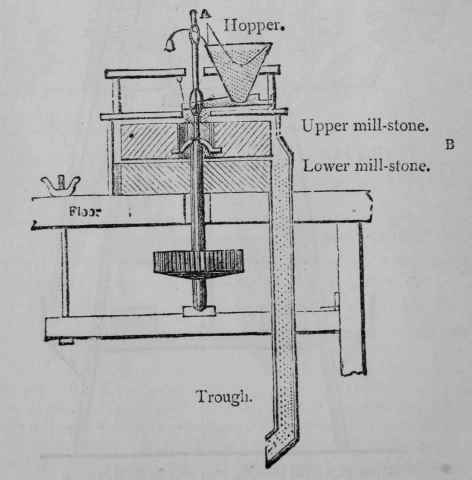
It is necessary to keep the stones a little distance apart, for if they touched they would grow very hot. This is effected by a strong spindle being put through a small hole in the lower stone, which turns the upper mill-stone. By raising or lowering the spindle the upper stone is raised Or lowered. The centrifugal force drives the flour from the centre to the circumference, where it falls into a box. The upper stone is slightly concave, therefore the broken grain can gradually find its way outwards, being ground in its passage. A blast of cold air is directed on the stone to keep it cool.
The flour descends through a spout into a bin below, after which it is "dressed" - i.e., sifted through a sieve, which varies in fineness.
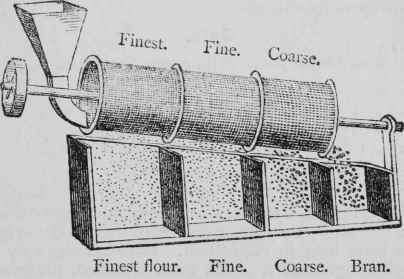
A spindle through the middle of the sieve, has brushes fastened to it. When the flour is in, the brushes revolve swiftly, and rub the flour through the sieve - the bran falling out at the end. By an exhausting or pumping apparatus, the loose flour dispersed in the air by the blast is collected and saved from waste.
A quarter of wheat, when ground, produces:
Flour.
Best pollard.
Biscuit or fine middlings. Fine pollard.
Toppings or specks. Bran and coarse pollard.
The pollards are sold for feeding pigs and poultry, the bran for horses and cattle; three kinds of flour remain for the bakehouse - firsts, for fine wheaten bread; seconds for household bread; thirds, for brown bread.
The flour, when ground, is placed in sacks; each sack contains five bushels, that is, 280 lbs. The bushel is divided again into four pecks. In some English counties BREAD is measured by the gallon - in Hants, for example. In London, and generally in England, by the 41b., or quartern loaf.
American flour is much cheaper than English; and, when good, is very excellent - it is sold in barrels.* Seconds are quite good enough for ordinary bread ; firsts are required for pastry. The whole meal should be used for making bread, as the phosphates of wheat necessary for forming bone are contained in it. It is said, on high medical authority, that the decay in the teeth amongst young people, so much more prevalent than it was a century ago, proceeds from our never eating anything but the finest flour. A mixture of bran also assists digestion.
The whole meal is obtained by simply grinding the grain without sifting it : it is not only best for nourishment, but would effect a great saving if used.
Flour is fearfully adulterated, the usual substances used for the purpose being pea and bean meal, potato-flour, plaster of Paris, bone-dust and alum. In purchasing flour, it is wise to take up a handful and make a ball of it. If it holds together well for a little while the flour is probably pure. Plaster of Paris may be detected by its great weight. Observe in your toast whether there is any scent of bean or pea, while the toast is hot. Nitric and muriatic acid will also test the purity of flour ; if it is not adulterated nitric acid will turn it orange colour, and muriatic acid will change it to a deep violet colour.
Continue to:


My Books

