


Making Disinfectant Solutions
Description
This section is from the book "The Profession Of Home Making", by American School Of Home Economics. Also available from Amazon: The Profession Of Home Making.
Making Disinfectant Solutions
A bottle of blue bichloride tablets can be bought at any chemist's; this is the safest form to use it in the home, as the tablets make a blue solution. The bichloride is perfectly odorless, and if the clear, uncol-ored solution were used it might be mistaken for water. As this is a very strong poison the tablets should be kept always under lock and key, and out of the reach of children. It is well to have a bottle of tablets in the house at all times, to use in case of cuts, etc. They contain salt, which is always required in making bichloride solution.
To make bichloride solution dissolve one tablet in a quart of hot water.
When a large quantity of carbolic acid solution will be required continually, it is cheaper to buy the 95 per cent solution, which can be reduced as needed to the required strength. To make five pints of 1-20, mix four ounces of the 95 per cent carbolic \vith five pints of boiling water and shake the bottle well.
As 95 per cent carbolic is not only a strong poison, but also very corrosive to the skin, so be careful not to spill even a drop on your hands, but if you should, wash the spot immediately with alcohol or warm water and soap.
An infectious disease is not always a contagious one; that is, it cannot be contracted by being in the same room with the patient, but it is transmittable by some intermediate means of communication.
Bichloride of Mercury
Carbolic Acid
Infection and Contagion
Tuberculosis is not contracted by coming in contact with a patient suffering from that disease, but by inhaling dust containing the germs derived from the dried sputa of some consumptive person.
The germs of typhoid fever are disseminated when the stools and other excreta of the patient are not properly disinfected by those in charge.
It is not necessary to isolate patients suffering from diseases of this kind, but it is necessary to disinfect, according to the nature of the infection; thus, knowing that the germ of typhoid fever is in the stools, and to some extent in the urine, the stools and urine must always be disinfected by covering with bichloride, 1-1000, and letting stand half an hour before emptying. The bed pan must be well washed and disinfected afterward. It is also a wise precaution to disinfect the bed-clothes by soaking in carbolic, 1-20, for twelve hours, and then boiling; also to keep utensils and dishes used for the patient separate, boiling them before they are again mixed with the household supply.
Consumption, or tuberculosis of the lungs, is perhaps the most dreaded disease of the present day. There are more deaths from it than from any other, except in times of epidemic. The sputum of patients suffering from this disease contains many millions of the bacilli. If this is deposited in places where it is allowed to dry and become pulverized, it is a source of danger to others, The sputum must, therefore, be disinfected,
Patients suffering from this disease should be provided with sanitary cups. The best for this purpose are made of prepared paper and are very cheap. These should be burnt after being in use for twelve hours at most. If these cannot be obtained, porcelain ones with covers may be used, but bichloride or carbolic must always remain in the cup, and it should be emptied and scalded frequently. The patient should not use ordinary handkerchiefs, but gauze or Japanese paper, which should be burnt. All clothing and bedding soiled by the sputa should be disinfected in the usual manner, and the sufferer should wash and disinfect the hands frequently.
Perfect cleanliness, plenty of sunlight and fresh air, and nourishing food are the most important points in the modern treatment of consumption. Special care should be taken by consumptives to smother every cough when close to other people.
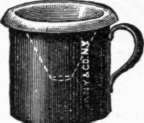
Sanitary Cup
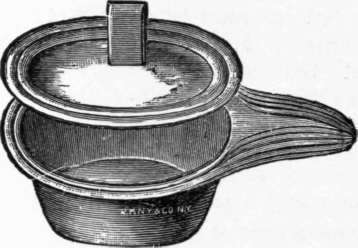
Paper Sanitary Cup
Continue to:


My Books

