


4. The Garden
Description
This section is from "Every Woman's Encyclopaedia". Also available from Amazon: Every Woman's Encyclopaedia.
4. The Garden
By The Hon. Frances Wolseley
Principal of the Glynde School for Lady Gardeners in Sussex Drawings by Miss M. G. Campion
The Ornamental Value of the Sunk Garden - The Garden in the Front of Kensington Palace - Suggestions for Making such Gardens, and Practical Hints Adapted to All Purses
'"There is great charm about a sunk garden, and I recommend all who think of making one to study that which is in front of Kensington Palace.
In this instance it forms but one feature in a large garden, one of the many little surprises which all large pieces of ground should be provided with, to save them from monotony. Here we have the wide, stately, pleached alley, made of lime trees, surrounding two sides of an oblong. Under the shade cast by this covered Way we look down, through small openings, to the dazzling brightness of the sunk garden below. Beneath us are paved walks, water-lily tanks, old grey ornamental lead cisterns, clipped box-trees, and gay flowers.
Across the garden, on the other two sides, are clipped privet hedges, raised upon banks and shaped into artistic half-circle lines. Here and there, to give additional height to the enclosing fence, a small upright tree stands erect as a sentry.
Let us study Plan a, which belongs to a house in a country town, built on the top of a very high hill.
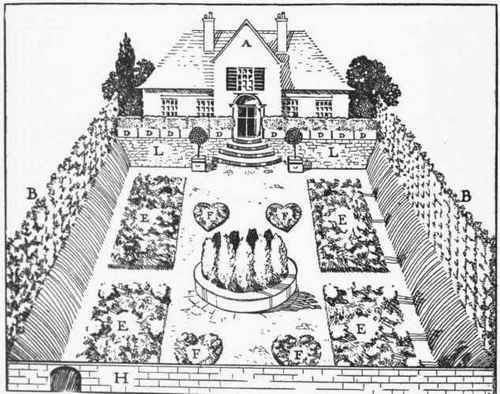
Plan A.a-the house: B,closely clipped hedge, five feet high; D, Oblong wooden boxes; E, Beds of sunflowers. dahlias, etc.; F, Heart-shaped beds for tea-roses, etc.; H, Wall; L. Brick wall supporting house terrace
The garden is at a considerably lower level than the road, in fact, it is about 20 feet beneath it. The site being such an exposed one, this is fortunate as regards the plants and flowers, for they obtain shelter. There is, however, a slight drawback to the privacy of the place, for a passerby can look over the four-feet-high wall h and scan not only the whole garden, but also the windows of the house.
In order to protect these from observation, oblong wooden boxes have been placed on the small terrace at d, upon which the house stands. The boxes are painted dark green, filled with good soil, and in them privet is planted. It is trained to bamboo stakes which stand five feet upright in the boxes. To strengthen their support, bamboo stakes are interlaced horizontally with the upright ones, and form a firm but scarcely noticeable trellis for the privet. Thus the windows of the house are hidden from observation.
The next thing to do is to protect the east and west sides of the garden likewise. Some of the soil which was originally taken out to make the sunk garden has been raised up evenly to form a sloping bank of good soil. This bank can either be a well-mown grass slope - winter aconite, blue scillas, yellow crocuses enliven it in spring - or, as at Kensington Palace Gardens, it may be made the home of bright herbaceous plants.
At the top of this bank a closely clipped hornbeam hedge will give the protection required, and, when it has grown to be about five feet high, there will be no fear of the garden being overlooked either on the east or west.
The centre of the garden will be arranged and planted according to the final decision of this point. If the flower-beds get plenty of sun, tea-roses would look lovely in the heart of heart-shaped beds, with a carpet of contrasting violas beneath them. Tall growing flowers, such as sweet-peas, sunflowers, dahlias, Michaelmas daisies, would be in the larger beds at e.
If bedding-out be preferred, there are lovely pale pink geraniums, of the ivy-leaf kind, Miss Willmott pink verbena for the small beds, and tall-growing heliotrope or plumbago would look well in the large beds. Should it be decided to heighten the wall h, and if a great deal of shadow is thus cast upon the centre of the ground, it will be wise to have large stretches of turf and fewer flower - beds. Small paved walks could divide the turf, and only shade-loving plants would be put either in the chinks between the paving-stones or in any very small border or beds that it was considered possible to have.
This would then be an ideal place for a water-lily tank or small aquatic garden, with London pride, lily of the valley, and violets encircling the fountain. Any study made of Kensington Palace Gardens will give many and varied ideas for this scheme.
I may here mention that the Plan a shows a brick wall supporting the house terrace, and at l there are circular stone steps leading from it to the sunk garden.
Anything to do with stonework always means heavy expense, and as I am endeavouring to give ideas to those who do not wish to garden extravagantly, who wish to spend only a small surplus upon the outside of the house, I may here mention a cheap way of arriving at nearly the same effect.
Instead of having a stone facing to the house terrace, with a little extra earth - which probably will be to spare from what is originally extracted to make the sunk garden - a sloping bank may be made. In the centre of this it would look bad to have stone steps, but turf circular ones would look remarkably well.
All you will have to do to shape the sides of these steps is to cut out in even strips pieces of an empty oil-barrel. Measure and peg out accurately the outline required, and then place these strips upright in the ground. The wood can be painted the colour of grass, and will not be noticeable, and you thus will gain a firm support at the sides of the steps, where turf so often gets worn away from constant tread.
Having filled up and levelled with soil, you can either lay turf up to the level of these uprights, or sow grass seed.
But should you think grass steps a trouble to keep mown, I have another economical plan to suggest. Have straight steps, and make them of disused railway-sleepers. These can usually be obtained from the station-master by ordering some little time in advance, and, although they do not sound romantic or artistic, you will find that when pretty little stonccrops, pansics, aubrictia and other dwarf plants grow in between the steps and spread slightly over the wood, they look well. Of course, the lasting qualities of tarred wood are indisputable.
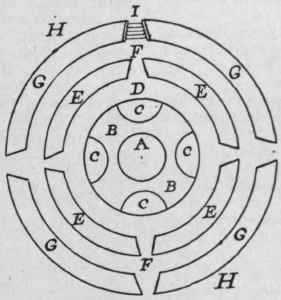
Plan B. - A,tank of water-lilies; B, Grass plot
C, Half-moon flower beds; D, Gravel path; E,
Herbaceous border; F, Grass walk; G, Bank or wall; H, Level of house; I, Stone steps
It is advisable to offer various plans for selection, in the hope that amongst them there may be ideas that will suit different requirements. With this end in view, I submit a plan for a circular-shaped sunk garden.
The one I have specially in mind, partly real, partly imaginary, was near the sea. There were protecting walls round it to save the flowers from boisterous winds, but these were hidden by a feathery green hedge of tamarisk. This makes a pleasing-looking sheltering hedge - the foliage is graceful, the colour of the green is restful. The kind I mean is tamarix gallica, which has pale pink flowers, borne in summer upon cylindrical spikes.
The house stands upon a level (h) and looks down upon path d, but as the paths and many of the beds are outlined by tall posts with chains suspended from them, and on these are wound creepers, thus hanging in festoons, the circular shape of the garden is not quite so apparent from the house terrace as it would appear to be on paper.
It is only on descending the stone steps at I that the plan of the garden strikes us. As we walked along the grass walk F, we had upon the right side a lovely bank of varied colours, and on the left side were tall herbaceous plants in border e.
Then came the path d - in this instance a gravel one, but possibly more in keeping had it been paved - and from it we could see the lovely pink water-lilies in the centre tank (a),.
Surrounding the tank was a grass plot (b), with half-moon flower-beds (c) cut in These were filled with bright bedding plants, and gave a culmination of strong colour to the centre of the garden. The advantage of this plan is, that in a somewhat limited area are a great many plants, and each has a fitting and suitable home, for the Alpines and shelter-loving things are on a bank, the hardy herbaceous plants are in a wide border, where they can be easily seen and cut from, the water-lilies find a happy home in the tank, and if a few bedding-out plants are needed, the beds (c) are easily filled with them.
Continue to:


My Books

