


Practical Millinery. Fur as a Season's Trimming
Description
This section is from "Every Woman's Encyclopaedia". Also available from Amazon: Every Woman's Encyclopaedia.
Practical Millinery. Fur as a Season's Trimming
Fur as a Season's Trimming - The Combination of Fur and Lace - The Intricacies of Rosette-making
We must always remember that no hard-and-fast rules can be laid down with regard to the trimming of headgear. Every season has its novelty - or, rather, many novelties - but the best modistes of the world never overtrim their models, but depend rather on the application of fabrics of good quality at an artistic angle on the shape itself. The amateur, however, has much to learn regarding the elementary laws of trimming, even admitting that she has mastered in some degree the difficulty of shape-making and covering. In the last article we rehearsed the phases of tying the simplest bows; in this we will further elaborate a popular trimming. Fur is used on hats no less than on dresses, and on millinery it is light and elegant as an edging to the lace rosette; a wintry appearance is therefore given to the hat without overloading the shape in a physical or an artistic sense, though, of course, fur is used equally for velvet or silk bows. It is sold by the leading drapers in strips, from 3s. 1 1 1/2d. a yard, for millinery purposes; marabout strips are also used, where a lighter and cheaper edging is required. For the lace bow, 1 yard of guipure or torchon lace, in black or white, at 2s. 1 1/2d. per yard, 18 inches wide, and 4 yards of skunk or marabout will be required.
To Make the Bow

Fig. I
Take 36 inches of lace, and cut it in half lengthways. This will give two lengths, each 36 inches by 9 inches.

Fig. 2

Fig. 3
Cut each of these lengths in half; this gives four lengths, each 18 by 9 inches. Three pieces are for the loops and the fourth for the "tie-over."

Fig. 4
Hem the two long sides of each piece, and leave the hem sufficiently wide to allow a wire to be inserted.
Nip off eight lengths of wire, each measuring 19 inches. Then push one of these through each hem separately to support and strengthen the bow.

Fig. 5
Sew an edging of fur along each hem, on the wrong side, being careful not to catch the hair.

Fig. 6
Make loops of three lengths, as illustrated, and pleat each at the ends.
F,g. 7
Join two of these lengths together.


Fig 8
Take the third length and sew on one inch from the top right-side front of bow, but on the slant; this is to avoid stiffness. Bend the wire here and there to give a softer effect.

Fig. 9
Sew the bow on to the left-side front of hat, and stitch through the crown.
Tie or knot, as artistically as possible, the remaining piece of lace over centre.
A large rosette of Chantilly lace edged with skunk would also be a very smart finish for a hat. If skunk is too expensive, marabout or a velvet edging can be substituted.
Rosette -making
For a fairly large rosette, 1 yard of Chantilly lace, black or white, 18 inches wide (about 2S. 11 1/2d. per yard), 5 yards of skunk or marabout, or any other fur selected, and two rings of lace wire to support the lace, are necessary.

Fig. 10
Cut lace in half lengthways; this gives two lengths, 36 by 9 inches each. The first stages are the same as described above for the making of the bow.
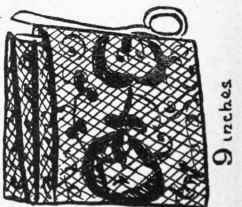
Fig. 11
Fold one of the lengths in half, then refold and cut, leaving four pieces, each 9 by 9 inches (see Fig. 11).
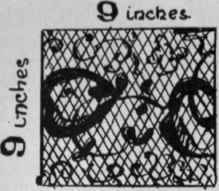
Fig. 12
Repeat the same with other half, and there will then be eight separate pieces, or squares, 9 by 9 inches each.
Pin all the squares one on the top of the other, round off each square at the top; this gives eight leaves, as illustrated. The object of placing one on the other is to secure perfect uniformity of curve.

Fig. 13

Continue to:


My Books

