


How To Mend And Keep Linen In Order. Continued
Description
This section is from "Every Woman's Encyclopaedia". Also available from Amazon: Every Woman's Encyclopaedia.
How To Mend And Keep Linen In Order. Continued
On arriving home, place them in basins of water in which has been dissolved a good pinch of salt, and leave them for an hour or so before arranging them in vases. So numerous are our British wild flowers that but a small number of them can be mentioned in an article of this description, but here is a general rule that can be followed invariably with advantage.
Study diligently the natural growth of your wild flowers, and arrange them as nearly as possible as they grow in their natural haunts. For primroses, violets, wood anemones, and flowers of their nature, use low bowls with plenty of moss.
We all love these woodland flowers, and they are within reach of us all. Those who live in the country can gather them with but little trouble, and town-dwellers can buy them very cheaply in these days.
For these kinds of blossoms, have a special table set of low-shaped baskets or bowls not more than two inches in height, and if you have chosen baskets, enamel them a dull shade of moss green, but be sure that it is not a shade that will clash with Nature's greens.
A very ingenious little set of table baskets can be made from the ordinary baskets that strawberries are sold in. Cut them down until they are only two inches in height. Use a large one for a centre and four smaller ones. Fit them with shallow tins, and enamel the baskets and the outside of the tins.
Fill them with moss and water, and you have ideal receptacles for any low-growing woodland blossoms. For your luncheon-table, fill them with wild violets and wood anemones; for your evening meal, substitute primroses or kingcups, or combine either of the latter blossoms with clusters of forget-me-nots, and you have a dainty table decoration.
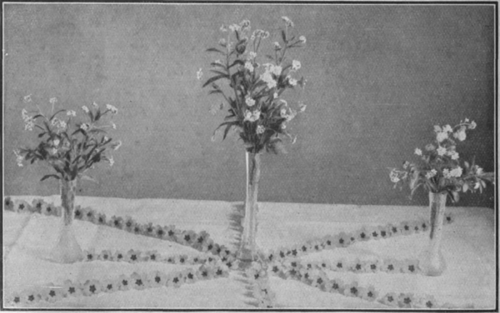
A wild-flower scheme for spring table decoration in forget-me-nots and primroses. Plain crystal vases only should be used, the centre vase being taller than the two flanking it
Primroses that have been in water can be stripped of their stalks and used to form designs on the cloth. A very uncommon one is here shown.
Forget-me-nots should not be used out of water, as they so quickly flag. Here lines of primroses are arranged from corner to corner of the table, and from sides to centre. Two lines of blossoms are also placed from the centre vase to the side ones. A length of string Stretched from side to side and corner to corner is a vast help in forming these lines of blossoms.
A slender crystal vase filled with forget-me-nots is used as a centre, and a smaller one on either side; or three of the enamelled strawberry baskets can be utilised instead.
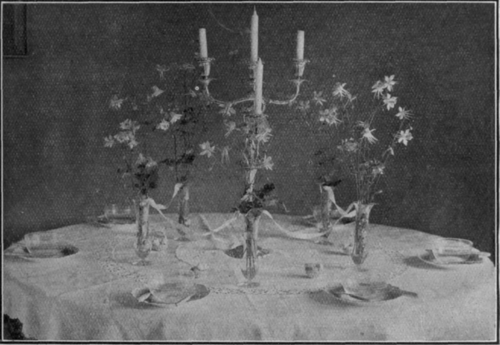
A pleasing design in graceful columbines, which could be carried out effectively also in wild hyacinths and the foliage of cow parsley. The ribbons connecting the vases should be pale rose-pink to contrast with the vivid blue of the hyacinths
For the sweets, enamel miniature baskets to match the others. Trim them with artificial moss, and fill them with fondants of primrose hue.
Green rush baskets are also very suitable for all woodland flowers. The boat-shaped ones may be used to advantage with a mirror centre, and the effect is good in conjunction with any other wild flowers that grow by pond or stream.
Any piece of mirror will answer the purpose, framed or unframed. Bank it round with moss, and under the moss at intervals place little bowls or tins of water.
Use boat-shaped rush baskets on the mirror and fill them with rushes and any water-loving wild flowers. Fill the little bowls or tins around the mirror to correspond, and mix plenty of small rushes and sword-like grasses with the flowers.
This design could be carried out with wild yellow iris and forget-me-nots.
Columbines of any kind are light and fairy-like in effect. Use vases of medium height, and group them around a silver candelabrum. Arrange the flowers lightly as shown in the illustration, and connect them with ribbons of a contrasting hue that harmonises with the flowers. This scheme is also charming for bluebells. Mix them with cow parsley, and use pale rose-pink ribbons to connect the vases. Cowslips and fine grasses also lend themselves well for this design, with ribbons to match the blossoms, or ribbon of palest pink, blue, or green may be used. But, whichever colour is chosen, it must be in a pale shade that will harmonise with the cowslips.
With a little trouble, a charming bluebell woodland scene can be arranged on the table. To prevent any damp coming in contact with the cloth, use a strip of macintosh of a suitable size for your table, and twice as long as it is wide. Cover this with green carpet-moss. Under this moss place some small shallow bowls of water, with lead supports in them.
In the bowls arrange bluebells, imitating as far as possible the way they grow. Here and there place some sprays of foliage in the moss to imitate miniature trees.
Make the whole as natural-looking as possible and arrange wee ferns among the moss.

Her Grace the Duchess of Devonshire, one of the greatest ladies in society and Mistress of the Robes to H.m. Queen Mary
Photo, H. Whitlock & Sons
Continue to:


My Books

