


The Herbaceous Border. Part 2
Description
This section is from "Every Woman's Encyclopaedia". Also available from Amazon: Every Woman's Encyclopaedia.
The Herbaceous Border. Part 2
5. Sweet-pea, Nora Unwin. Annual. July.
(5 ft.)
6. Hyacinthus candicans. Bulb. Aug. (3 ft.)
7. Michaelmas daisy commutalis. Perennial.
Sept. (3ft.)
8. Japanese anemone, Honorine Joubert. Perennial. Sept. (3 ft.)
9. Gladiolus colvilli, The Bride. July. (I 1/2 ft.)
10. White ten-week stock. Annual. July.
11. Phlox Berenice. Perennial. Aug. (2 1/2 ft.)
12. Viola cornuta alba. Perennial. July.
(6 in.)
Pale Yellows
13. Dahlia yellow cactus. Caradoc. Aug.
(5 ft.)
14. Scabiosa caucasica. Perennial. July
15. Helianthus, Soleil d'or. Perennial. Sept.
16. Chrysanthemum, Carrie. Perennial.
(4ft.)
17. Tree lupin (yellow). Perennial. July.
(3 ft.)
18. Antirrhinum, Yellow King. Biennial.
Aug.
19. Carnation Daffodil. Perennial. July.
(2 ft.)
20. Coreopsis tinctoria, Golden Ray. Perennial. July. (I 1/2 ft.)
Blues
21. Campanula pyramidalis. Biennial. July.
22. Michaelmas daisy, Amellus. Perennial.
Sept. (2 1/2 ft.).
23. Anchusa, the Opal. Perennial. July.
24. Cornflower, Victoria Blue. Annual. July.
(2 ft.)
25. Salvia patens, needs protection in frost.
Aug. (2 ft.)
26. Nigella, Miss Jekyll. Annual. July.
(2 1/2 ft.)
27. Agathea coelestis. (Protect in winter.)
July.
28. Veronica spicata. Perennial. Aug.
(2 1/2 ft.)
29. Ageratum, Little Gem. Annual. July.
(6 in.)
Pale Pinks
30. Sweet pea, Countess Spencer. July.
(5 ft.)
31. Hollyhock (double pink). Biennial. Aug.
32. Chrysanthemum, Cranford (pink). Aug.
33. Lilium speciosum roseum. Sept. (3 ft.)
34. Gladiolus, Rosy Gem. Aug. (2 ft.)
35. Carnation, Salmon Queen. July.
36. Phlox, Thomas Moore. July. (2 ft.)
37. Verbena, Miss Wilmott. Half-hardy.
July.
Deep Pinks
38. Dahlia, Isadora Duncan. Aug.
39. Phlox matin.
40. Lavatera splendens rosea. July.
41. Pentstemon, Barbateous torocyi. Aug.
(3 1/2 ft.)
42. Larkspur Lustrous (carmine). Aug.
43. Heuchera sanguinea (coral). July.
44. Stock (delicate pink). July.
45. Antirrhinum, Rose Dore. July. (2 ft.) 40. Ivy-leaf geranium, Souvenir de J. S.
Turner. July.
Deep Yellows
47. Golden rod. Sept. (5 ft.)
48. Kniphofia choloris. (4 ft.)
49. Chrysanthemum, Mrs. A. Thomson.
Sept.
50. Rudbeckia, Golden Glow. Sept. (2 ft.)
51. Inula glandulosa. Aug. (I 1/2 ft.)
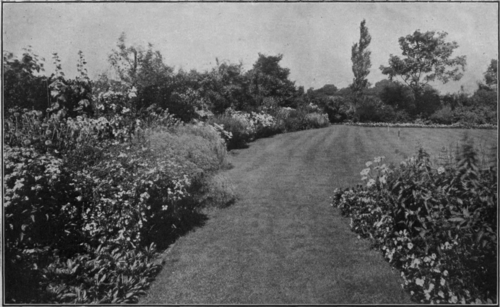
A beautiful example of an herbaceous border arranged with a succession of flowers, and at its full beauty during July, August, and September
Copyright, Ware & Sons, Feltham
52. Alstromeria aurea. Aug.
53. Montbretia californica. Aug.
54. French marigold (dwarf, striped).
55. Sweet-pea, Nora Unwin.
56. Dahlia (single pink).
57. Helenium. Sept. (4 ft.)
58. Lilium Henryi. Sept. (5 ft.)
59. Gaillardia. Aug.
60. French marigold (tall orange).
61. Nemesia (orange).
62. Calceolaria (brown). July. (2 ft.)
63. Nasturtium (terra-cotta). July.
Crimsons
64. Phlox, Etna.
65. Salvia splendens. Sept. (5 ft.)
66. Chrysanthemum, Ethel Blake.
67. Lychnis. July.
68. Clove carnation. July.
69. Antirrhinum, Crimson King.
70. Begonia (orange red). Aug.
71. Phlox drummondi (crimson).
By referring to the plan, it will be seen that the foregoing plants are arranged so as to lead from colour to colour, at the same time blending together, their heights being also arranged in harmony with the scheme. A return sequence should include other and similar plants. An old wall clothed with creepers, and supporting flowering climbers, would be the most fitting background, the colours again being arranged to suit each other. Or a shrubbery of the best evergreens, with flowering subjects introduced, will serve as an appropriate setting, though care must in this case be taken that the soil of the border is not over-exhausted by shrubbery plants. In preparing the soil for herbaceous plants, an effort will, of course, be made to provide pockets of specially sandy, gravelly, or clayey nature for specially fastidious subjects.
Arrangement Of The Border
When putting in the plants, a certain number will very likely be found to consist of divisions from other borders. Some intelligence is needed in the method of division. Very rank-growing plants, such as chrysanthemum maximum, Michaelmas daisy, and old specimens of phlox, may be cut through the clump, using a spade or strong knife. Any worn-out centres, where present, should be discarded, as it is from the younger fibrous growth that fresh roots and shoots will presently push up.
Theoretically, it is possible for a single flower border to make a show during three-quarters of the year, but, actually, this is hard to manage. It will be done only with great skill and forethought, and a very excellent supply of greenhouse plants for dropping in judiciously wherever a gap occurs - that is, when the flowering season of a plant is over, as in the case of bulbs. Of course, many people think it amply worth while, even at the expense of gaps, to have a border in which there is something always in bloom.
For this class of enthusiast - who is by no means to be despised - the following list will be useful, showing what plants can be had in bloom during nine months in the year.
Hellebores (the Christmas rose and other varieties), snowdrops, glory of the snow (Chionodoxa luciliae). winter aconites, croci, early and late narcissi, scillas, hyacinths, tulips, and other bulbs, Megasia cordifolia (the large leathery-leaved saxifrage), and winter heliotrope should be planted for the earliest display of the year.
Continue to:


My Books

