


Preparations For Cooking
Description
This section is from the book "The Complete Cook", by J. M. Sanderson. Also available from Amazon: The Complete Cook.
Preparations For Cooking
38. A great deal has to be done before the cook can commence the operation of cooking. She has to truss her fowls and prepare her fish, butcher's meat, and vegetables, with other things not necessary to mention here. Never wash butcher's meat except for the purpose of cleansing it of blood, which would otherwise disfigure it when dressed. Few joints require this operation; heads, hearts and scrags always require to be well washed before they are cooked, but if they or any thing else are intended for roasting or frying, they should first be rendered perfectly dry, by rubbing with a coarse cloth, or otherwise. Salt rubbed in with warm water will speedily remove the blood and cleanse the meat. Hares must be always well washed with salt and water, or milk and water.
37. Trussing is little required in butcher's meat; but loins, boned and stuffed, such as those of beef, mutton and pork, must of course be trussed. This is done by spreading the stuffing and seasoning over them, then rolling them up as tightly as possible, tying up with a tape or string, and securing all by skewers. The long flap of the fillet of veal must be filled with stuffing, and then secured as above directed.
38. All kinds of poultry should be killed the first thing in the morning, when their crops are empty. They should be plucked while they are warm; be sure take out all the flues, and let the hair be singed off with white paper. It is recommended to crop fowls and pigeons immediately you have them; but there is a difference of opinion as to the time of drawing them; some say they should be drawn as soon as killed, or at least as soon as bought, which prevents the disagreeable flavour so often perceived in chickens; others say, and indeed the generality of cooks are of this opinion, that they should not be drawn till just before they are dressed, as it is apt to make them dry: we are of opinion that poultry should be drawn soon after they are killed; we do not believe that this makes them dry, though we are sure that to leave them undrawn will be apt to make them stink.
39. In drawing poultry, or removing the entrails, a very small slit may be made under the vent with a penknife, at which slip in the fore-finger, and if there is any internal fat about the vent, draw it out, as it is in the way of taking out the entrails, and, if left in, would be very strong when roasted. Next get hold of the gizzard, which may be known by its being the hardest part of the interior; draw it out carefully; it will generally bring the whole of the intestines with it, but if the liver should be left, again slip in the finger and take hold of the heart, which will bring out with it the liver, which you must not touch for fear of bursting the gall-bladder. The heart is generally left in by poulterers, but it is much better out, as it is apt to give a bloody appearance to the interior of the fowl. Trim round the vent with a pair of scissors.
40. Be careful to take away the gall-bladder from the liver without breaking it, for if one drop of the gall escapes, the whole liver is spoilt. The gizzard consists of two parts, with a stomach or bag in the middle, containing gravel and undigested food; one part of the skin by which the two parts of the gizzard are united is rather narrower than the other; slit this with a knife, and turning the gizzard inside out, remove the stomach bag and trim round the gizzard, but avoid cutting the skin by which it is joined in the middle.
41. In trussing poultry, cut off the neck about two joints from its commencement at the shoulders, but be sure to leave half an inch, or more, of the skin longer than the part of the neck remaining-, for the purpose of wrapping over on being tied.
42. The legs of fowls intended to be roasted should be taken off about one inch below the first joint; the feet and legs of young chickens are generally left on, but they must be scalded in boiling water, and the claws and outside scaly skin taken off. Thrust the liver through a slit made in the skinny part of one pinion, and the gizzard through the other; then turn the top of the pinion over the back, lay the legs close to the sides; with a wire skewer fix the middle joint of the pinion outside of the knee joint of the leg, and so through the body to the other knee and pinion; with a short skewer fix the lower joint to the lower part of the body; then the feet, or whatever part of them is left, may turn back over the belly. The skewer for this purpose must go through the sidesmen, fixing the stumps or feet between them. For a fowl that is to be boiled, a slit is made on each side of the belly, and the leg-stump tucked in.
43. To remove the crop and windpipe of those whose heads are left on, open the skin a little just in front of the throat; then pull each separately gently, first from the beak or bill, then from the stomach. Fowls whose heads are taken off' may have the crop removed by putting the finger down the throat. The windpipe is easily removed in the same way.
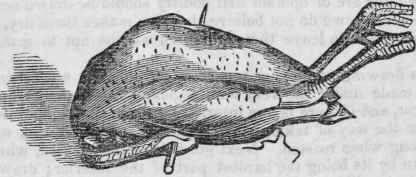
[Trussed Fowl for roasting.]
44. Before dressing, a little flour should be dusted over fowls. Poulterers, to make the bird look plump, often break the breast bone; this is a bad practice - it lets the air into the fowl, and drys the meat; it often breaks the gall-bladder, and, of course, spoils the fowl, and it always renders the bone troublesome. The head of capon, we ought to observe, is often twisted under the wing in the same way as a pheasant's.
45. Ducks have the feet always left on, but the wings must be taken off at the middle joint; in doing this, leave more skin than belongs to the bone. The feet must be scalded, and the skin and claws taken away; they then must be turned over the back. In placing the skewers, keep the thigh joints outside of the pinions, and run the skewer through the leg, then through the bit of skin that hangs below the pinion, then through the body, the other pinion, skin, and the other leg The short skewer must be inserted just above the joint, which is twisted to turn back the feet. Tie the skin round the throat; put in the seasoning at the vent and turn the rump through a small slit in the apron.
Continue to:


My Books

