


Preparations For Cooking. Continued
Description
This section is from the book "The Complete Cook", by J. M. Sanderson. Also available from Amazon: The Complete Cook.
Preparations For Cooking. Continued
![[Trussed Duck for roasting]](images/Trussed-Duck-for-roasting.jpg)
46. Geese are trussed exactly in the same way as ducks, except the feet are cut off, and dressed with the giblets. The liver is some-times dressed separately, and considered by some persons a great delicacy. A piece of greased white paper should be laid over the breast, and secured with a string, not skewers, before a goose is put down to roast.
47. Turkeys are trussed the same way as fowls, but the sinews of the leg must be drawn out before trussing. The gizzard of a turkey intended to be roasted should be scored, and both gizzard and liver covered with the caul of veal or lamb; but buttered paper does as well, and is more generally used: this is to prevent them becoming dry. The breast should be secured in the same way, with a piece of buttered paper. Nicely clean the head, and twist it under the wing.
48. Pigeons should be cleaned with great care. For roasting, truss with the feet on; tie the joints close down the rump, and turn the feet over the front (see engraving). Most people season them. For
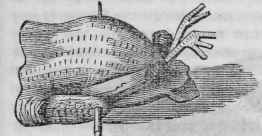
[Trussed Pigeon for roasting.]
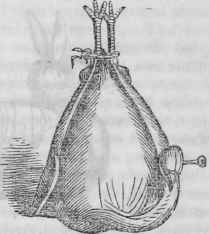
[Trussed Pheasant.] boiling or stewing, cut off the feet, and truss just as fowls for boiling. For broiling, lay them open by cutting them down the back, and lay ing them flat. As pigeons have no gall, no extra care will be required with the liver.
49. Pheasants, Partridges, and Guinea Fowls, are trussed with the head tucked under the wing, and the feet on, which are twisted and tied to the rump, and turned back over the breast. The liver may be used in the stuffing.
50. Wild Ducks, and all other web-footed wild fowl, should have the feet left on, and be cleaned and trussed in the same manner a tame ducks.
51. Woodcocks, Plovers, etc., and all other birds that live by suc tion, are not drawn; the feet are left on, the knees twisted round
![[Trussed Woodcock] each other, and raised over the breast, by which means each foot turns back and falls on the side of the rump.](images/Trussed-Woodcock-each-other-and-raised-over-the-breast-b.jpg)
[Trussed Woodcock] each other, and raised over the breast, by which means each foot turns back and falls on the side of the rump.
52. Hare, trussed for roasting, has the legs turned back without disjointing, so that the haunches are thrown up, much in the form that a cat is often seen sitting - the end bones of the fore and hind legs meet each other, and lie side by side. Two skewers should be inserted, one where the end of the leg meets the fleshy part of the shoulder, and the other where the end of the shoulder meets the fleshy part of the leg; the head is fixed back with a skewer thrust
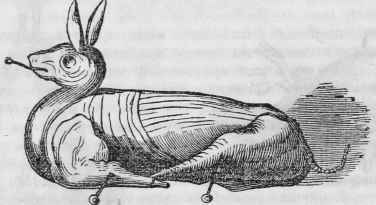
[Trussed Hare.] into the mouth, through the head, and into the back between the shoulders. The belly should be slit no more than is necessary for taking out the paunch. To secure its keeping in place, a string is employed for bracing it; the string is laid across the back, twisted round the end of both skewers, and brought back across the back and tied. In skinning hares and rabbits, particularly hares, the ears and tails should be preserved entire, as they improve the appearance of these dishes on the table, and are much esteemed.
53. Rabbits for boiling are opened all the way down the belly; joint the legs at the rump so as to admit of their turning along the sides; turn the shoulders back to meet them, so that the lower joints of each lie straight along, side by side; the head should be skewered down to the right shoulder. Rabbits for roasting are trussed like hares.
![[Trussed Rabbit for boiling.]](images/Trussed-Rabbit-for-boiling.jpg)
[Trussed Rabbit for boiling.]
54. Fawns or Kids are generally trussed and dressed in the same way as hares. As the flesh is of a dry nature, they should be covered with a caul or buttered paper, which should be tied on, not skewered. Fawns will not keep above a day or two at the furthest.
55. Sucking Pigs, the moment they are killed, should be put into cold water for a few minutes. Some persons then rub them over with powdered resin: others object to this on account of the flavour of the resin, which the pig will retain, if not well washed. Put the pig for half a minute into a pail or pan of boiling water, and take it out and pull off the hair or bristles as quickly as possible. If any should remain, put it again into hot water; when quite free from hair, wash it thoroughly with warm water, and then rinse it several times in cold water, that no flavour of the resin may remain. The feet should be taken off at the first joint: then make a slit down the belly and remove the entrails; once more wash the pig inside and out in cold water, and wrap it in a wet cloth till you are ready to dress it, which should be done as soon as possible. Fill the belly with seasoning, and sew it up; skewer back the legs, and the trussing is completed. The feet, heart, liver, lights, and melt, are to be dressed separately, when well cleaned. This dish is called pig's pettitoes.
56. Fish, in cleaning, should have every particle of the entrails very carefully removed. If the blood has settled down the back-bone, or elsewhere, it should be carefully taken away, and care should be taken not to break the gallbladder of the liver. Some fish must be slit in order to clean them; others may have their entrails drawn out at the gills, which should be always done when it is practicable. Mackerel, perch, etc. are cleaned in this way. Flat fish may be so cleaned, but it is usual to make a slanting slit on one side, just below the gill, in order to put in the finger and remove the clotted blood from the back-bone. Fishes with scales should be scraped from the tail to the head, till all the scales are removed; others, such as soles and eels, are skinned. The cook ought not to depend upon the cleaning of fish by the fishmonger, but carefully examine them before dressing.
57. Eels are remarkably tenacious of life, and appear to suffer after they are cut into several pieces. In order to take the sense of feeling entirely from this fish, it is only necessary, before it is skinned, to pierce the spinal marrow, just at the back of the skull, right through, when all feeling in the eel will instantly cease, though it has the appearance of being alive. Then raise the skin, at the part cut or pierced, draw it back over the mouth and head, secure the head with a strong fork to a table, or dresser, and draw back the whole skin. To prevent the eel from slipping through your hands, rub them with salt, and you will then draw off the skin easily. Eels, except very small ones, require to be slit all the way from the vent to the gills, and the inside of the back-bone should be rubbed with salt. The liver, roe or melt, are much esteemed, and should be therefore preserved.
Continue to:


My Books

