


Recipes For Pullet (Poulards). Part 7
Description
This section is from the book "The Epicurean", by Charles Ranhofer. Also available from Amazon: The Epicurean, a Complete Treatise of Analytical and Practical Studies on the Culinary Art.
Recipes For Pullet (Poulards). Part 7
(1995). Pullet With Ravioles (Poularde Aux Ravioles)
Draw a fine pullet, singe and clean it well, truss it for an entree, (No. 178), and cover over with slices of fat pork. Butter the bottom of a braziere (Fig. 134), lay over some sliced onions and carrots, a bunch of parsley garnished with thyme and bay leaf, a clove of garlic and two cloves. Moisten with stock (No. 194a) to three-quarters its height, then boil, skim and cook slowly for one hour and a half to two hours; drain off' the stock, free it of fat and return this to the braziere to keep the pullet warm. Reduce the stock with veloute (No. 415) if for white, or espag-nole (No. 414) if for brown. Dress the pullet on a layer of ravioles (No. 2976) mingled with some veloute or espagnole and parmesan cheese, and serve a separate sauce-boat of the sauce with cooked fine herbs (No. 385) and chopped parsley added.
(1996). Pullet Garnished With Water-Cress - Roasted (Poularde Rotie Au Cresson)
Six to nine months old pullets are the most desirable ones especially when quite fat. Roasted poultry should be treated with extreme care, for the roast is the most essential part of a dinner and is partaken of by almost every one. Should the fowl not be barded, then it must be enveloped in a buttered paper and basted frequently while cooking, either with butter or else good poultry fat. Draw and singe a good pullet, truss it for roasting (No. 179) and place it on the spit or in the oven, although roasting on the spit is far the most preferable. When the pullet is nicely done dress and surround with water-cress, serving its own gravy strained and free of fat separately.
(1997). Blanquette Of Pullet With Mushrooms (Blanquette De Poularde Aux Champignons)
Begin by detaching the legs from a trussed and singed pullet, cut each of these in two, then lay them in a vessel containing water; divide the breast in two and cut each piece into three parts; plunge them also into the cold water with the cut up carcass; let soak for fifteen to twenty minutes then drain and lay them in a saucepan with an onion and a bunch of parsley, and cover plentifully with white chicken broth (No.188); boil and skim this liquid for twelve minutes then take it off the fire. Prepare a white roux (No. 163) with flour and butter, dilute it, with the strained and skimmed pullet broth when partially cold and stir this sauce well until it boils; let it despumate for a quarter of an hour on the side of the fire while removing the fat from the surface. Pare and wipe the pieces of pullet, return them to the saucepan with two dozen turned mushrooms (No. 118): strain the sauce over and finish cooking, finally dressing the pieces of pullet in a deep dish with the mushrooms. Reduce the sauce for a few miuutes, thicken with two egg-yolks finishing it off the fire with a piece of butter worked in, also some lemon juice; strain and pour it over the pullet.
(1998). Pullets A La Montmorency-Breasts (Filets De Poularde A La Montmorency)
Fasten to a dish a plain or ring-shaped bottom covered with cooked paste (No. 131) or noodle paste (No. 142), having in its center a tin cup equally covered with ornamental pieces of paste, egg it all over and dry in the air. Pare the fillets of five small pullets, suppressing the superficial skin, remove the minion fillets and streak them with truffles, also suppress the pinion bones, trimming them into half hearts rounded on one end and pointed on the other. Place the minion fillets on the larger ones, both slightly bent; Range the fillets on the bottom of a sautoir with a layer of cold clarified butter, being careful to have them all lie in one direction, so that the pointed ends extend toward the center. With the cut up pullet carcasses, prepare a little chicken essence (No. 387) and when done and nicely seasoned, strain and skim off the fat and incorporate into it a few gills of good veloute (No. 415) in the act of being reduced. When this sauce is perfect and succulent, finish it with a few spoonfuls of good, raw cream and afterward a piece of fresh butter; keep it in a bain-marie till needed. Just when ready to serve, sprinkle the fillets over with salt and poach them lightly, drain and dress in a circle on the foundation prepared on the dish.
Fill the center cup with a garnishing of peeled truffles cooked in Madeira; cover the fillets lightly with the sauce, serving the rest in a sauce-boat.
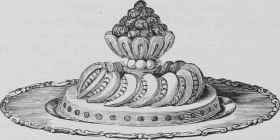
Fig. 383.
Continue to:


My Books

