


Chapter III. How To Cook Meats. Observations On Meats
Description
This section is from the book "The Illustrated London Cookery Book", by Frederick Bishop. See also: How to Cook Everything.
Chapter III. How To Cook Meats. Observations On Meats
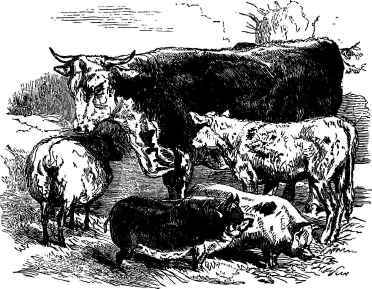
How to choose, and the best parts to choose of meats, are given under their appropriate heads; we will come at once, therefore, to the process of cooking when they have been chosen.
If the meat has to be roasted, a clear fire is indispensable; and the fire should also be maintained at one uniform heat by the addition of coal, only in small quantities. If the joint is large, it should be commenced as far from the fire as the apparatus will permit, and as it progresses gradually be moved nearer the fire until done, this will ensure, in large and thick joints, the heart of the meat being properly done, while it prevents the outer parts from being cooked to a chip. A small joint should have a brisk fire, should be well basted, as also larger joints; it should be sprinkled with salt, and dredged with flour when three parts cooked, but it should be remembered that this must not be left until the meat is just cooked, for the fire is apt to catch the flour, and give it a most disagreeable flavour.
There are a variety of opinions respecting the washing of meat previous to roasting. Many old and experienced cooks declare that it destroys the flavour of meat. Professors of the art, however, hold a contrary opinion. I am not disposed, from my experience to differ so essentially from them as to advise meat to be roasted without this operation, but should advise that the meat be not suffered to remain too long in the water, unless frost-bitten, and then it should soak an hour or two previous to cooking.
The time necessary for cooking a joint must depend, of course, upon the weight of the joint to be roasted; experience gives not less than fifteen minutes to each pound of meat; where the quantity is very large an extra two or three minutes must be given, but so much depends upon the state of the fire, and the attention directed to the joint while cooking, that the judgment must be exercised; although the above calculation may be taken as a general rule, giving time for any drawback which may occur.
In boiling meat, as much attention must be paid as in any other process; if the joint be permitted to boil too rapidly, the cook may be satisfied the meat will go to table as hard as it could be wished to be tender; if while cooking it should be allowed to stop boiling, it will prove underdone when cut, even though more than the usual time be allowed for it to be cooked. The meat generally is better for being soaked a short time, and then wrapping it in a cloth well floured, if fresh; if salt, the water should be kept free from scum as fast as it appears. All joints to be boiled should be put into cold water and heated gradually, and nothing boiled with it save a dumpling, or if beef, carrots or parsnips.
Roast Meats
In every case where meat is washed before roasting, it should be well dried before it is put down to the fire, which must be kept clear, banked up to the height it is intended to keep it, and kept at that height until the meat is sufficiently cooked; remember the regulation of gradually advancing the meat nearer to the fire while it is cooking, baste with a little milk and water, or salt and water first, but as soon as the fat begins to fall from the meat, put down a clean dish and then baste with the dripping as it falls; the meat should not be sprinkled with salt until nearly cooked, or too much gravy will be produced. Preserve the dripping; pour it from the dish into some boiling water, leave it to cool. When cold it will be hard, white, and all the impurities will be deposited at the bottom. It occasionally happens that the joint cannot be sent to table as soon as cooked; in such case place it on a dish upon a fish kettle of boiling water; place over it a dish cover, and spread over all a cloth; the meat will thus be kept as hot as if placed before a fire, but will not be dried, nor will the gravy be evaporated.
Continue to:


My Books

