


How To Shape Croquette Mixture
Description
This section is from the book "Practical Cooking And Serving", by Janet McKenzie Hill. Also available from Amazon: Practical Cooking and Serving: A Complete Manual of How to Select, Prepare, and Serve Food [1919].
How To Shape Croquette Mixture
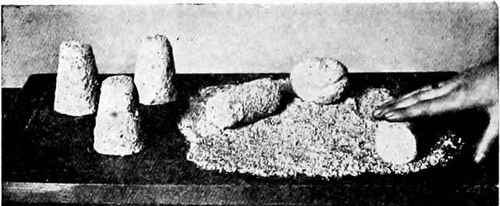
When the croquette mixture is cold and firm, roll with the hands into balls, then gently roll each ball in turn in crumbs, carefully covering each part with crumbs and giving to the ball such shape as is desired. The easiest shape for a beginner to attempt is that of a cylinder. To secure this shape, lightly roll the ball back and forth upon the crumbs, pressing upon it gently to lengthen, then take up lightly and drop the end gently on the board, turn and drop the other end upon the board, repeating the process. Let stand to stiffen a little, then cover with the egg. Roll at once in the crumbs a second time, rolling and shaping as before, to insure perfection in shape and smoothness of crust. Let stand an hour before frying. Croquette mixtures made of fish or lobster are usually given a half-heart or cutlet shape. To secure this flatten the ball with a broad-bladed knife, or the hand, making one end pointed and the other round; round out one side and curve the other by pressing with the fingers. Insert a short piece of macaroni into the pointed end of a fish chop before cooking. After cooking cover with a paper frill; or, omit the macaroni, and insert sprig of parsley after the chop is fried. The small claws of the lobster are inserted in lobster chops, or cutlets, after frying. A tiny, paper aigrette is used for croquettes made cork-shaped.
Continue to:


My Books

