


Part 2. Chapter 24. The Preservation Of Fruit
Description
This section is from the book "Practical Cooking And Serving", by Janet McKenzie Hill. Also available from Amazon: Practical Cooking and Serving: A Complete Manual of How to Select, Prepare, and Serve Food [1919].
Part 2. Chapter 24. The Preservation Of Fruit
Instinctively, as it were, in time of plenty we are inclined to lay aside something for use in time of need. This is particularly true when one has a bountiful supply of fruit, which, in any form, is a welcome addition to the dietary, and which, unless preserved in some manner, soon becomes worthless.
There is said to be one supreme moment when a peach is in perfect condition for eating. It is much the same with all fruit. There is a time when it is at its best; but passing that, it is unsatisfactory either for "putting up" or for eating raw. The first step, then, in the process of preserving fruit is to secure fruit that is uniform in ripeness and at the height of its flavor. Thus selected, the fruit should be so preserved as to retain this flavor, and, when admissible, its shape. The ease with which this may be done and the wholesomeness of the finished product are also worthy of attention.
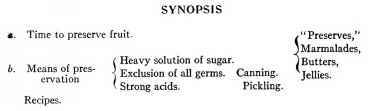
Long before people had any knowledge of microbes, it was discovered that fruit could be readily kept, and almost indefinitely, in a heavy solution of sugar, or in a strong acid, like vinegar. Hence came pickles of various kinds, and the compositions, pound for pound, of sugar and fruit, called by our grandmothers jam, marmalade, jelly, and "preserves."
Preserves, though a general term, is more particularly applied to sweets made of whole fruit, or large pieces of fruit, kept as whole as possible, while marmalades, jams and butters are made of fruit fine-divided or crushed, and jellies of fruit juices only. Fruit "put up" in these ways owes its preservation to the fact that the ubiquitous microbe, whose primal mission is to reduce everything earthly to its "lowest terms," cannot thrive and multiply in a thick solution of sugar. On this account, though the usual sanitary ways of cooking should always be employed, care in securing absolute freedom from all bacteria is not so imperative as it is when the fruit is put up without sugar, or in a light syrup. In the latter cases the microbes that flourish upon the outside of the fruit, and in water and air, must be destroyed by heat at the boiling point, or by heat at lower temperature applied for a short time on several occasions, else the fruit is liable "to spoil." A dry, sunny day is preferable for preserving fruit, as for all cooking of sugar.
Utensils For Preserving Fruit
Among the utensils that are the most necessary for use in preserving fruit are scales, measuring cups, porcelain or agate-ware saucepans, earthen or agate-ware bowls, silver, agate or wooden spoons, a fruit press, an agate colander, small dipper and funnel, jars with new rubbers and perfect covers, glasses for jelly, jam, etc., bottles for catsups and sauces, and jelly bags of felt, loosely woven flannel, or doubled cheesecloth. It is needless to add that each of these, if not absolutely new, should be in an immaculate condition.
Continue to:


My Books

