


Part 2. Chapter 25. Frozen Desserts
Description
This section is from the book "Practical Cooking And Serving", by Janet McKenzie Hill. Also available from Amazon: Practical Cooking and Serving: A Complete Manual of How to Select, Prepare, and Serve Food [1919].
Part 2. Chapter 25. Frozen Desserts
"Ice cream was not discovered; it was developed. A direct descendant of the sherbet of the Orient, it traces its pedigree back thousands of years." -The National Baker.
"And Isaac brought forth the milk of the goat, cool with the mountain, and said to Abraham, 'eat and drink for the sun is hot, that thou mayest be cool.' "
No form of dessert is held in such high esteem as the frozen; it is, at once, the best approved and the most palatable of all desserts. By the presentation of a well-prepared cream of good quality, one may atone for a very meagre dinner, while a mould of well-flavored fruit ice of attractive appearance fitly forms the crowning piece of an elaborate dinner. But the dinner is only one (and probably not the most hygienic) occasion at which an ice may be appropriately served. In the summer season ices are acceptable at any time and on all occasions; and they are fittingly served, also, at meals, or functions of ceremony, throughout the year. The frozen dessert has, at least, one advantage over many others: it is eaten in perfection only when prepared and left to ripen for some hours before serving.
In England and on the continent of Europe any frozen dessert is called an ice. In this country, there is a tendency to restrict the meaning of the word "ices," applying it simply to the water ices, so called. The word, however, is here used in its broader sense.
Perhaps the following outline will give a general idea of the subject:
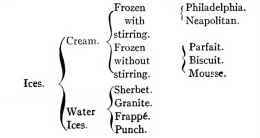
Besides these, mention may be made of frozen custards, frozen puddings, milk sherbets, souffles and frozen fruits. Some idea of the magnitude of the subject can be obtained from the fact that there are above a hundred varieties of iced puddings known to French cooks, while the number of ice creams and water ices is limited only by the imagination of the one compounding them.
The cost of the simple forms of these desserts is not large, if they can be prepared at home; and the labor involved in preparing them is considered great only by those who make them infrequently. Now that the patent freezer has reduced the time of freezing to a minimum, the crushing of the ice is the most objectionable feature in the operation.
For home use nothing as yet has been devised by which the ice can be so well and easily crushed as by the use of the canvas bag and mallet. With the ice crushed and deposited in a large pail, and with the command of a sink sufficiently large to hold the freezer and pail of ice, the packing, freezing, and moulding, when the latter is required, may be done quickly and without confusion or disorder. If the ice is to be served at the noonday meal, it is well to cook the cream or syrup, of which it is to be made, so that it may be thoroughly cold before it is turned into the can of the freezer.
Continue to:


My Books

