


Recipe For Making Bombe Glace
Description
This section is from the book "Practical Cooking And Serving", by Janet McKenzie Hill. Also available from Amazon: Practical Cooking and Serving: A Complete Manual of How to Select, Prepare, and Serve Food [1919].
Recipe For Making Bombe Glace
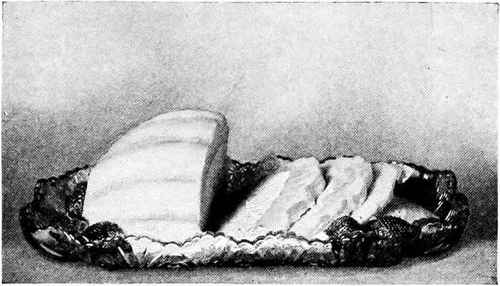
Strawberry Bombe Glace. Moulded in melon mould.
These handsome ices are very easily prepared. The handsomest bombes are those in which there is a pronounced contrast in color between the mixture on the outside and the inside of the bombes. Cream or water ices may be used in combination or separately. Bombes in which the lining is made of a sherbet and the centre of a Charlotte Russe filling are always attractive and offer a compromise between the richness of a cream and the lack of it in a sherbet. In lining a mould, let the chilled mould stand in a pail of equal parts of ice and salt, then spread the frozen mixture evenly to the depth of an inch upon the inside of the mould, turn in the mixture for the centre, cover the frozen mixture used for the lining, filling the mould to overflow, spread a piece of wrapping paper over the top and press down the cover over it; finish packing the mould and let stand an hour or two. If the mould is to stand several hours or over night in warm weather, omit the paper and after pressing the cover down tightly bind closely over the joining of cover and mould a strip of cotton cloth an inch wide that has been dipped in melted suet.
Combinations For Bombe Glace
1. Strawberry, raspberry, orange or coffee sherbet and Charlotte Russe filling: The natural color of each of these gives a handsome contrast with the white of the cream.
2. Lemon sherbet may be tinted pink with vegetable color paste or liquid.
3. The natural yellow of orange sherbet is changed to salmon by the use of a little pink color.
4. Pineapple sherbet tinted a delicate green with white or pink centre gives a pleasing contrast.
In bombes made of creams, chocolate ice cream with Charlotte Russe centre filled with candied fruit is one of the best.
Continue to:


My Books

