


Cooking Utensils
Description
This section is from the book "Practical Cooking And Dinner Giving", by Mary F. Henderson. Also available from Amazon: Practical Cooking And Dinner Giving.
Cooking Utensils
The Bain Marie
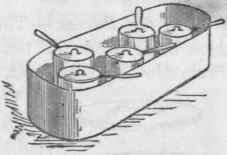
This is an open vessel, to be kept at the back of the range or in some warm place, to be filled with hot (not boiling) water. Several stew-pans, or large tin cups with covers and handles, are fitted in, which are intended to hold all those cooked dishes desired to be kept hot. If there are delays in serving the dinner, there is no better means of preserving the flavor of dishes. The bain marie is especially convenient at any time for keep ing sauces, or vegetables for garnish, which can not always be prepared at the last minute.
The Braising-Pan
The use of this pan will be found by referring to the article on "braising."
The Fish-Kettle
The fish is placed on the perforated tin sheet, which is then put into the kettle of water. The fish is thus taken out of the water at will, without breaking. When done, it is placed for a minute over an empty iron kettle on the fire, to drain well and steam. It is then carefully slipped on a napkin in the hot platter in which it is to be served.


The Custard-Kettle
This is an iron utensil, the inside kettle being lined with block-tin. Al-though there are cheaper custard-kettles made of tin, it is better economy to purchase those of iron, which are more durable. The inside kettle containing the custard is placed in the larger one, which is partly filled with boiling water.
The Sauté-Pan
This pan may either be used for sauté-ing, or for an omelet pan.
Sieve For Purées
This is a substantial arrangement, the sides being made of tin. It is invaluable for bean, pea, or any of the purée soups, which should be forced through the sieve. It is also used for bread or cracker crumbs - in fact, for any thing which requires sifting.
The Steaming-Kettle
The article to be cooked is placed in the pan perforated with holes. It is put in the long kettle, which is partly filled with boiling water, then cover-ed with the close-fitting cover. This is an invaluable kettle for cooking vegetables, puddings, and, in fact, almost any tiling that is usually immersed in boiling water. A cabbage, with salt sprinkled among the leaves, is cooked much quicker in this way than when immersed, and is much more delicate. It is especially nice for plum-puddings, which then can not become water-soaked. Cooks generally manage to let the water stop boiling for some minutes when boiling puddings, which is just long enough to ruin them. This kettle is no less valuable for cooking chickens or rice.


Continue to:


My Books

