


Meat
Description
This section is from the book "The Pattern Cook-Book", by The Butterick Publishing Co.. Also available from Amazon: The Pattern Cook-Book.
Meat
Meat is the general term applied to the flesh of animals used for food, and is of three classes: Meat, including beef, veal, mutton, lamb and pork; Poultry, including chickens, geese, turkeys and ducks; Game, including quail, partridge, grouse, pigeons and other birds, venison and any wild meat that is hunted in the forest or field.
Meat is in season all the year round, but certain kinds are best at certain seasons. Pork is good only in autumn and winter. Veal should be eaten in the spring and summer. Venison is in season in the winter; fowls in autumn and winter ; lamb in the summer and fall, and mutton and beef throughout the year.
Beef is considered by most people the best and most nutritious of meat. An ox should be five or six years old before it is killed, being then in its prime. Ox-beef is the best. The meat is fine-grained, the lean being of a bright red color, marbled throughout with fat, when the animal is well-fed and of good breed. The fat should be white, not yellow; and the suet should also be white and firm. Beef should never be lean - that is, lacking in the usual amount of fat; for unless there is a good quantity of fat, the meat will be tough and undesirable. Heifer-beef is paler in hue than ox-beef and of closer grain, the fat being white, and the bones, of course, smaller. Bull-beef should always be avoided. It is dark colored and coarse-grained, has very little fat, and possesses a very strong, meaty smell. If when meat is pressed with the finger it quickly rebounds, it is prime; but if the dent disappears slowly or not at all, the meat is of inferior quality. Any greenish tints about the fat or the bone, or any slipperiness of surface, indicates that the meat has been kept too long and is unfit for use, except by those who enjoy what is known as a "high flavor."
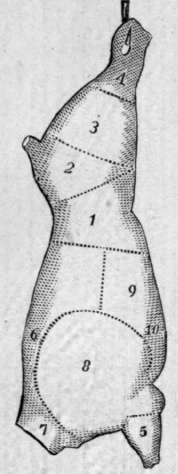
Meat is cut differently in different parts of the country, but the accompanying cut of an ox shows one way of dividing it.
1. | Sirloin. |
2. | Top or aitch-bone. |
3 | Rump. |
4. | Round. |
5. | Lower part of round |
6. | Veiny piece. |
7. | Thick flank. |
8. | Thin |
9. | Leg. |
10 | Fore-rib (5 ribs). |
11. | Middle rib (4 ribs). |
12. | Chuck rib (3 ribs). |
13. | |
14. | Brisket. |
15. | Clod. |
16. | Sticking. |
17. | Shin. |

OX.
Choose the ribs or the sirloin for roasting; if the former be selected, let them be the middle ribs. One rib, unless the bone is taken out and the meat rolled and stuffed, is too thin to be an economical cut, because much is lost in cooking. In selecting sirloin, have it cut from what butchers call the "chump end," which has a good under-cut. The tenderloin lies under the short ribs and close to the back. It is considered by many to be the choicest piece and can be purchased by itself, but only at the larger markets. It is usually cut through with the porterhouse and sirloin steaks. Of these the porterhouse is generally preferred, and the short or small porterhouse is the most economical. The coarse and tough end of the large steaks may be used for soup. The family that has to carefully consider the expense of meat will find recipes farther on for preparing the cheapest cuts so as to make a nutritious dinner at small cost.
Calf.
1. Loin, best end.
2. Loin, chump end.
3. Fillet.
4. Hind knuckle.
5. Fore knuckle.
6. Neck, best end.
7. Neck, scrag end.
8. Blade bone.
9. Breast, best end 10. Breast, brisket end.
Veal is best when the calf is two or three months old ; if over four months old, the flesh will be coarse. Veal should be white and the kidney well covered with fat. If the flesh is dark and hangs loosely about the bone, it is not good. It should be dry and closely grained; if moist and clammy, avoid it. The fillet, loin, shoulder and best end of the neck are the roasting joints. The breast is usually stewed, as is also the knuckle. A calf's head is a great delicacy. Calves' feet are boiled and stewed, or used for making jelly. Sweetbreads have come to be looked upon as a great delicacy and are therefore expensive. The calf is divided as illustrated in cut.
1. Leg.
2. Chump end of loin.
3. Best end of loin.
4. Neck, best end.
5. Neck, scrag end.
6. Shoulder.
7. Breast.
A saddle is the two loins undivided. A chine is the two sides of the neck undivided.
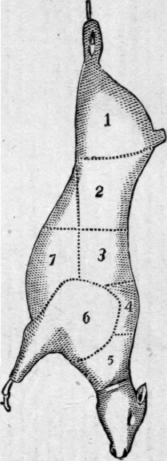
Sheep.
Mutton should be fat, and the fat should be clear, hard and white. Wether-mutton is the best and may be known by having a knob of fat on the upper part of the leg. Mutton to be perfection should be from sheep five or six years old. The flesh should be dark-colored, the color being an indication of age. The ribs may be used for chops, but there is much waste, the bones taking up half of the weight. The leg chops are most economical. All the joints of a sheep may be roasted, the saddle being the best, and the haunch next. The leg and neck are used for boiling. The scrag end - an eco-nomical piece - is very sweet stewed and served with rice. The sheep is cut up as illustrated in the engraving.

Lamb.
1. Leg.
2. Loin.
3. Shoulder.
4. Breast.
5. Ribs. Forequarter, 3, 4 and 5 together.
Lamb should be a year old ; and it is more digestible than any other young meat. The flesh should be a pale red and should be fat. Lamb is generally roasted or broiled, the finest chops being from the loin.
Venison is best when from the female deer. The flesh should be a reddish-brown, and the fat thick, clean and close. This meat is more often eaten "high" than any other variety.
1. Haunch.
2. Neck.
3. Shoulder.
4. Breast.
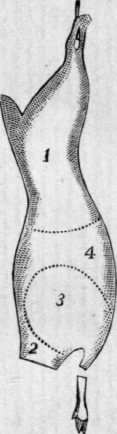
Deer.
Buy pork only when the butcher can be relied upon to have good meat; for diseased pork is of all meat the most to be avoided. The fat should be firm, and the lean white and finely grained. If the fat is full of small kernels, the pig has been measly, and the meat is unfit for use. Pork should never be eaten during the warm months. The pig is divided as illustrated below.

Pig.
1. Spare-rib.
2. Hand.
3. Belly.
4. Fore-loin.
5. Hind-loin.
6. Leg.
Continue to:


My Books

