


Heaths Or Ericas
Description
This section is from the book "Commercial Gardening Vol2", by John Weathers (the Editor). Also available from Amazon: Commercial Gardening, A Practical & Scientific Treatise For Market Gardeners.
Heaths Or Ericas
Many thousands of Heaths are sold annually during the winter season, the demand apparently being as great now as ever. At one time no Heath was ever sent to market in any pot smaller than a 5-in. one or 48, and it took three seasons to grow. Now, however, tiny Heaths may be seen in flower in pots from 2 in. in diameter and upwards - pretty bushy little plants that command a ready sale. The varieties mostly grown in a small state are Erica caffra, E. gracilis and its variety nivalis, E. melanthera, and E. persoluta. These make bushy specimens, covered with bloom, and realize from 3s. 6d. per dozen upwards in the smaller sizes. Thousands of plants are sold in 5-in. pots, chiefly of E. gracilis and E. hyemalis - the last-named (fig. 281) being particularly handsome with its white and rosy-pink tubular flowers. In the variety alba they are almost pure white. Good specimens usually fetch from 10s. to 12s. per dozen in 5-in. pots. E. melanthera, which has globular pinkish flowers with black anthers, usually realizes higher prices, but is not so extensively grown. Other kinds of Heaths met with in smaller quantities are E. Willmorei, which resembles E. hyemalis in appearance, but usually flowers later; E. candidissima, dwarf growing, with white bell-shaped flowers; E. ventricosa, a fine bushy species, having flowers varying from white to red; and E. Caven-dishiana, a strong-growing kind with yellow flowers.
The kinds mentioned are all propagated from cuttings. These are taken from the tops of the young half-ripened shoots, generally in spring, and are usually inserted in 5-in. pots. These are carefully drained by filling about two-thirds with crocks, the rougher ones being at the bottom. Over the crocks is placed a layer of fibrous peat or moss before the layer of sandy peat. Over the sandy peat is a layer of silver sand, which brings the prepared surface to within 1 in. of the rim. The cuttings are taken off with scissors or a keen - edged propagating knife, and are inserted about ½in. deep and about \ in. apart. In this way the tops are lower than the rim of the 5-in. pot, which will hold about 200 cuttings. The older Heath propagators, after gently watering the cuttings and allowing to dry, usually placed bell glasses over the cuttings. Modern growers use a flat sheet of glass instead. This is better than the bell glass, as it has simply to be inverted each day, putting the dry side beneath, whereas when bell glasses are used a certain amount of time must be devoted each day to taking them off and wiping the interior dry with a piece of cloth.
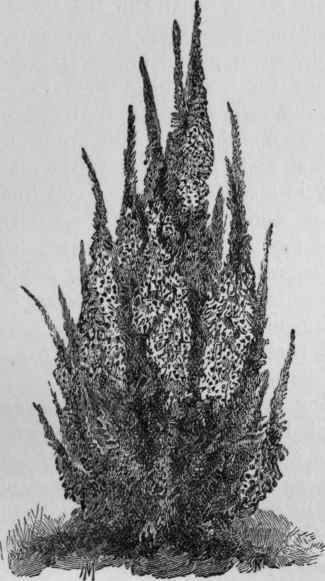
Fig. 281. - Erica hyemalis.
The cuttings are placed in a temperature of about 60° F., and the glasses are kept on until they are well rooted. The sand is never allowed to become dry, but care is taken to avoid too humid an atmosphere, as this causes the cuttings to damp off.
The rooted cuttings are potted up when ready, usually in the autumn and early spring. While still in the cutting pots they have the tops cut out to induce branching. Afterwards, when placed either trebly or singly in small pots, they are kept close for some little time to get established, after which more air is given. The tops are nipped off again in due course, and during the summer months the plants are grown in cold frames with ash or cinder bottoms so as to be quite near the glass.
Heaths are usually potted very firmly in a soil composed of soft turfy peat with a liberal supply of clean silver sand to keep it porous. The pots are well drained, and are not used too large for the plants. The small Heaths which now form such a conspicuous feature of the market are usually brought to the flowering stage in about twelve months, but larger plants in 5-in. and 6-in. pots take about three seasons to grow. The first two seasons they are cut hard back in winter, and when new growth commences they are moved into larger pots.
During the period of growth, watering is carefully attended to, and on all favourable occasions abundance of light and air is given when established. When the flowering stage is approaching for plants in 5-in. and 6-in. pots, they often receive weak doses of liquid manure, the plants in many cases being plunged out-of-doors in beds of ashes or fibre during the summer months. Very little artificial heat is given to the plants, and in the event of severe weather those in pits or frames are protected with one or more layers of mats or canvas.
Continue to:


My Books

