


Gooseberry. Continued
Description
This section is from the book "A Dictionary Of Modern Gardening", by George William Johnson, David Landreth. Also available from Amazon: The Winter Harvest Handbook: Year Round Vegetable Production Using Deep Organic Techniques and Unheated Greenhouses.
Gooseberry. Continued
Culture
At the end of the first year, the shoots must be cut down to a few eyes, and the plants kept clear from any summer shoots that may be on the stem or that spring from the root; they must have plenty of water the first summer.
They will be fit to plant out in two or three years into borders or quarters, at eight feet between the rows, and six feet apart. At the time of planting out, some rich compost may be added with great effect towards the flavour, size, and abundance of the crop. - Doyle.
"There is a continual tendency on the part of the under ground buds to become branches, and these are the suckers that we find so troublesome in many kinds of soils. By continually stopping and wounding them, however, they will in general perish; and to do this is what we recommend.
"The Lancashire gooseberry growers adopt the following as the best means of preventing gooseberries from throwing up suckers, and also an excellent plan of insuring an abundance of large fruit.
"In the sketch, (Fig. 60,) A is the bush, B B is the soil taken out about eighteen inches all round the plant, and about six inches deep at C, that if there are any buds or suckers, they are sure to be seen and destroyed. This do every year in December, and as soon as the soil is taken out, spread cowdung over the roots as shown at B, after which replace the earth that has been taken out: when you have any new seedlings to propagate, do not take out the soil, but lay the manure round them, and cover it with a layer of earth, which encourages the plant to produce suckers.
Fig. 60.
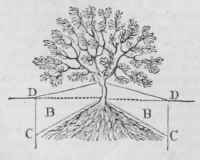
"By these means good bushes are sooner obtained than by cuttings, and generally speaking, well-rooted suckers may be taken off in October, which produce fruit the following year. The cuttings should be deprived of all their under-ground eyes or buds; before they are put into the ground to take cuttings from twelve to fifteen inches long, cut the upper end to a bud, leaving three or four other buds below it, then pare away all the other buds, and pick out the lowest of all, finishing just below it by a horizontal clean cut." - Gard. Chron.
Pruning in the summer is confined to pinching off superfluous and misplaced shoots, it always being kept in mind that the centre of the tree in standards must be kept open so as to admit the light. "At the time of pruning," says Mr. Doyle, "some fine young shoots should be left in the most convenient place as bearing wood for the ensuing year, and room must be made for them by cutting out some of the oid wood. Each of the old branches should have a leader left of new wood, which may be shortened according to its strength so as to leave five or six inches above the old wood. Very strong shoots need not be so much shortened unless in a part of the bush which is naked, and requires to be furnished.
"Avoid shortening the shoots unless when the tree is naked, or the wood will be crowded, tufted, and productive of very small and indifferent fruit. The leading shoot at the end of each branch should, where it is possible, terminate naturally, if it be not inconsistent with the equable extent of the tree; and in most cases it may still be so contrived by having recourse to the next lateral branch of the desired extent, and by taking away that which straggled beyond it. Let it be recollected that at the time when the young trees are growing in the nursery, and at all times after, the attention of the gardener must be directed to what is called "stemming the trees," which is producing and continuing a clear stem to a given height, (according to the growth of the different kinds,) by taking off all lateral shoots at their first appearance. Espaliers. - No fruit is more benefited than that of the gooseberry, by having the tree trained as an espalier. It is best done to stakes arranged lozenge-wise, (see Espalier,) or the bush may be trained round hoops in this form.
Fig. 61.

Fruit
This should be thinned, the smaller berries be cut away with a pair of scissors for tarts, etc, as required, and the fine berries left for dessert. If some of reds, as the Warrington, and of the thick-skinned yellows, as the Mogul, are matted over when the fruit is ripe, it will remain good until Christmas. This is easiest done when the tree is grown as an espalier. To increase the size of the berries, abundance of water and liquid manure are given to the roots, and the berries are suckled by keeping their tips in saucers of water; this is sacrificing the flavour to increase the circumference of the fruit.
Vermin
The caterpillar and the black-fly are both destroyed by syringing the bushes with water, and then dusting the leaves above and beneath with white hellebore powder, or with lime and soot mixed in equal proportions.
Forcing
Neither the gooseberry nor currant can be forced without great care. No heat must be applied when they are first put under glass. A very low temperature, about 60° afterwards, and not higher than 40° at night.
Continue to:


My Books

