


Pit
Description
This section is from the book "A Dictionary Of Modern Gardening", by George William Johnson, David Landreth. Also available from Amazon: The Winter Harvest Handbook: Year Round Vegetable Production Using Deep Organic Techniques and Unheated Greenhouses.
Pit
Pit, in the Conservatory, is the body of soil in which the shrubs, etc, are planted; in the Stove, it is the excavation in which is the tan, or other material for plunging the pots; and for Forcing, it is a structure having a glass roof, and differing from a forcing frame only in being larger, and with sides fixed to the soil. Pits for this purpose were usually sunk in the ground; but it has been justly observed, that "sunken pits are inconvenient to get at; there is no pulling their sashes off and on with ease, and ventilation is troublesome. Then, again, in spite of all that can be done, they will always be damp; and although this is advantageous for some purposes, it is destructive to green-house plants in long winters. Upon the whole, the inconveniences are at least as considerable as the advantages. We doubt whether sunken pits can often be recommended in gardens." - Gard. Chron.
Under the various titles Melon, Cucumber, Pine Apple, &.c, descriptions of pits suitable for their cultivation will be found. The following outline is of one for various purposes, strongly recommended by Mr. R. Fortune, gardener at the Chiswick Gardens:
Fig. 129.
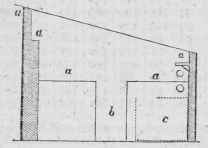
a, stages and back and front shelf; b, passage along the middle; c, proposed tank; d, proposed ventilators.
The width of the pit is nine feet; and, as the sketch is drawn from measurement, any one may easily ascertain the different proportions.
The two stages are made of wood, having cross bars, as seen at a, and upright bearers on each side of b. The small shelf in front is supported by a bracket, which also supports the hot water pipes; and the back shelf might be supported in the same manner, although in this instance it is formed out of the thickness of the back wall. The only improvement in its construction, is to have a large tank in some convenient place in front, as at c, to receive the rain which falls on the roof; and also some wooden ventilators in the back and front wall at d, which could be opened at those times when it is not prudent to draw down the sashes. By having the door in the back wall, and the passage along the middle, a person can go in at any time without pushing down the sashes, and reaching from the back to the front, he can water or do anything else the plants may require.
" This pit is extremely useful for raising seeds, or for growing small green-house plants, and keeping such things as verbeneas, petunias, and scarlet pelargoniums, for turning out into the flower garden during the summer months ; or by dividing it into two parts by a partition, having a door in it, one half may be used for striking cuttings, raising seeds, or keeping plants, which have been newly potted off, and the other filled with well established plants, requiring more light and air; so that, with a little contrivance, it is astonishing how many things the amateur may do in a small place like this."-Gard. Chron.
Continue to:


My Books

